
Introduction
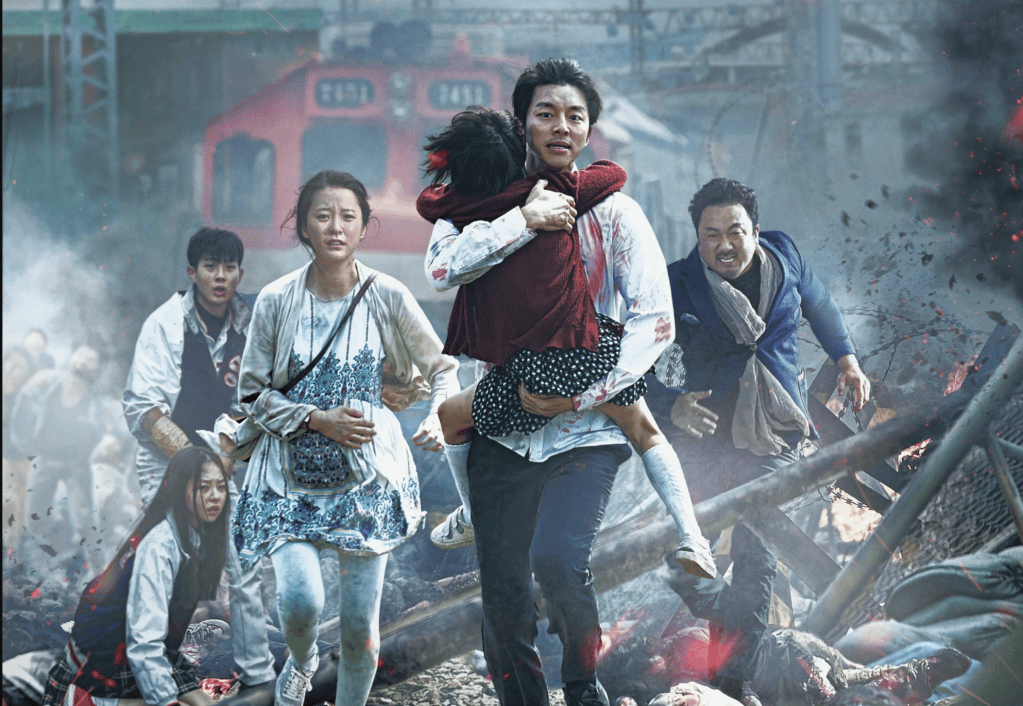
The Korean film Train to Busan (2016) excelled both domestically and internationally. It follows a father and daughter taking a train from Seoul to Busan for the daughter’s birthday so that she can see her mother. During the ride, while the passengers are being led to believe that riots have broken out, a zombie outbreak takes place on the train, revealing the truth of what is actually happening. The father takes on the mission of trying to escape alive to somewhere safe with his daughter. Although the film is foreign and was released ten years ago, it remains quite well-recognized. Train to Busan is so well known because it is an effective combination of the dystopian genre and a blockbuster. When combined with its focus on its Korean themes and audience, the film was able to be a major success both domestically and abroad.
Train to Busan as Dystopian
To be dystopian, a film must focus on an extremely bad or unfair society, often in the future where something has happened to create this new structure. In Train to Busan, a virus has begun to spread, creating a horde of zombies and other disasters that the government tries to handle. Zombie films are often considered a form of disaster film, but the disaster is manmade, something that could have been controlled. The audience finds out by the end of Train to Busan that the company where the main character, Seok-woo, works created the virus. The film creates this atmosphere where those in power harm the rest of society. Additionally, the hero of the film, while he participated in and upheld the harmful system, still fights to overcome it. Writers and directors often rely upon these markers to make a film fit into the category of dystopian.
Furthermore, the characters in the film create their own social hierarchy on the train, further perpetuating the dystopian theme. Those in higher social positions before the outbreak are able to access resources others are not. For example, Seok-woo uses his professional connections to seek information about where the group can find safety and avoid quarantine. Connections in high places give Yon-suk, the rich businessman who selfishly tries to save only himself, information revealing that a zombie outbreak is occurring and not just riots. He does not have to simply rely on what the government told everyone else. When the passengers on the train are distilled down to one train car due to the spread of the zombie virus, it is the first-class car. Those who were in that car at the beginning of the ride were the most likely to have survived until this point, already starting with the advantage as the start of the catastrophe was in the back of the train. These people would have bought more expensive tickets to be there, their wealth giving them the advantage. Later in the film, the people in this train car were ultimately those who were willing to sacrifice other living humans to guarantee their own safety. Those in higher positions being willing to harm those in lower positions to secure their own comfort is a recurring theme in many dystopias, and the film creates this dystopian world through the portrayal of people in power as both responsible for the catastrophe and the most likely to survive it.
Korean dystopian films and shows tend to capitalize on the opportunity to critique social issues, most often capitalism and how government officials fall short. Films like Parasite, Snowpiercer, and Squid Game are examples of artistic ventures critiquing capitalism. Referencing government inaction in times of crisis critiques how capitalist society stays out of most issues. The portrayal of government in these films also places responsibility for the tragedy on those in power, encouraging viewers to oppose characters who represent wealth and privilege. In Train to Busan, the virus was created because of capitalism, with Seok-woo’s company doing anything in its power to earn money, including ignoring safety protocols. Additionally, capitalism is often a driving theme in zombie films of any sort. The writing can do this through representing zombies as rabid consumers, showing that the end of capitalism can begin with an apocalypse, or critiquing how the government would take advantage of an apocalypse to make more money. Using a dystopia allows for criticism of capitalism without directly attacking the current system in a way that many may not appreciate.
Train to Busan as a Korean Blockbuster
A blockbuster is a film that reaches high levels of success, usually taking advantage of large pools of funding and publicity. Blockbusters are typically associated with Western films like Jaws, Jurassic Park, and any James Bond movie. They usually have famous actors and focus on spectacle to draw in large audiences. Korea draws inspiration from the Hollywood blockbuster formula but does not replicate it exactly. They follow the aforementioned normal conventions, but according to Hyunseon Lee in “The South Korean Blockbuster and a Divided Nation,” “what differentiates South Korean blockbusters from the Hollywood ones is their engagement with Korean history and reenactments of historical events, which is in part the reason for their success at the domestic box office, in the global market, and at film festivals.” Korean media focuses on local themes, which is necessary in order for local viewers to connect with it. This makes it distinctly successful in the domestic sphere while still being able to draw a larger audience.
Korea’s marketing of its blockbuster films was heavily intertwined with Hollywood, even though the country has tried to separate itself from Western media. Because of Hollywood’s success, it would make sense for other industries to try and copy their format. Instead, the Korean industry vilified Hollywood while replicating their film structure. During the promotion and showing of Shiri—a film up against Titanic in theaters—people created division as they rallied to help Shiri beat Western competition. This event created a new competitive nature in the film industry, where Koreans tried to get domestic films to perform better than international films. Along with this new competitive mindset, many Korean blockbusters feature critiques of Hollywood and its perceived colonization of non-Western film through its borrowing of storylines. However, popular Korean blockbusters use Hollywood’s conventions often, taking advantage of what makes them so successful. Even so, they add in Korea’s local themes, allowing the film to benefit Korea’s national identity rather than benefit Hollywood.
Train to Busan plays into each of the conventions of Korean blockbusters, which helped lead to its success. It was actually the first Korean Horror Blockbuster, which came after the expansion of interest in the zombie genre in Korean media. The film had a large budget of about $8.5 million, a cast of well-established actors, and featured scenes full of spectacle. The zombie actors wore grotesque makeup, and the film featured CGI to make the zombie hordes and disasters appear real. There were certain parts of the movie that felt very Hollywood, such as the characters fighting through the zombies with sheer will, armed only with baseball bats and their fists. These scenes replicate sequences found often in Hollywood films that focus on catching viewers’ eye and being engaging to watch, yet they are not usually found so distinctly in Korean films.
What made Train to Busan distinctly Korean, though, was the focus on local themes and melodrama between the characters. It references the Sewol Ferry Sinking, where 304 people (250 of whom were students) died when a ferry capsized in 2014 when it was carrying students attending a school trip to Jeju Island. At the time, a statement claimed that many passengers were being rescued. However, the claim was later proven false: all but a few died after the captain told the passengers to stay in their rooms, where they ultimately drowned. In the film, the disaster was represented by the government announcing that they had everything under control and that the spread of the zombie virus was just riots they were suppressing. This was overlaid with footage of the zombies taking over and spreading chaos, further demonstrating that the government was not being truthful in their statement. During the Sewol Sinking, the government’s statement that rescue efforts were successful was later heavily critiqued, reflected by this moment in the film. Including this form of national trauma is important for Korean films, as it lets them retain their identity while making commentary on the events that took place. Korean films do not have to use this sort of commentary, but the most successful films have historically done so.
Korean blockbusters also often focus on melodrama, an important aspect of Korean films that draws in many older viewers who may not watch the content otherwise. Melodrama is a production where the characters, plot, and actions are exaggerated, usually focusing on emotional storylines. When used in the correct context, it can help viewers feel the collective trauma of an event, which is something prioritized when making Korean films. In Train to Busan, we can see this being the case. The story follows a father-daughter relationship, showing their disagreements in life. In the end, the main character sacrifices himself for his daughter to guarantee she could get to Busan. This relationship-focused storyline is compelling to Korean audiences, and while sometimes brought into Western films, it is usually more of a side plot than the main driving factor for the characters. Thinking of Jaws as an example, the main character, Police Chief Martin Brody, has a family that he tries to protect. However, that is not the point of the film, but rather the driving force behind his actions. The point of the film is killing the shark, not saving Brody’s family. Other characters in Train to Busan also have melodramatic moments that are essential to the plot, like Sang-hwa having sweet moments with his pregnant wife and later sacrificing himself to save her. The blockbuster formula, combined with the melodramatic elements traditionally included in Korean media, works together to create an action-filled, heart-racing movie that still hits those emotional beats.
Train to Busan as a Dystopian Blockbuster
Dystopian blockbusters are common in Hollywood, with examples like The Matrix (1999), Ready Player One (2018), Mad Max: Fury Road (2015), and The Hunger Games (2012). These films tend to attract famous directors and actors due to their promise for large budgets, promotion, and engagement, usually performing well at the box office. For Korean dystopian films, aiming for blockbuster success is sometimes a bit more risky. Science fiction films tend to perform poorly in Korea, as Korean audiences have a harder time connecting with the storyline. Some audiences may want Korean films to have local themes, and the science fiction world is too far-fetched. This can be seen in Korean space films and shows, where most of them underperformed, as seen in the films The Silent Sea, Jung_E, and The Moon. Therefore, dystopian films in Korea have to connect with the local themes in one way or another.
Train to Busan succeeds in this task by setting the plot in present-day Korea with the spread of a disease that, while unlikely, is plausible. This is not some futuristic version of Korea that could never come to fruition but it is a world based on human suffering and human cost that seems realistic. The real government feels removed from the storyline, and while they do tell citizens what they should be doing, they only affect the citizens through their inaction. This helps capitalize on the themes that Koreans care about, and making this relatable film a blockbuster made sense. Additionally, they focused on personal issues that many people could relate to, like divorce, child custody issues, and hard work. The themes of family, power, and disaster ultimately made Train to Busan a worthwhile investment.
Categories: Culture


