
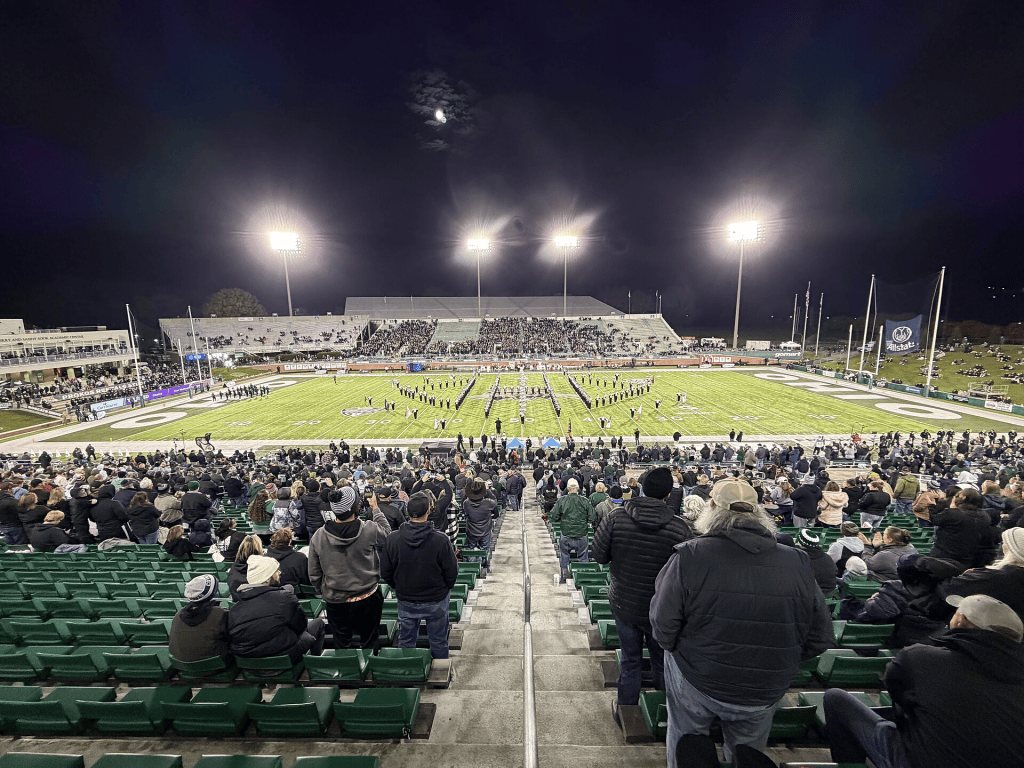
On average, over 100,000 spectators attend the home football games at UT: a modern-day rendition of Roman gladiatorial combat. And even better—it’s streamable, postable, and shareable. The human, desperately tribal at his core, cheers from his couch. He goes to sleep, the rumble of triumph in his chest reducing his demeanor to that of a purring kitten. On NFL Sundays when he turns red-faced on the sofa, and the screen—his people—fail him, the chance of him raising his fist at his wife rises 10 percent.
The best facet of the spectator sport is that it rewards the human with community while requiring no substantial investment. The man does not have to step on the field, risk a head injury, or hone his skill and craft to have access to the in-group. His only down payment is to watch and respond, which he’ll be doing nonetheless.
The same machinery of spectatorship reappears in the wake of major sexual assault scandals. #JusticeForJohnnyDepp garnered over 20 million views. While a woman recounted her rape in court, fans purchased Johnny Depp trial-themed embroidered sweatshirts to wear like sports jerseys. On the other hand, when the anonymous woman in the Cornell 7 case faced doxxing threats, supporters flooded TikTok and Instagram with #IAmJaneDoe posts.
What is the similarity between these two groups?
Both socially flag their allegiance to a certain group and thus receive communal responses, whether positive or negative. Their online activity becomes recognizable signals to others who share their political or social affiliations, offering invitations to agree, condemn, repost, and participate.
It feels tempting to exempt the #IAmJaneDoe posts, because many of them came from survivors themselves, and for a noble cause: the hashtag itself was meant to act as camouflage in the wake of said doxxing threats. But the words “I am Jane Doe” have their own repercussions. Every “I am her” keeps the case trending, and keeps people looking for her. Every post retells her story in someone else’s voice, with someone else’s face attached, for someone else’s followers. The crowd meant to hide her has absorbed her, swallowing some of her personhood along the way. Her story is repurposed: she is no longer a specific person with a specific experience, but a slogan for survivors to wear. Surviving sexual violence grants you authority over your own story, not a stranger’s. Shared pain should not, and does not, equate to shared ownership. A survivor can still turn another survivor’s case into content, and the feed will reward her for it exactly the way it rewards the person in the embroidered #JusticeForJohnnyDepp sweatshirt.
In other words, despite different motivations, both of these groups—the Johnny Depp supporters and the Jane Doe protectors—take a victim’s suffering and turn it into their own personal branding: the kind of branding that grants a dose of oxytocin in the capsule of online engagement. Both post on their Instagram story, buy their Redbubble stickers, and turn off their phones.
Meanwhile, Amber Heard and the Jane Does of the world cannot get off the couch. They cannot click any off switch. They will watch the graphic details of some of the most painful moments of their lives blasted on repeat for shock value, comedy, and entertainment. They will grapple with the short- and long-term effects of sexual violence.
The demand for spectacle does not end in the courtroom or the comment section. It follows survivors into the supposedly neutral spaces where their experiences are evaluated, interpreted, and consumed. At the beginning of my freshman year, I described in a personal essay how reckoning with sexual and gender-based violence became a catalyst for my growth. My grader simply underlined the words “sexual assault” in my essay and annotated, “More detail here? Make it more shocking for the reader?” I lost a point for lack of description, and I figured that maybe I wasn’t cut out for narrative writing—that maybe some stories cost too much to tell well.
None of this storytelling—or rather, this kind of consumption—is new. Long before hashtags, media was teaching audiences how to behave. The “Happy Housemaker” propaganda in the 1950s successfully pushed women back into the kitchen after they’d just entered factory labor during World War II. The “Share-a-Coke” campaign significantly increased brand loyalty to Coca-Cola. Individuals exposed to media that positively depicted the LGBTQ+ community were more likely to express tolerance of real-life LGBTQ+ individuals. In each instance, the audience is given something to aspire to, participate in, or recognize as socially acceptable. The image of the happy homemaker, the name printed on a Coke bottle, and the visibility of a queer family become a small instruction on how to understand the people around us and how to understand ourselves among them. We learn what to consume, what to accept, and, perhaps most importantly, ways to make ourselves visible through media cues.
Sexual violence has become another stage through which these identities are negotiated and performed. Social media has informed society that sexual violence is a public event for consumption: it is a tag, a post, and a way to share affiliation and allegiance to the anti-woke crowd or online warrior advocates. The survivor becomes the subject through which everyone else gets to say something about themselves.
Visibility matters. But good intentions and kind reposts do not, on their own, transform into material support for any Jane Doe. The usage of victims’ lived pain as an indicator of social branding and in-group loyalty is consumption of a real person for larger, algorithmically curated use.
As a result, we have learned to make ourselves the protagonists when bearing witness to another person’s suffering—and then when we see that suffering invoked in real life, we say, “But he is my friend,” or “But he wouldn’t do that.”
“But.”
“But.”
“But.”
Then, we ask a woman to make her story more shocking to the observer’s eye.
It is easy to add a hashtag to a post. It is not easy to believe the person who accuses your close friend or your brother, to financially support organizations like Austin’s SAFE Alliance, to speak up in your interpersonal relationships. It won’t trend. You probably won’t get a reward. In fact, it may cost you your friends, your group chat, your place in an in-group that a #IAmJaneDoe repost and real-world silence would have kept you in.
Someone’s pain should never be another’s to skin, eat, and wear like cowhide. Survivors do not need to be cannibalized by a swarm of likes—they need advocacy and support when there is nothing left to post.
Categories: Culture


