
The U.S. Should License South Korea to Manufacture the SM-3 Anti-Ballistic Missile
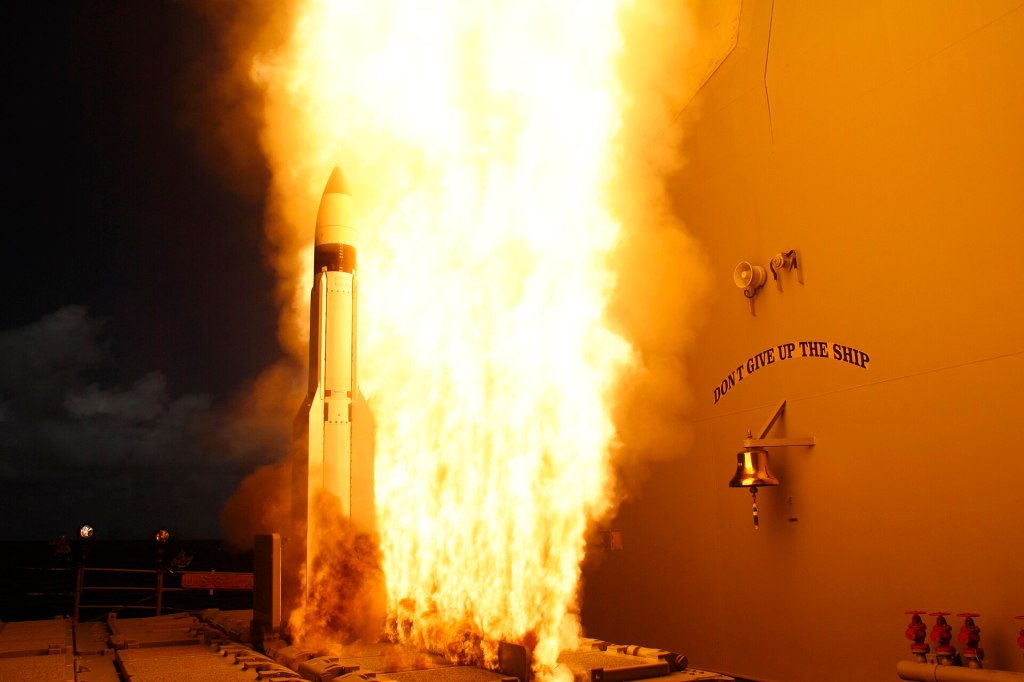
Much attention has been given in the Indo-Pacific to a possible invasion or blockade of Taiwan by the People’s Republic of China in the late 2020s. Indeed, such a conflict would disrupt the world’s procurement of cutting-edge semiconductors and potentially herald the end of the U.S. alliance network. But to the north lies a closely connected theater, being the Korean Peninsula.
The 2020s have seen a major evolution in the military balance on the Korean Peninsula between the Republic of Korea (ROK) and the Democratic People’s Republic of Korea (DPRK). New capabilities are constantly being fielded by the South and North. On its side, the ROK organizes its military capabilities into a three-axis system under the military’s Strategic Command: Kill Chain, Korea Air and Missile Defense (KAMD), and Korea Massive Punishment and Retaliation (KMPR). Kill Chain is South Korea’s preemptive-strike system. Cued by Seoul’s new reconnaissance satellites, its missiles and stealth fighters aim to destroy North Korean missile launchers and nuclear sites within 30 minutes of detection. KAMD is South Korea’s layered defense against North Korean ballistic and cruise missiles. Finally, KMPR is a capability set assembled to eliminate North Korea’s leadership after an attack. Its conventional weapons include the Hyunmoo-V ultra-high power ballistic missile, built to strike deeply buried bunkers. This article focuses on KAMD and the one altitude band it cannot yet defend.
Since the three-axis system took on its current form in 2016 under Park Geun-hye’s administration, the North has fielded ever more advanced ballistic missiles. Pyongyang’s ballistic missile force has gradually shifted to solid-fuel weapons, many of which fly flattened trajectories that peak below 100 kilometers (km). Countering them requires low- and mid-altitude terminal-phase interception systems like the U.S. MIM-104 Patriot and Seoul’s Cheongung-II (M-SAM). Unlike liquid-fuel missiles, which are fueled shortly before firing, solid-fuel missiles are fueled during manufacture. Their launch preparations are therefore minimal and too brief for the ROK to reliably detect and strike first, which makes preemption through Kill Chain far less viable. Furthermore, in June 2025, Ukraine’s military intelligence chief said that Russia had agreed to help North Korea establish its own production of the Russian-designed Geran and Garpiya strike drones. Those drones pose a future swarm threat that KAMD was not designed to counter.
Most relevant to this article are North Korean medium- and intermediate-range ballistic missiles (MRBMs and IRBMs) fired on a lofted trajectory (a steep, high arc over a comparatively short distance), whether they’re liquid- or solid-fueled. This makes them a threat that KAMD cannot fully counter, because no in-service ROK system can intercept targets above 100 km. Only the U.S. Terminal High Altitude Area Defense (THAAD) battery in Seongju County, which intercepts at altitudes of up to roughly 150 km, covers any of that band. In 2017, the DPRK conducted two tests of its Pukguksong-2 MRBM, a solid-fuel, nuclear-capable weapon fired from a tracked launcher. Both tests flew about 500 km, a distance comparable to a strike deep into South Korea, while climbing to apogees (maximum level of altitude during flight) of 550 and 560 km. An MRBM or IRBM on that arc spends most of its flight far above the reach of land-based ROK and U.S. systems. When it finally descends into their range, it does so at high speed, leaving little time to intercept. Even the South’s planned L-SAM-II, a THAAD counterpart with a new multifunction radar, is reportedly capable of intercepting targets only up to 180 km. In short, the upper part of a lofted missile’s arc is beyond every interceptor South Korea fields today.
How has the ROK Ministry of National Defense (MND) sought to address its current lack of an upper-atmospheric to exo-atmospheric midcourse phase anti-ballistic missile (ABM)? The answer lies in its KDX-III Aegis guided-missile destroyers (DDGs). The KDX-III fleet will ultimately be six ships in total, but of specific relevance are the latter three Batch-II ships dubbed the Jeongjo the Great class. Their Aegis Baseline 9.C2 combat system gives them the ballistic missile defense capability that the three older Sejong the Great-class ships lack. Only the first, ROKS Jeongjo the Great, is in service; the other two are due for delivery to the ROK Navy by the end of 2027. On April 26, 2024, the MND’s Defense Acquisition Program Administration (DAPA) announced plans to acquire the RIM-161 Standard Missile-3 (SM-3) anti-ballistic missile for 803.9 billion won (about $583 million) through U.S. Foreign Military Sales (FMS). This acquisition was later reported to cover around 30 interceptors, which will be loaded into the ships’ Mark 41 Vertical Launch System (VLS) cells. In April of this year, DAPA revised the plan to 753 billion won through 2031, reportedly for the Block IB variant, though officials have declined to confirm the variant publicly.
The SM-3 is a family of surface-to-air missiles designed to intercept ballistic missiles in the midcourse phase of flight, above the atmosphere in space. Two variants are in production: the aforementioned Block IB as well as the Block IIA, which the U.S. and Japanese governments co-developed. American contractor Raytheon builds Block IIA missiles with major components from Japanese firms, including Mitsubishi Heavy Industries (MHI). Block IB can intercept targets up to roughly 500 km in altitude, while Block IIA reaches about 1,000 km. No ROK Armed Forces service branches field a homegrown equivalent. Continuing, the SM-3 is the only exo-atmospheric interceptor that could be fired from the ROK Navy’s Mark 41 cells, and by extension, the whole KDX-III DDG fleet. Therefore, it is Seoul’s best prospect for countering the narrow but real threat of the DPRK’s lofted ballistic missiles in their midcourse phase.
On paper, procurement of the SM-3 Block IB via FMS is a reliable and transparent method of acquiring midcourse capability for the KDX-III Batch-II DDGs. Under FMS, the Pentagon buys the weapons on the receiving government’s behalf and transfers them government-to-government. However, FMS customers compete with the U.S. military’s own needs, and the Iran war has already pushed back deliveries to allies. Switzerland has been told its Patriot deliveries could slip by up to five years, and Japan has reportedly been told its 400 Tomahawk cruise missiles may be delayed. According to the Center for Strategic and International Studies (CSIS), the U.S. possessed around 410 SM-3 interceptors just before the start of the 2026 Iran war. In the first 39 days of the Iran war, before the April ceasefire, an estimated 130 to 250 were fired.
This represents a major supply chain obstacle for South Korea’s acquisition of the missiles. This May, CSIS warned that U.S. replenishment to prewar levels would take until early 2029, a projection that does not account for possible Chinese aggression against Taiwan. Switzerland’s and Japan’s experiences suggest significant delays for Seoul’s SM-3 order, with deliveries potentially pushed past the program’s 2031 end date. There is already a precedent on the same ships. Seoul’s purchase of up to 38 SM-6 interceptors (the SM-3’s lower-tier counterpart) was due to finish by 2031 but has slipped to 2034. DAPA says delivery will follow “the schedule agreed upon with the U.S. side.” Seoul holds a 2023 Security of Supply Arrangement with Washington that lets it request priority delivery, but that arrangement is non-binding. In the meantime, KAMD will have no ROK-owned means of intercepting lofted missiles in midcourse, hundreds of kilometers up, where they spend most of their flight.
With this issue in mind, how can the U.S. and ROK ensure Seoul obtains SM-3 missiles for its KDX-III Batch-II Mk 41 VLS cells while also maintaining current American inventory levels? The question grows sharper as 2027 approaches, the year by which Xi Jinping reportedly ordered the People’s Liberation Army to be ready to invade Taiwan. The answer is to license South Korean industry to build the SM-3 Block IB for the ROK Navy. The most plausible vehicle is an International Traffic in Arms Regulations (ITAR) manufacturing license agreement between Raytheon and a Korean firm. Such an agreement requires State Department approval and congressional notification, and it bars transferring the missiles to any third party without Washington’s written consent. The license should cover the SM-3 in particular: Raytheon aims to lift SM-6 output past 500 a year, while the SM-3 remains the scarce round. On land, Seoul also has its own terminal-phase interceptors, M-SAM now and L-SAM from 2027 at the earliest. Continuing, a ship-based version of L-SAM is planned for the Batch-II destroyers’ K-VLS II cells. However, none of these systems are intended to engage ballistic missiles in their midcourse phase. In summary, a license would let South Korea build its own SM-3s instead of waiting for American ones. The best candidate for production is Hanwha Aerospace.
What is Hanwha Aerospace, and why should it be the contractor to produce the SM-3 on South Korean soil? Hanwha Aerospace is one of the ROK’s premier defense companies, a subsidiary of the Hanwha Group chaebol (family-owned business conglomerate). Two of its most notable weapons systems are the K9 Thunder family of self-propelled howitzers and the K21 infantry fighting vehicle. It also supplies the launchers and launch tubes for Seoul’s mid-altitude Cheongung-II (M-SAM) system. Most importantly, in November 2025, Hanwha won a $480 million contract to produce the ballistic missile interceptors and launchers for L-SAM, Seoul’s high-altitude terminal-phase counterpart to THAAD. Since June 2025, it has also led to the development of the follow-on L-SAM-II. With these details in mind, Hanwha Aerospace is arguably the South Korean company with the most experience building high-altitude ballistic missile interceptors.
L-SAM operates at lower altitudes than the SM-3, but its interceptor relies on the same core technique. It destroys the target by direct collision (“hit-to-kill”), steered in the final moments by a divert and attitude control system (DACS). This is the same class of technology that guides the SM-3’s kill vehicle.
As an alternative, LIG Defense & Aerospace (formerly LIG Nex1) is the next-best candidate. It builds the Cheongung-II interceptor and serves as L-SAM’s overall system integrator, also producing its anti-aircraft interceptor. But prior experience in missile manufacturing alone will not be enough to determine the winner of any license competition. Which defense-oriented company in South Korea would have the most suitable facilities and available staff for the contract? In a company-to-company license, which firm would Raytheon and its rocket motor suppliers be most willing to deal with? Both firms already operate inside U.S. export-control channels. Hanwha’s U.S. subsidiary is investing $1.3 billion in a co-production partnership with the U.S. Army to make explosives and propellants at Pine Bluff Arsenal. LIG holds State Department-approved export authorizations and agreements. Washington would still vet any licensee, and it would weigh Seoul’s imperfect record on technology security. A rather severe example of this record occurred in January 2024, when two Indonesian engineers were caught at Korea Aerospace Industries trying to remove more than 6,000 files regarding the KF-21 fighter on USB drives.
Why limit the license to the Block IB, given its roughly 500 km intercept ceiling versus the Block IIA’s 1,000 km? As said before, Japanese firms build major Block IIA components (the nosecone and second- and third-stage rocket motors). In March 2026, Washington and Tokyo agreed to quadruple production of these parts. A three-way arrangement among the governments and industries of the ROK, Japan, and the U.S. could add bureaucratic and political obstacles to Seoul acquiring the SM-3. South Korean opinion is one of them: support for strengthening military cooperation with Japan fell from 63.4 to 51.8 percent between 2025 and 2026, according to a Hankook Ilbo–Yomiuri Shimbun poll. And because an SM-3 intercepts its target along the arc rather than at its peak, a 500 km ceiling still leaves a wide window to engage even a Pukguksong-2 lofted to 560 km.
Lastly, the license should let the Korean licensee build the SM-3 Block IB’s rocket motors and DACS in South Korea to American designs, not merely assemble missiles from U.S.-made parts. Those parts now come from L3Harris and Northrop Grumman, the Pentagon’s only two domestic suppliers of solid rocket motors. This industry has struggled to keep up with demand since Russia’s 2022 invasion of Ukraine. Fortunately, Hanwha Aerospace already builds this kind of hardware. The L-SAM interceptors it is producing carry the aforementioned DACS as well as a dual-pulse rocket motor, parts that had never been produced in South Korea before the L-SAM program. Meanwhile, LIG built Raytheon’s RAM Block I ship-defense missile in South Korea from 2008 to 2016. Last year, it agreed with Raytheon to pursue co-production of the RAM Block II. That track record could speed a licensing deal. However, Washington lists the SM-3 Block IB as a government-to-government-only item. Therefore, any license would likely need to support a U.S.–ROK government program rather than stand alone as a Direct Commercial Sale.
North Korea is advancing its arsenal of low-altitude ballistic missiles, along with nascent drones and hypersonic glide vehicles. Even so, the ROK/U.S. Combined Forces Command and the political leadership in Seoul must not become complacent about the continuing threat of lofted MRBMs and IRBMs. While liquid-fueled ones such as the Nodong may be outdated and vulnerable to preemption, the solid-fueled Pukguksong-2 is not. Seoul has reportedly abandoned its plan to upgrade the Batch-I DDGs beyond Aegis Baseline 7.1 so they could carry SM-3 and SM-6 interceptors. That leaves the three Batch-II vessels, one in service and two still being built, as the ROK’s only exo-atmospheric-capable ships. As such, it is imperative that Seoul acquire the right to build SM-3 Block IBs, ensuring that KAMD’s upper tier is domestically produced and that its coverage extends from the lower atmosphere into space.
Categories: Foreign Affairs


