
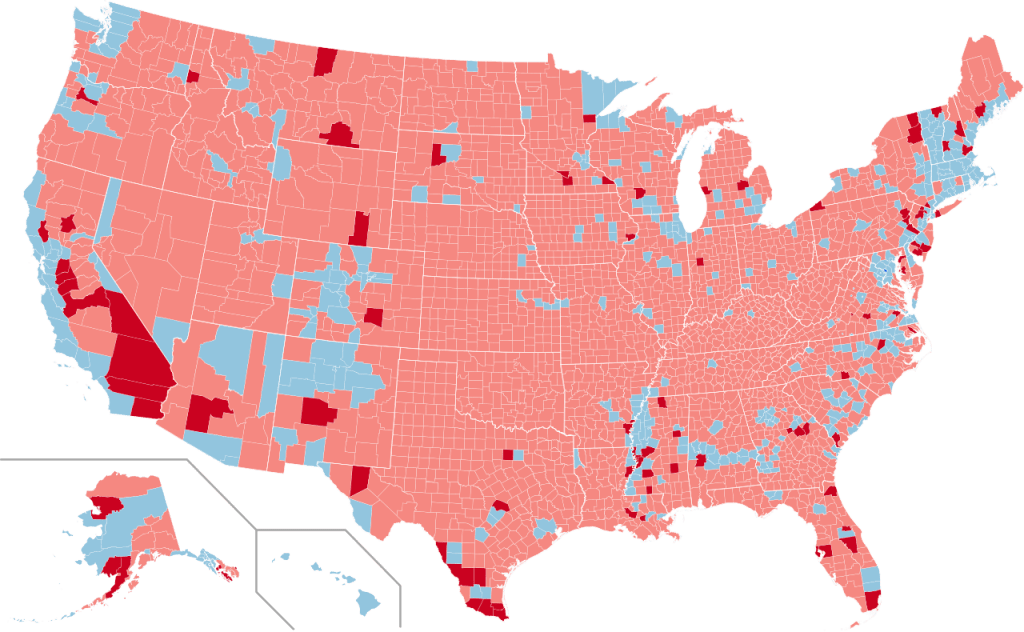
Every other October, major national news channels shift their talking points from the sensationalized drama of crime and the market to drawn-out political musings culminating in that year’s elections. Central to the political commentary are conversations about the “swing” states and the political attitudes of the few states that decide the majority of national elections. Swing states have been the determining factor in all elections since 2000. President Biden’s victory in 2020, by a margin of 74 electoral votes, was granted by the same five states that put Obama in office in 2012, and flipped for Trump in 2016. This lean towards minority rule (where the same few states wield the most power) has been exemplified over the past three elections, with President Donald Trump running as the Republican candidate. Swing states act as a pendulum, with their electoral votes ‘swinging’ between the two parties each election cycle. However, this idea of constant motion, a literal swing, oversimplifies how these battleground states actually work.
Battleground states, or states where political competition is generally within a margin of five points, can be found in Arizona, Georgia, Michigan, North Carolina, Pennsylvania, and Wisconsin. Together, these states wield 71 electoral votes and have voted as a bloc in the past two elections. Nevada is often lumped in with these states, which act more like the stereotype of a swing state oscillating between red and blue every two to three election cycles. Excluding Nevada, the other “swing states” saw less back-and-forth, with occasional flips, and consistently close races. Since 2000, four of these states flipped twice, and Georgia and North Carolina have flipped only once. But why are these battleground states crucial to monitor as more and more states become close races? The simple answer is funding. Presidential campaigns and Political Action Committees (PACs) raise billions of dollars every four years, spending their war chests on battleground states. Yet, the war chests are built by the loyalists within solid states, whose electoral votes have remained loyal to a party, and therefore are expected to contribute to the campaigns without reaping the benefits of attention and political capital. Ultimately, the plight of the solid state is one of obedience to a party, at the mercy of the demands of a minority of swing states whose volatility seals elections.
The voting bloc of the South has been largely unified in presidential elections, favoring conservative candidates at the ballot box and through political donations. While these donations are not exorbitant, they consistently fill the purse of the GOP candidate running for president. As the South is generally considered a win for conservative candidates, they do not have to put as much money or effort into these states. Instead, they spend the money donated from the South on battleground states. As a result, the South acts as a bank for the GOP candidates while receiving none of that money or attention in return. GOP candidates benefit from this arrangement, but do people in the solid states, especially in the South, benefit at all from their donations to these candidates? Is it worth it to be the “Bank of the South”?
Since 1976, with the election of President Jimmy Carter, three southern states have consistently lent their electoral votes to Republican candidates. Alabama, Mississippi, and South Carolina have all donated votes and crucial funds to the campaigns and PACs of conservative-aligned candidates without the need for campaigning in those states. In South Carolina, 48% of the 2024 primary ballots were filled out by Republican voters, yet nearly 66% of their political donations went to Republican-aligned candidates and PACs for a total of $12 million. Similar statistics are seen in Alabama and Mississippi, with the percentage of donations received by Republican groups being disproportionately higher than the percentage of Republican voters in those states. Though these donations are lower than those from New York or Texas, each person gave more than the national average. Unfortunately, when looking at these donations as an investment, their payoff is not necessarily apparent. In his 2020 campaign, Mr. Trump held just one rally in the state of South Carolina, a state that provided him significant funding per person. Alabama and Mississippi have consistently voted for the Republican candidate and provided conservative groups with $10 million. Despite their support, in his three campaigns, Mr. Trump visited Mississippi only once during 2016, never setting foot in Alabama on the campaign trail. The displayed lack of attention given to the Southern states demonstrates the assurance of these states’ red votes, creating a grant program from the South as Southern voters see little attention yet significant monetary support.
Just as Southern voters give with little return during election years, Californian voters see the same. California donated $236 million to political campaigns in 2024, nearly 10% of total contributions, according to the Federal Election Commission. Despite giving just 24% of that to conservative groups, National Republicans still netted $56 million, more than conservatives received from Texas. In 2024, Democrats received 15% of their war chest from California and an additional 20% from Florida, New York, Texas, and Washington. It should be noted that despite their red lean, Florida and Texas donate significant amounts to Democratic candidates. However, these states (including the solid blues) go largely unnoticed by the Democratic campaigns, paralleling the neglect of the “Republican Bank of the South” by conservatives. Those five states received campaign stops from Mr. Biden a total of 20 times, 17 of which were in Florida. Vice President Kamala Harris and Governor Tim Walz only visited three out of these five states in their campaign in 2024, clearly signaling that a battleground state received more attention while the ones that funded the campaign were ignored. While both the solidly blue and red states went unnoticed, the key difference between the two is wealth. States that give a higher percentage of contributions to Democratic campaigns tend to have residents with higher incomes and better general standards of living. In contrast, the states giving to GOP campaigns tend to be more rural, bringing in less income. This is not to say that solid blue states are treated fairly. Democratic donors in California and Texas shell out millions each election cycle in an attempt to hold onto the four left-leaning battleground states: Michigan, Nevada, Pennsylvania, and Wisconsin.
The word “hold” is used because battleground states often lean one direction, with candidates attempting to upset the “natural order”. Michigan, Nevada, Pennsylvania, and Wisconsin have consistently voted for the Democratic candidate. Arizona, Georgia, and North Carolina have trended Republican, particularly in presidential races. Yet, Arizona and Georgia elected two Democratic senators each to the U.S. Senate in 2020, providing a telltale sign of political contention. The crucial aspect of states flipping, rather than swinging, is that one party is on offense, and one is on defense, depending on the state. Given recent electoral history, the offense seems the easier of the two, with battlegrounds having gone opposite of the sitting party. This trend reveals two potential truths. First, there may be a constant state of flux of political power, with each party winning one election and losing the next. The other, more likely truth is a more gradual shift from left to right by each state at different times. This shift can be seen with Texas and Ohio over the past nine decades, which originally had stretches of consistent voting for Democrats. They became battleground states before cementing themselves as consistent Republican voters. For Texas, which was part of the solid South and remained blue for World War II, the great shift occurred in the 1970s. For Ohio, whose rust belt attitude gave Democrats, who aligned themselves with blue-collar voters, an edge, it was the 2000s, and with both, it is near inconceivable for many that they may swing back to blue.
While the solid states fund the candidates’ campaigns, the candidates tend to invest in the battleground states out of necessity. Within the battleground states of Pennsylvania and Wisconsin, only a third of the donations from each state went to conservative-aligned groups, less than in traditional “red states”. Lower contribution numbers signify to the GOP candidate that they have fewer votes in these states. Thus, the burden is on Republicans to persuade battleground voters to support them, often by hosting campaign events to petition for support. Mr. Trump visited Pennsylvania 19 times and Wisconsin ten times in 2020. With Vice President Mike Pence, he hosted rallies at least ten times in each state. Mr. Biden visited the state of Pennsylvania 26 times and Wisconsin once, largely shifting his campaign to a virtual space following COVID lockdowns. Mrs. Harris visited each state less than five times, focusing on Pennsylvania with four visits. While the solid states of California, Mississippi, and South Carolina clearly pay into the political pot, Pennsylvania, Wisconsin, and other battlegrounds reap the rewards: rewards to the tune of tens of millions of dollars each election cycle.
While money has a measurable impact on the local economies of states, a greater emphasis should be placed on the exchange of political capital, or lack thereof, between battleground states and solid states. The distinction between battleground states and solid states is, at face value, the slim margins by which the states are won. Taking a deeper look, the candidate travels to the battlegrounds, visiting each state on numerous occasions. Each time, the candidate brings a willingness to work with the population for their vote, demonstrating a stark contrast to the baseline assumption for solid states. This spirit of solicitation ultimately lends power to the swing states, often focusing on the needs of voters most reliant on government, either from aid or support of industry. One example is Mr. Trump’s emphasis on coal when speaking in Appalachia and Wyoming: the nation’s two largest coal-producing regions. Another example was when, at a stop in Wisconsin, Mrs. Harris attempted to rally her voters and independents with fiery remarks, straying from the usual message of party and national unity. The common thread of these speeches, given by candidates on both sides of the aisle, is emotional direction. Specifically, the use of language and sensitive subjects to rally the voters behind a common enemy. Language is important, but so are the intentions behind it. Avoiding debate of the efficacy of targeted policies such as Mr. Trump’s Clean Beautiful Coal or Mr. Biden’s Inflation Reduction Act, it is apparent that some of the most used buzzwords on the campaign trail do turn into attempted policy. Thus, the issues that matter the most to swing state voters get brought to presidential agendas, whereas solid states whose votes are less reliant on their voices being heard are less likely to be prioritized. As a result, solid states that donate the majority of political funds see no economic stimulus from campaigns and hold little sway over the general political agenda, compared with the few battleground states whose indecision gives both economic and political boons.
Ultimately, battleground states wield power via increased economic stimulus each election cycle, as well as the ability to determine special interests that may top the president’s legislative agenda. In the same elections, solid states and consistent regions of the United States are left out of campaign rhetoric but crucially included in funding requests. This inequality serves battlegrounds but begs the question: why don’t interest groups in solid states move to battlegrounds for more attention and political capital? It is because the nature of battlegrounds, or flip states, is one of constant motion. Wisconsin and Pennsylvania, two battleground states, are the only two with split representation in the Senate. Four states in 2024 elected a Democratic candidate to the U.S. Senate but favored Mr. Trump in the general election. This split may not appear out of the ordinary for battleground states, but it has been seen before in what are now considered solid states. In 1961, the voters of Texas elected John Tower, a Republican, to serve in the U.S. Senate alongside the senior Democrat Ralph Yarborough. In the following two presidential election cycles, the state voted for the Democratic candidate while continuing to support John Tower (R) for Senate. In 1976, Texas voted blue in the presidential election for the last time (as of now), yet the state voted for split representation in the U.S. Senate up until 1993. Both the solid and battleground states have the same gradual shift between parties, trending left and right at different times in their voting patterns for presidential elections. Within the state’s representation, we see a diverse range of political parties in both the House and the Senate, often impacted by the party in the White House. The major difference between this example and those considered battlegrounds is the speed at which they shift.
Just as the dominant economies of states shift over time, the ideological leanings of political parties shift, albeit more slowly. In the coming decades, several states look ready to throw their hat in the ring for the attention and money of battleground states. The first of those is Alaska, which, in 2022, elected its first Democratic representative in over 50 years. The state consistently votes a split ticket and moved almost 20 points to the left over the last eight presidential elections, positioning itself as a tight race. While it has few electoral votes, the state deserves attention. As mentioned above, some states have a tighter turnaround than others, with some taking significantly longer to shift from one extreme to another. The final swing state is probably the most obvious: Texas.
The Lone Star State has been an icon of Republicanism since 1980, with the last Democrat winning statewide office in 1994. Today, things look somewhat different: races are closer, Democrats register in higher numbers, and margins have shrunk to under three points in some races. The most notable example is Representative Beto O’Rourke’s run for US Senate in 2018. These shifts create the need for increased campaigning in these states, with Texas turning from donor to recipient. That said, each state that has shifted from one party to another has been an individual case, relying on local and global conditions, making predictions difficult to make with any level of accuracy. Yet the question remains: will solid states continue to complacently fill the war chests, or will a lack of attention lead to more battlegrounds over time?
Categories: Domestic Affairs


