
For a moment, turn it all off.
Turn off the television. Forget the endless war, the 24-hour news cycle, or the latest social issue.
None of it matters as much as a single number, quietly racing past forty trillion dollars.
That number is the national debt. Nobody talks about it at the dinner table. Nobody chants about it in the streets, and yet, it’s the root cause of the country’s most pressing problems: housing costs, insurance premiums, medical bills, and rising inequality. They all trace back to the same fundamental problem: America consistently spends more money than it collects, and everyone feels the consequences of that overspending.
First, let’s lay out how federal government debt offerings work. The Treasury borrows (sells United States Treasuries), and investors lend (purchase United States Treasuries). In exchange, the government promises them interest. This process happens at an enormous scale; after decades of borrowing, the government now pays over a trillion dollars per year in interest on past debt. And the larger the debt becomes, the more expensive it becomes to maintain, creating a vicious cycle, known as the debt doom loop. The government runs a deficit, borrows money to cover the deficit, pays interest on the accumulated borrowing, and then borrows again to cover the interest. Repeat, and repeat until it becomes a never-ending cycle.
In popular media, we often hear claims from the left that the solution to our nation’s fiscal problems is to increase taxation on the wealthy. If you believe that claim, then you fundamentally misunderstand the problem at hand.
Take all 989 billionaires in the United States. Liquidate them. Take every asset, holding, and even the coins in their seat cushions, and hand it to the Treasury. Congratulations, you’ve covered barely over one year of federal spending. That’s it. Just over a year. Tax every corporation in the country at 50%, and you’d fund the government for a few months at most. Neither of these tactics come close to solving the problem, and both are as realistic and effective as wishing upon a shooting star for all of your problems to go away.
Alright, instead of those options, let’s think about trimming spending—what about the defense budget first? Surely, according to the news, it must be at least half of the budget. Thus, if we cut defense spending, we won’t have to run a deficit.
Also wrong.
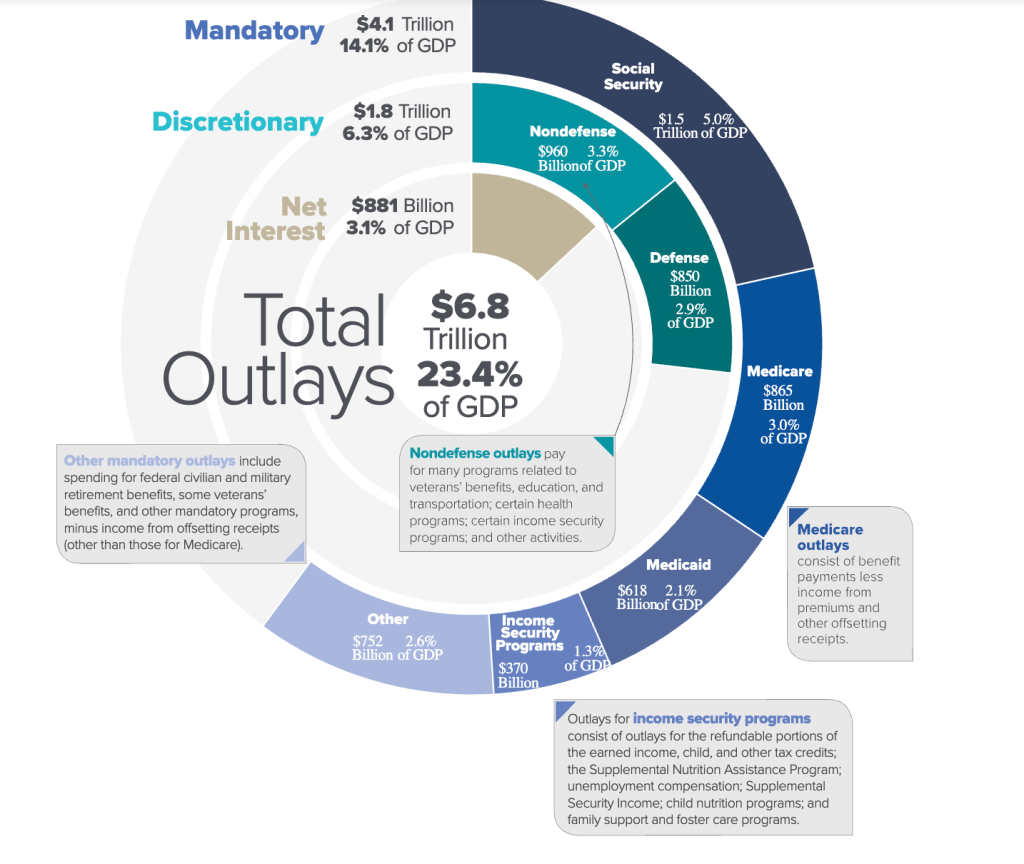
If you turn your attention to the chart above, you’ll realize that spending on defense is roughly 13% of the budget. Not a small figure, but considering the size, scope, and duties of the US military, and the fact that this includes veteran benefits, the number doesn’t seem particularly insane. Also, cutting it would still leave a vast portion of the budget untouched.
Now, turn your attention to the categories under the mandatory label, which can also be classified as entitlements: Social Security, Medicaid, Medicare, retirement programs, and federal welfare. Combined, these entitlements account for nearly 60% of the overall budget, and they are untouchable. They are codified by the law, and growing every year. Add in the interest payments on the debt, and you reach nearly 75% of the entire budget. 75% of the budget is untouchable and it grows larger every year.
Despite this overspending, millions of Americans want the government to grow even larger.
Why? Please, look at the current state of our welfare system. It is a system defined by inefficiency, excess, and failure. Obamacare has funneled trillions of dollars to insurance companies since its passing, and a third of Social Security benefits go to households making over $100,000 a year. On top of that, tens, if not hundreds of billions of dollars, are lost every year to outright fraud and administrative bloat, without including the absurd sums individual states burn through on their own.
Do you see the issue?
The U.S. government has a spending problem. It’s addicted to cheap borrowing to fuel bloated and unrealistic welfare programs. No country on earth has a larger welfare system than the United States that proves dysfunctional, and people want it to be larger?
Oh wait, I forgot. We live in a “democracy.”
Imagine in 2028, a candidate were to run on slashing the federal government’s spending, moderately increasing taxation, and securing a fiscal future for the United States. Do you think they would win?
No, because the American political system is great at creating benefits and exceptionally bad at removing them. Give someone a government benefit, and they will fight to protect it. Take one away, and they will fight to get it back, and ruin whoever took it away in the process. Retirees will not surrender Social Security. The poor will not surrender Medicaid. The elderly will not surrender Medicare.
No group receiving government benefits truly cares about the sustainability of their benefits or the impact on the broader economy. If a politician tries to manage the burgeoning size of these benefits, they’ll simply vote them out. Everyone has an incentive to protect their own piece of the system. Because of this incentive, few people have the will to sacrifice today for a crisis that may not fully materialize until years from now; they simply do not care.
And that is the central contradiction of fiscal policy reform in our democratic society. Everyone agrees that the government should spend less, and yet nobody agrees that their government benefits should be reduced because reduction would require sacrifice, which will not occur in a democratic society. Those benefiting from these payments, including corporations, will fight tooth and nail to ensure they remain flowing, only worsening the crisis.
In a monarchy like days of old, a king would have slashed the kingdom’s spending, mandated harsh taxation, and crushed the public unrest that followed in order to save the kingdom. We do not have that option, nor were we meant to. Our system is designed to prevent a singular person from imposing that kind of solution. However, by preventing one person from holding too much power, our system also makes it extraordinarily difficult to respond when a crisis requires sustained sacrifice from everyone, especially for matters as abstract as fiscal policy.
So what are we left with? Our system is inefficient and incapable of stemming the bleeding. After a certain level of taxation, the people will revolt and the economy will contract. So if the government cannot pay its obligations through taxation, and cannot reduce its spending without committing political suicide, there is only one remaining mechanism available:
Inflation.
Inflation dilutes the value of the dollar until the debt shrinks in real terms. The government therefore keeps printing, the debt keeps growing, and the cycle continues.
This cycle, though, does not create a pretty world. The wealthy, with their investments, will see continued increases to their quality of life. If you think the United States is in a period of “unaffordability” right now, you cannot even fathom the harsh reality of a true inflationary society. The average person’s existence will become increasingly unaffordable and their lifestyle less sustainable. This will only compound over time because the deficit will continue to grow, the debt will increase even more, and the value of the dollar will slowly erode as the government becomes reliant on inflation to manage its payments.That is the world you should be prepared for. No political party will save you.
210 years ago, Thomas Jefferson said the following: “I, however, place economy among the first and most important republican virtues, and public debt as the greatest of the dangers to be feared.”
Soon, we will all realize the importance of his warning.
Categories: Domestic Affairs


