
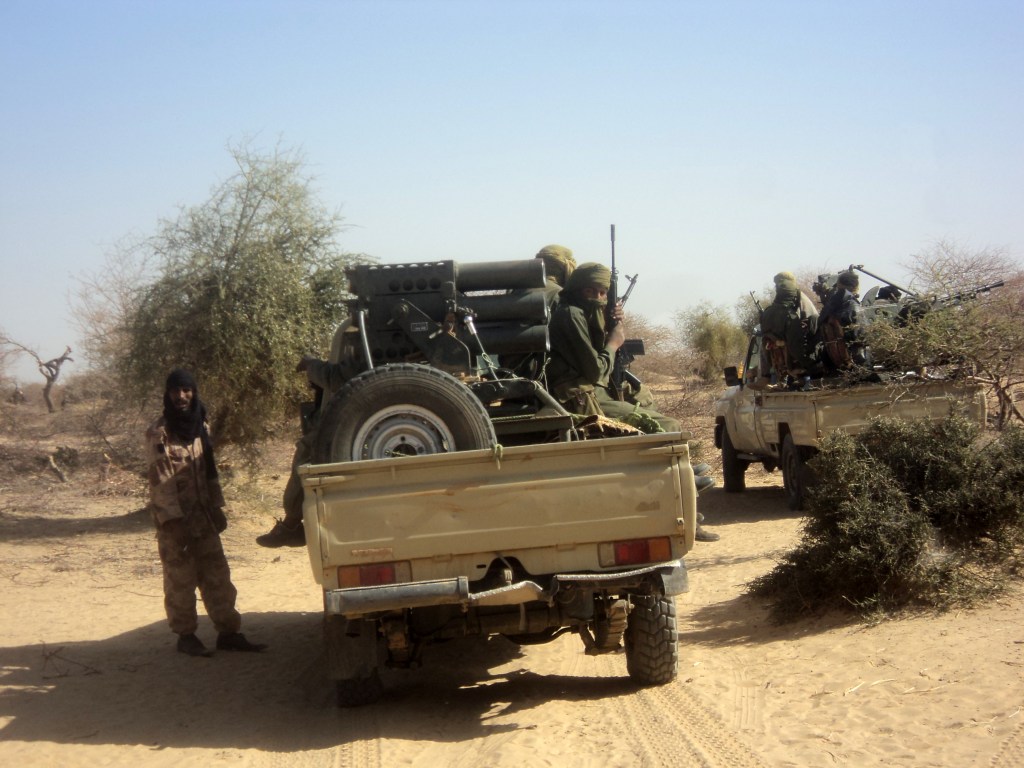
“Do Not Travel to Mali for any reason due to crime, terrorism, kidnapping, unrest and health,” reads the US Department of State’s travel advisory. As of the writing of this article, July 14th, what were once infrequent incidents may become the de facto policy of the nation. For nearly three months, intense fighting between an Al-Qaeda linked group—the Jama’at Nusrat al-Islam wal-Muslimin (JNIM)—and government forces has besieged the nation. The ruling Malian junta, supported by the Russian-linked Africa Corps, has suffered the assassination of its defense minister and significant territorial losses.
The attack launched on April 25th was an aggressive step by JNIM after a months-long campaign of economic strangulation. Since September 2025, JNIM had been attacking fuel tankers and seizing routes into the city, imposing a partial fuel blockade of the capital, Bamako. The April 25 offensive was the culmination of months of military and economic pressure and was launched while a hostage-related peace deal signed in late March was still technically in place.
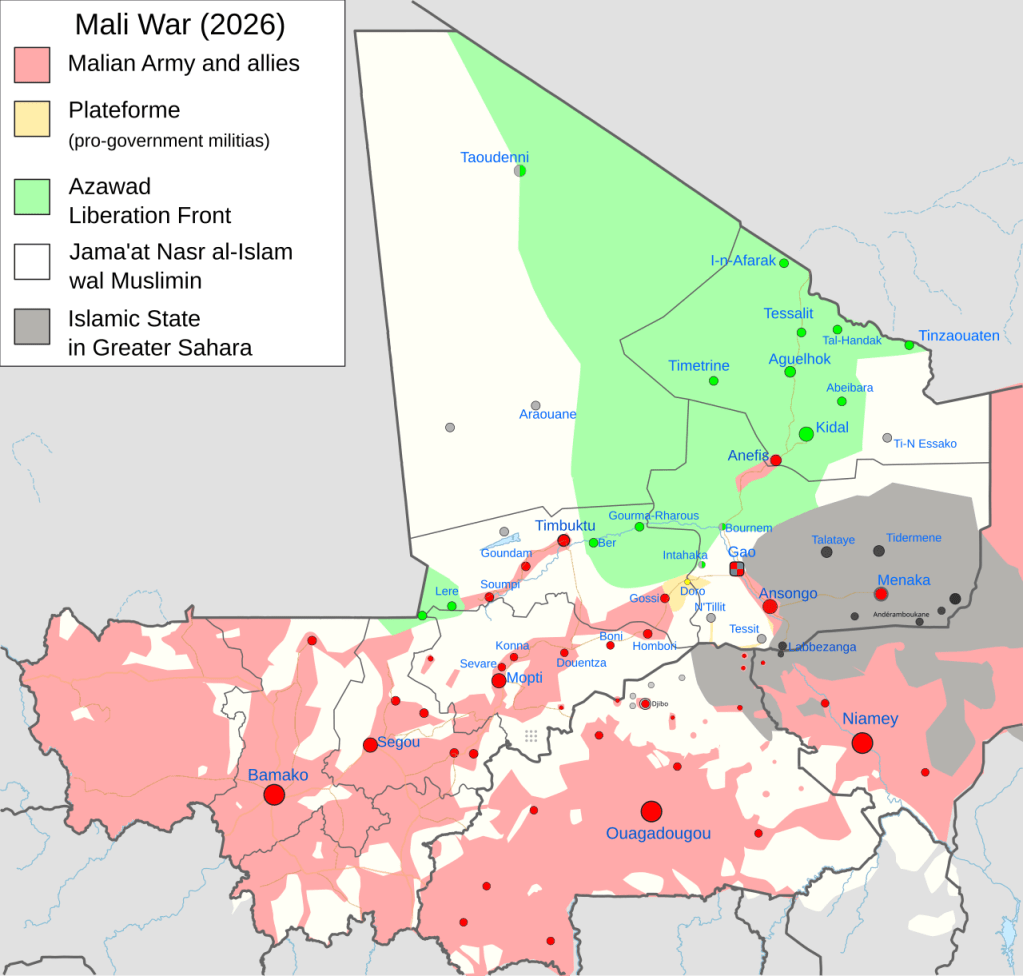
Since the onset of the renewed fighting, government and Russian forces have fled Kidal, Aguelhok, and Tessalit in the Kidal Region; Tessit in the Gao Region; and Ber in the Tombouctou Region. As of now, JNIM, the Azawad Liberation Front (FLA, a separatist JNIM ally), and the Islamic State in Greater Sahara control and/or contest anywhere from 60–70% of the country, per estimates, although the situation is fluid. Bamako and its surrounding cities are under a JNIM blockade, restricting the movement of people and goods. The western cities of Nioro and Kayes are also cut off. The Kayes region, which handles nearly 80 percent of Mali’s gold production, is under JNIM attack and siege. A roughly two-month lull in the fighting occurred after these major gains for JNIM, FLA, and their allies, but the rebels renewed their fighting on July 4th, when the FLA and JNIM hit the northern cities of Anéfis and Gao. The rebels also struck Kouakourou, positions near Bandiagara, the Kati military base, and Kénieroba. While the Malian army and the Africa Corps claim to have driven them back, the rebels are, without a doubt, threatening to take over the entire country.
“Why is this important?” one might ask. Because it isn’t just Mali. If JNIM and its allies were to take control of Mali, it would be the first country to be governed by Al-Qaeda, the group that brought down the Twin Towers, attacked the USS Cole, and drew the US into the War on Terror. This would be unprecedented in and of itself, but what is far more worrying is what is occurring across the rest of the African Sahel.
Since its founding in March 2017, JNIM has been involved in nearly 40,000 deaths across Mali, Burkina Faso, Niger, Benin, and Togo. And it is only accelerating. Between 2024 and 2025, violent events involving jihadist groups in the Sahel region increased by roughly 86 percent, while related fatalities surged by over 260 percent. Next door to Mali, in Burkina Faso, the state remains locked in a brutal conflict with Islamist groups that control nearly half of the country. In Niger, JNIM assaulted the Diori Hamani International Airport in Niamey, killing 11 soldiers and two civilians. A similar strike in January had been claimed by a rival Islamic State affiliate. In Nigeria, more than 1,200 civilians were killed between January and February alone, including 170 people in a single February 3rd attack in Kwara State.
The African Sahel is at the brink of an Islamist takeover, and no one is currently able to slow them down. When French forces left Mali in 2022, the government rejoiced, claiming the Russians would be able to crush JNIM and simultaneously refrain from “exploiting” the nation. But the Russians have failed. Mali has failed. Burkina Faso has failed. Niger has failed. Nigeria is failing. No nation in the Sahel is able to stop the spread of groups like JNIM, and they’re not slowing down anytime soon. JNIM has made significant inroads in several West African coastal states and established a presence in Guinea, Senegal, and Mauritania, with JNIM-linked attacks also recorded in the Ivory Coast, Benin, and Togo. In November 2025, JNIM staged its first attack in Nigeria, where ISWAP and Boko Haram are already slaughtering thousands every year.
In Mali, JNIM has seized resource-rich areas that can fuel their fighting for years to come, and with record-high gold prices, they will pocket a pretty penny. With greater territorial control, the groups are also able to finance future conflicts by trafficking greater amounts of South American cocaine
Since major powers such as the US, France, or China are unwilling to commit themselves to another quagmire, it is very likely that in the coming months and years, the African Sahel will be drastically reshaped. But this won’t stop at the Sahel; these things never stop where they start. West Africa is next, then North Africa and the Mediterranean. Ethiopia and Eritrea are butting heads, creating a perfect environment for these forces to intervene. In the Democratic Republic of the Congo, a new, savage group of fighters, the Islamic State Central Africa Province, is already involved in the current conflict between the DRC government and M23, with their influence growing every minute.
Africa is the future. Everyone knows it. It has the resources we need to power the next industrial revolution and the largest youth population on Earth. It is the next frontier of economic growth.
But what happens when the future looks like this?
Categories: Foreign Affairs


