
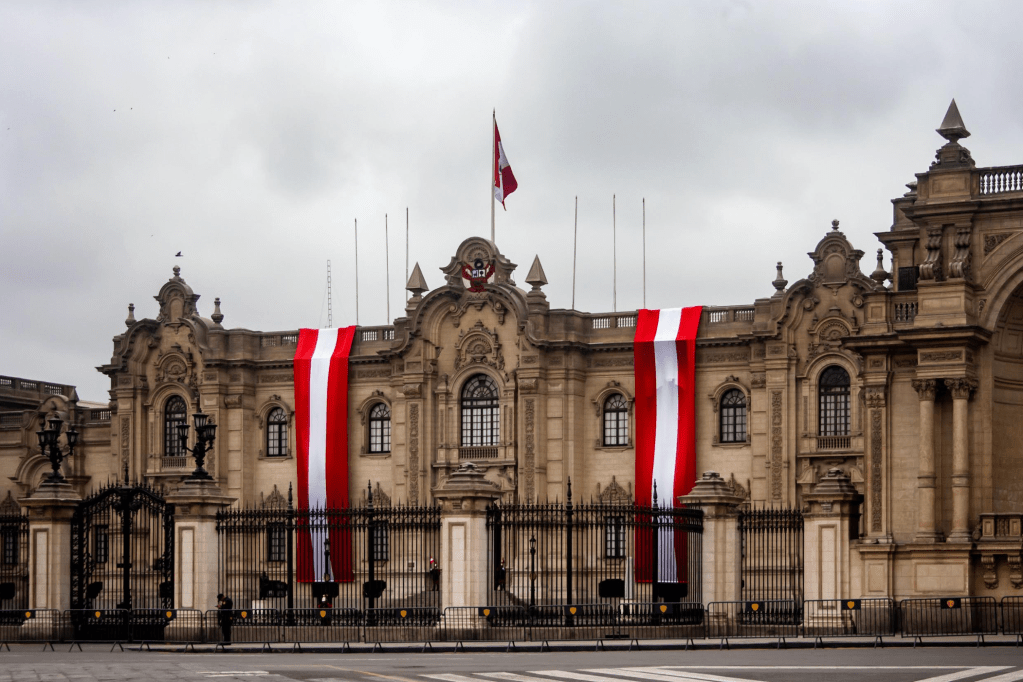
A Fujimori is once again in power in Peru. This time, it is the daughter of former autocratic President Alberto Fujimori who will sit as president.
Alberto Fujimori is notorious for his autocratic presidency from 1990–2000, which was flooded with corruption scandals and human rights violations. Though he was initially hailed for Peru’s speedy economic recovery and defeat of the violent terrorist organization Sendero Luminoso (Shining Path), this soon unraveled. In 1992, Fujimori undermined the rule of law by launching a “self-coup” that dissolved Congress, rewrote the Peruvian constitution, reorganized the judiciary, and exerted control over the media. When democracy “returned” with the establishment of a new Congress, it returned under institutions overseen by Fujimori and his intelligence apparatus. In 2000, a corruption scandal broke in which Fujimori’s head of intelligence was caught on video bribing an opposition congressman in exchange for switching political allegiance. This triggered the discovery that brought down the regime. An investigation found deep-rooted corruption in military intelligence operations consisting of hundreds of cases of illegal arrests, forced disappearances, torture, and massacres of dozens of civilians under the guise of combatting domestic terrorism. After fleeing the country, Fujimori was eventually detained in 2005 and convicted in 2009 for human rights violations. Today, he still remains a greatly divisive figure in Peruvian politics. His president-elect daughter now bears this legacy as she enters the same office.
Her name is Keiko Fujimori, and she has earned a controversial reputation in her own right. As the herald of the Fujimorismo far-right movement, it took numerous presidential campaigns for Fujimori to to turn the tide from liberal politics. Winning by a slim margin of 0.3%, Peru’s 2026 presidential election will be definitive for the future of an unstable democracy in South America, as a drastic shift to the far-right takes place amongst political turmoil.
This election comes at a pivotal point in Peru. This past February, Peruvian politicians voted to impeach interim president José Jerí just four months into his term under corruption allegations arising from his failure to disclose private meetings held with controversial Chinese businessmen. He was the eighth president of Peru in the past decade, none of which finished their term. After a very narrow electoral victory in runoff, an individual from the far-right has ascended to power. But she is no stranger to Peruvian politics.
Serving as first lady under her late father, Keiko Fujimori continued in politics running for president for the past four election cycles. She leveraged the political crises of liberal governments in corruption scandals as a rallying cry for a return to the politics of her father. Fujimorismo—a conservative, populist, “law and order,” ideology—has seen a resurgence after the personalist rule of Alberto Fujimori. Under the Fuerza Popular (Popular Force) Party, Keiko Fujimori leads as the heiress to this ideology of restoring an order that saw the introduction of neoliberal economic policy and staunch law enforcement to combat domestic terrorism. During her campaign, President-elect Fujimori defended this economic model while waging a “frontal war” against crime and extortion she claims will mirror her father’s defeat of the Shining Path terrorist group.
In all fairness, the economic system she champions has seen historical success in Peru. The market-led, technocratic approach put in place to address hyperinflation in the 1990s has been generally stable for the Peruvian economy. The OECD highlights that Peru’s growth in 2026 remains resilient despite supply shocks caused by the current war in the Middle East. It is in Fujimori’s best interest to continue reinforcing her father’s functioning economic system that few presidents have modified. Additionally, rhetoric about tough law and order policy comes from a severe crime and corruption problem in the country. According to Freedom House’s Peru 2025 report, severe corruption in government persists, along with organized crime-related violence in illegal mining and extortion. There is great need for President-elect Fujimori to address the deep-rooted organized, and institutional crime she will inherit.
Outside Peru’s borders, Fujimori will have the great task of balancing her country’s relations with both the United States and China. Though being the preferred candidate of Washington due to the Popular Force’s right-wing affiliation, Fujimori has yet to publicly take sides between the economic giants of the U.S. and China. Upon entering office, she will most definitely continue the position of maximizing Peru’s international economic interests with both influential trading and investment partners. In China, Peru has one of its most important economic relationships. Data from the Observatory of Economic Complexity as of March 2026 cites China as accounting for 32.2% of Peru’s revenue from exports, compared to the United States’ 12.6%. Fujimori has also promised to expand private investment, promote mining of copper, iron, and zinc, and boost infrastructure projects in Peruvian sectors which Chinese companies have been involved in for years. China is not an economic partner who should be cast away by the new Peruvian president. She cannot, however, ignore the value of American diplomatic allyship and economic cooperation in the global state of affairs—especially with renewed U.S. geopolitical maneuvers in Latin America under the second Trump administration. The President-elect will have to maintain a geopolitical balancing act for the sake of the Peruvian economy.
There are also many issues at home Keiko Fujimori will need to address. Besides the rampant state corruption and organized crime violence that threatens the rule of law, Peru struggles with civil rights and democratic stability. For one, Freedom House categorizes Peruvian society as “partly-free,” especially in the realms of social freedoms and widespread violence. Gender-based violence, especially femicides, have become all too common in the country. According to the National Institute of Statistics and Informatics in Peru, there were 154 registered cases of femicide in the country in 2024, which was equivalent to a rate of 1 femicide for each 100 thousand women; the Demographic and Family Health Survey conducted in 2025 found that 50% of women 15 to 49 years old have suffered domestic violence at least once. There is also discrimination and violence against indigenous populations, migrant groups, and the LGBTQIA+ community. Law and order must be used to apply to the protection and uplifting of these communities’ rights in the face of crime in the country. As for the state of Peruvian democracy, its greatest dilemma is that the power of impeachment using the “motion of vacancy” has become overly-normalized by the congress. Recent presidents have lasted mere months before being removed for a scandal, lack of coalition stability, or improvised rationale by Congress that have raised concern from international experts. Fujimori will need to navigate proper parliamentary relations and coalition-building to secure her presidency and complete her term.
There are many obstacles Keiko Fujimori will have to overcome upon entering office this month. This moment, however, is an opportunity for change. The implementation of far-right policy—controversial or not—will be notably distinct for a Peruvian state that has seen leaders from the center to the left since the end of autocracy under Alberto Fujimori. With her family history looming over her presidency, only time will tell how Keiko Fujimori’s policy will fare with the Peruvian public and Congress.
Categories: Foreign Affairs


