
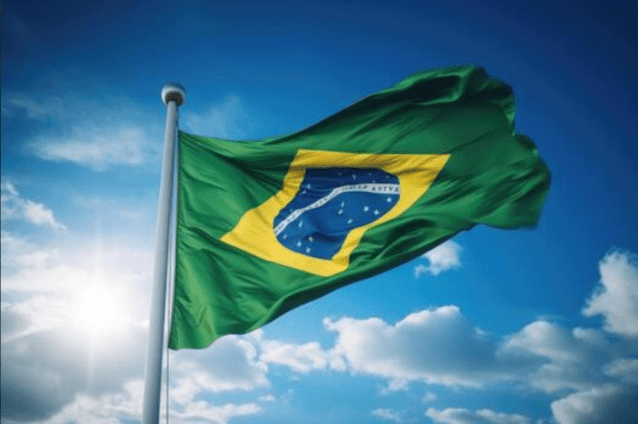
Brazil will head to the polls October 4th in what will again be a divisive election for the country. Brazilians will elect their next president and vice-president, several governors, two-thirds of the Senate, and the entirety of the Chamber of Deputies. Yet at the moment, there is little enthusiasm from the general public as the campaign season begins.
A tremendously polarized political landscape is to blame. The two frontrunners in the race are no strangers to Brazilian politics, and are in fact the leaders of this polarization: Incumbent President Luiz Ignacio Lula da Silva (Lula) and Senator Flavio Bolsonaro. Their opposing rhetoric and popularity represent a grave political dilemma for Brazil.
President Lula da Silva, who currently sits in office at eighty years old, will be running for a historic fourth-term under the Workers’ Party as one of the most enduring politicians of a modern Latin America notorious for political instability. Senator Bolsonaro, the son of Lula’s controversial predecessor President Jair Bolsonaro, will represent the Liberal Party and vows to carry-out the political legacy of far-right ideology cultivated by his father. As of August 5th, the latest Quaest poll projects Lula (44%) defeating Bolsonaro (39%) in a likely runoff between the two, with 13% of respondents stating they would cast a null ballot and 4% remaining undecided. The sheer percentage of ballots intended to be cast as blank or invalid is concerning. This apathy towards selecting either candidate in the event of a runoff election is owed to a growing public disinterest in Brazil’s recent politics observed since the mid-2010’s—politics characterized by two well-established factions of the left and the far right becoming increasingly combative towards one another as contentious events have shaken the country.
The hostility began in 2016 when then former-President Lula was the subject of a massive federal anti-corruption investigation known as “Operation Car Wash.” He was sentenced to nearly ten years in prison in 2017 for his involvement in the state-owned oil company Petrobras and its contract relations with engineering and construction firms found to be linked to a vast bribery scheme. After serving his sentence from early 2018 to late 2019, the Supreme Court intervened and cleared his charges in 2021. With the support of the United Nations Human Rights Committee, the Supreme Court found that Lula’s prosecution violated due process guarantees and was likely politically motivated.
Jair Bolsonaro, a champion of the far-right who had worked to impeach Lula’s presidential successor Dilma Rousseff in 2016 and who supported the federal judge who convicted Lula the following year, ascended to the presidency in the 2018 election. Throughout his time in office from 2019 to 2023, President Bolsonaro oversaw a period of immense political polarization as the country shifted to right-wing policy after thirteen years of leftist leadership under the Workers’ Party. Half of the country was in a state of shock and protest from the rapid prosecution of leftist leaders, while the other half praised the dissolution of “corrupt,” establishment politicians.
Upon the Supreme Court’s annulment of Lula’s convictions in 2021, Brazil had one of its most contentious elections in history as Lula declared he would run for a third term. The results of the 2022 election resulted in Lula narrowingly beating out incumbent Jair Bolsonaro. Yet, the political theatre did not end there. Bolsonaro, in similar fashion to his proclaimed idol President Trump in the United States, refused to accept the results and oversaw a conspiracy to overturn the 2022 election by disbanding the judiciary, assuming control the military, and even attempting to assassinate President-elect Lula, along with inciting a violent mob on Congress as they worked to certify the results of the election. His attempt failed when he could not convince the entirety of the military establishment to back his plan, and Bolsonaro fled to the United States in exile soon after this conspiracy was revealed to the public. After returning in 2023, Bolsonaro was tried for plotting a military coup and sentenced to almost thirty years in prison. Lula returned to the presidency in 2023, leaving half of the country disgruntled as the political situation flipped entirely on its head. In 2026, a decade of tumult only seems poised to continue throughout this October election.
As campaigning for the election begins, troubling factors aside from campaign issues have left the Brazilian electorate feeling dismal. These include Lula’s age and fitness for the presidency, Flavio Bolsonaro’s management of a divisive family legacy, and shifting relations between Brazil and the United States. Many in the media and the public raise concern about Lula’s physical fitness to be president after a longstanding political career that began in the 1980s as a union leader founding the Workers’ Party, serving two terms in the presidency in the 2000s, involved in the scandals of the 2010s, returning to office, and preparing for another term as an octogenarian. If elected this fall, Lula da Silva would make history as the longest-serving democratically-elected president of Brazil, at sixteen years. Some question his physical ability to govern at the highest office in the country. Others claim that he runs to stave off the return of Bolsonaro’s conservatism, as he is the only influential figure of the left capable of doing so.
Flavio Bolsonaro, son of the previous president, earned the Liberal Party’s nomination but has received criticism for a lack of a policy agenda, as well as recent controversies. Some Brazilian voters doubt his ability to run as a legitimate candidate focusing on the issues beyond the outrage regarding his father’s incarceration. To his credit, he champions a tough-on-crime approach and promises of tax cuts as the greatest elements of his campaign: two issues of great concern within the Brazilian public. Yet his popularity and resonance with the general public remains tested.
Above all, what has received the greatest extent of noise in this election cycle thus far has been the question of the United States’ involvement in this South American election. President Trump’s contempt for the left in Latin America is well known and has been a focal point of diplomacy in the region since his second administration took office. The Trump administration has made significant efforts to support right-wing parties and governments throughout South and Central America. In leftist Lula da Silva, there has been a limited, oscillating outreach from the American president that has caused tension in diplomatic ties between the longtime allies. In September last year, President Trump lanced numerous tariffs on Brazil in an effort to annul the prosecution of his geopolitical ally Jair Bolsonaro for his attempted coup charges. He also imposed sanctions on the Supreme Court Justices who oversaw the former president’s trial, much to the condemnation of President Lula. These actions were later reversed, and there have been temporary moments of truce such as their latest meeting at the White House in May, yet the two continue to spar on numerous geopolitical matters.
Now, President Lula warns of U.S. interference in the October election and has utilized the American president to frame opposition to Flavio Bolsonaro, claiming that voting for a “traitor to the nation” would mean surrendering Brazilian sovereignty for American interests. Bolsonaro, in contrast, openly seeks the support of the second Trump administration in hopes to align Brazil with the shift to the right seen across Latin America within the past few years. Voters, however, remain wary and concerned with the integrity of the election amid potential U.S. interference. Despite the two politicians galvanizing their voter bases, the rest of the Brazilian electorate have been left disenchanted, faced with limited and inadequate options.
There is no doubt a gloom surrounding this October election and its frontrunners. Nearly half of the country is turned against the other half, while the rest lose faith and turn away from politics altogether. The polarization from a decade of bitter political rivalry has caused both the Workers’ Party and the Liberal Party to resort to desperate measures to secure electoral victories and “protect” Brazil’s democracy from the other—notably adhering to their own conflicting definitions of what democracy to protect, and how. These desperate measures have been defined by a reliance on past triumphs of political heroes rather than searching for who can actually lower the political temperature.
To tranquilize the fervor and encourage wider political participation, newer candidates who can reconcile the established party system must be given a chance in the future—not candidates with names that provoke like Lula da Silva and Bolsonaro. The two candidates are already confirmed as their parties’ nominees and command the lead in the polls. However, the campaign season is barely starting, and much can happen from now to October 4th. There is a chance that fed-up voters may turn to other candidates in the race such as Renan Santos, an entrepreneur and newcomer to politics, whose outsider, firebrand appeal may allow for change. If not, Brazil must look to reform its party system, so this turbulent political era can finally be left behind.
Categories: Culture


