
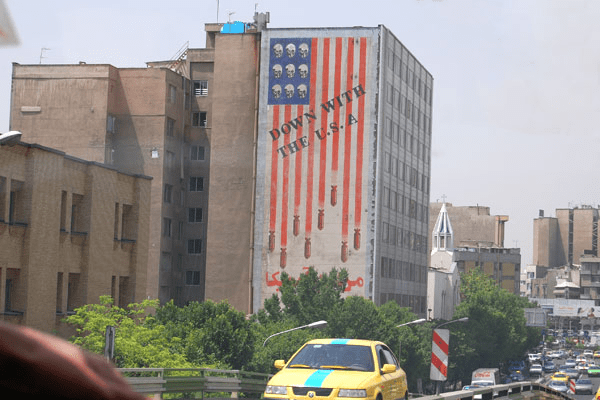
Despite all its study and press coverage, foreign policy boils down to a remarkably simple duality: diplomacy and war. In the era of modern civilization and defined borders, the goal of foreign policy was peace. Within this framework, diplomacy seems like the obvious tool, especially because in the short term, war inherently opposes that notion. So, is there any point in war, particularly offensive war, at all? A long-term analysis gives us some answers that help us understand the nature of the Iran conflict.
In the 1970s, President Nixon saw an opportunity to re-establish diplomatic relations with China and isolate it from the USSR, an agreement that opened China up to world markets and eventually led to its global ascendancy. While some assumed that China would democratize as it opened up to the world, that notion turned out to be a fantasy. Instead, in what was at the time a mutually beneficial relationship, the U.S. inadvertently created its most powerful rival.
What U.S. negotiators did not foresee at the time were strong, unchangeable values in the priorities of each regime, namely, that China did not believe in freedom and human rights the same way that we did. When a country has a fundamentally different set of underlying values than ours, an initially mutually beneficial deal becomes unsustainable so long as the foreign adversary gains more from the relationship than we do. Short-term diplomatic wins have typically translated into longer-term disasters, such as the appeasement of the German annexation of Czechoslovakia in 1938 that eventually emboldened Hitler to start World War II.
I see many parallels between appeasement then and the current desire in America and Europe to “find a peaceful resolution” to the modern-day conflict with Iran. Germany slowly swallowed up all of Central Europe before it eventually became powerful enough to challenge the entire continent. The playbook for weaker, adversarial nations is to build up economic, technological, and military might slowly, but not so much as to evoke the wrath of the stronger power. Eventually these nations cross into a threshold in which any further potential or realized conflict becomes impossibly costly. The key to the success of these strategies lies in the complacency of the stronger nation. For example, think of North Korea slowly developing nuclear weapons and missiles until we could no longer comfortably challenge them anymore; think of when we could no longer sanction China for human rights violations or stop them from invading the territorial waters of Southeast Asian nations because China controls the world’s rare earth supply. The story is the same everywhere: For nations that oppose democracy and freedom, deliberate inaction in the short term creates further damage in the long term.
A few politicians have argued that America is wasting money and lives on engaging in an avoidable war. To counter this point, it’s important to remember that Iran has been directly and indirectly killing Americans for the last 40 years—from 1983, when Iranian-backed Hezbollah killed 241 Americans in the Beirut barracks bombing, to the 46 Americans Hamas killed in just the past 2 years. Therefore, it’s a completely false premise to assert that there was no alternative cost if the U.S. did not fight Iran; it just would not have been as immediate or expected.
This is especially pertinent given that the legitimacy of the Iranian regime is tied to hating the US. Historically, I understand why this is the case—the Shah’s overthrow was how the current theocracy established legitimacy—but it does not give them a free pass to wreak havoc on an entire region through a network of well-funded proxy militias. This is why, unlike other countries, a peace deal was never going to spell the end of trouble; as long as Iran has power and influence to undermine American-led peace and security in the Middle East, it will.
Many have pointed out that Trump’s own actions made this war inevitable when he backed out of Obama’s 2015 Iran Nuclear Deal, the JCPOA, that limited Iran’s nuclear program. The argument goes that Iran would not be developing nuclear weapons today if not for Trump’s political miscalculation. This is not entirely unreasonable, but it misses the crucial point that Iran was causing harm to the world through a lot more than nuclear weapons. The JCPOA did nothing to curtail Iranian sponsorship of state terrorism, and its removal of sanctions only funneled more oil money to the IRGC for them to then give to proxies. It is not a coincidence that the strength of Hezbollah, Hamas, the Houthis, and other terror groups grew exponentially during this period. The strongman-led Iran was never going to leave the rest of the world alone, especially when it derived all of its legitimacy from doing the opposite. Even if new diplomatic agreements were made, it is almost certain Iran would have undermined and circumvented them wherever possible.
This leaves us with the harsh reality that the Middle East will never be peaceful with the existence of the current Iranian regime. Global trade through the Strait of Hormuz and the Red Sea, as well as the economic development of numerous nations throughout the region, would all continue to be at risk. We can either choose to continue this status quo, or we can pursue military action in an attempt to end it.
Critics say this is a war of choice, and in the short term, that is correct. Unless we want to sit back and let terror regimes accumulate power and strength as they please (thinking back to 9/11, we paid the price for doing exactly this in Afghanistan with 3,000 lives lost and over $100B in damages), America should not wait to act militarily until it has no other choice to do so; it should choose to act when it has the greatest advantage. Judging by the way the war is going so far, I would say striking at this moment provided us a great advantage indeed.
Categories: Foreign Affairs


