
Note: This article is part two of a series. Read part one here.
This is part two of a duology. In part one, I discussed the broad strokes of an adversarial coalition underpinned by Sino-Russian cooperation, seeking to destroy U.S. influence and the liberal world order through likely military action. I then summarized many events and phenomena in American history that have contributed to the inadequate defense industrial and fiscal strength that would prevent our country from winning a multi-front conflict.
The War
Our adversaries’ strategic goal is to destroy the West as a political and economic bloc, and by extension the liberal world order. They have two broad aims: destroy the global U.S. military presence through numerous diversions and destroy the West’s economic power. Building on the last section, the adversary coalition is counting on us not having the manufacturing capacity or human labor needed to sustain a global war effort.
With our military being the smallest it has been in decades (sitting at 2.1 million active duty and reserve personnel across all United States Armed Forces branches as of late 2025) the axis will launch a coordinated, global attack. All of our major adversaries will have equal or more troops in much smaller geographical areas while we have to cover the entire world. A strategic countervalue attack on the continental United States and a simultaneous invasion of our allies would not only divide U.S. and allied military power to prevent a coordinated defense, but it would also severely degrade our nation’s economic power. Especially with the advent of long-range missiles, artificial satellites, and cyberweapons, adversarial state actors do not need to physically invade us to inflict catastrophic damage.
Controlling the Narrative and Cementing Economic Influence
Our adversaries are not just using military means to attack us. The information war is just as, if not more, important. With the consent of the local autocracies, the Axis has flooded the developing world with all manner of disinformation using its cheap-to-stream media organizations, from big-name outlets like RT, Xinhua and PressTV to obscure front companies such as Yala News (a Damascus-based Russian propaganda mill). Such outlets expose Western internet users to propaganda via bot farms and doppelganger websites pretending to be legitimate media.
Russia and China amplify each other’s disinformation efforts. For example, in March 2022, the Chinese Ministry of Foreign Affairs and state media repeated Russian claims of U.S. biolabs in Ukraine. Alongside providing credence to Russia’s lies, this undermined speculation on COVID-19 and the Wuhan Institute of Virology. According to journalist Anne Applebaum’s book Autocracy, Inc., China has sought to weaken the United Nations Declaration of Human Rights by working to shift language among diplomats and UN documents, from universal human rights to “win-win cooperation,” “mutual respect,” and opposition to “intervening in a country’s internal affairs.” These moves and others by U.S. adversaries are intended to silence criticism of their internal abuses and stonewall broader international response to military aggression.
Russian disinformation networks parrot a “multipolar” future in the Global South while Putin has defined “sovereignty” as being limited to only a handful of countries: those with coercive power. The information war is assisted by the dismantling of U.S. soft-power and counter-disinformation infrastructure. The Global Engagement Center, the only U.S. government office dedicated to identifying and exposing foreign state disinformation campaigns, was allowed to expire on December 23, 2024 when Congress declined to reauthorize it. Its successor office, R/FIMI, was shut down by Secretary of State Marco Rubio in April 2025. This left the State Department without a dedicated foreign-disinformation office for the first time since 2016, in the same year Russia and China conducted documented influence operations targeting elections in Taiwan, Moldova, Georgia, and Romania. USAID’s dismantling, alongside the broader retrenchment of U.S. public diplomacy, removes the institutional architecture that previously contested Russian and Chinese narratives in the developing world.
China has gained influence in the Global South via the Belt and Road Initiative (BRI). The BRI has devolved into modern-day economic imperialism and has become little more than a venue for exporting Chinese jobs. Much of the roughly $1 trillion China has allocated for the BRI has been embezzled or not resulted in sufficient-quality construction. In February 2023, former Ecuadoran President Lenin Moreno was charged with taking $76 million in bribes from the Chinese state-owned company Sinohydro. Meanwhile, a troubled Chinese-built railroad stretching from Djibouti to Ethiopia has cost the Chinese government itself over $1 billion. The PRC has invested loans and bribed officials in many countries with the intent of taking ownership of local properties, such as mines, in order to feed natural resources to the burgeoning Chinese nation. In Zambia, half of the mining industry’s copper proceeds go to China. As of 2023, 60% of all BRI members had debt crises related to China. Said countries are also heavily reliant on China for tax revenues. In December 2025, Zambia became the first African country to accept tax filings in yuan.
The Sahel coup belt is the clearest example of adversarial information warfare. Since 2020, Russian-sponsored disinformation campaigns, initially through Wagner and now through the Russian Defense Ministry’s Africa Corps, have helped successive military juntas in Mali (2020), Burkina Faso (2022), and Niger (2023) reframe their post-coup positioning as anti-colonial resistance to France, even as Moscow’s paramilitary forces procure gold to be resold for revenue in a similar vein to oil and gas exports. The result has been the departure of French forces from Mali, Burkina Faso, Niger, Chad, the Ivory Coast, and Senegal between 2022 and 2025, ending France’s permanent military presence in West Africa. The three Sahel juntas formed the Alliance of Sahel States in 2023 and withdrew from ECOWAS, removing the region from Western security architecture. Russia’s operation is now weakened with the JNIM fuel blockade of Bamako, the April 2026 fall of Kidal, and Africa Corps’ inability to replicate Wagner’s combat tempo. However, Russia’s strategic gains are largely irreversible. U.S. and French presence cannot be quickly restored, and the information-environment shift has stuck.
Chinese surplus goods and workers have flooded local markets. The use of product overcapacity to flood global markets with Chinese goods can force economic reliance on China by other countries, which can not only be used as a weapon such as against Europe’s economies, but works alongside the previously mentioned information campaigns to ensure diplomatic complacency, especially in the event of acts of aggression.
A Rundown of Conflict if it Occurred in the Next Few Years
The opening days of any axis offensive will unfold across a layered escalation package, each layer intended to compound damage while complicating the U.S. response. None of our adversaries are capable of launching offensive operations against the U.S. and its allies yet. A leading example is American quantitative and qualitative superiority in its attack submarine arsenal, with 57 nuclear-powered attack and cruise missile submarines (SSNs and SSGNs) vs. China’s 25. China needs at least two more years to prepare. The axis will attack kinetically no later than 2030 if possible, as the U.S., its allies and India are beginning to build up their military capabilities. For example, Raytheon is entering an agreement with the Pentagon to produce 1,000 Tomahawk Land Attack Missiles a year by 2033, and India, China’s Himalayan rival and a valuable partner in interdicting the Strait of Malacca, plans to begin serial production of its AMCA stealth fighter among other indigenous capabilities by 2035. Russia wants to wrap up in Ukraine by 2027 before it launches the offensive against NATO, both by grinding down Ukrainian resources plus morale and wearing us down towards agreeing to an effective surrender, a strategy it has followed since the failure of the initial February 2022 assault. At the same time, Xi has directed the PLA to be capable of invading Taiwan by the end of 2027. Regardless of when, the opening day(s) of the war will likely involve one massive, rapid assault on us and our allies spanning strategic and industrial weak points.
Trade Weaponization
A coordinated trade cutoff is the most immediate non-kinetic damage method. China refines roughly 90 percent of global rare earths and 100 percent of heavy rare earths, and 20 percent of U.S. uranium-235 came from the Russian Federation as of 2025. Severing these supplies plus other materials and manufactured goods could starve the American economy and military stockpile without firing a single shot. Nearly all of the U.S.’ rare earth mineral refinement is outsourced to China given America’s lack of processing infrastructure. Combined with manufactured products such as lithium-ion batteries, strategically cutting off trade to us and our allies before or during the commencement of military operations will deliver a devastating economic shock. The Chinese also expect the destruction of Taiwan Semiconductor Manufacturing Company fabrication facilities by the U.S., which they have worked to blunt by building up their own chip industry for personal supply, alongside serving as a node for domestic and Western chips bound for Russia and North Korea. As such, the “silicon shield” belief that underpins Taiwan’s national security is weaker than commonly assumed. If Washington plans to destroy the advanced fabs rather than risk their capture, Taiwan’s semiconductor base becomes an asset the U.S. loses either way, weakening rather than strengthening the case for intervention. Per Bloomberg in 2024, a military invasion of Taiwan may cost the global economy over $10 trillion, with a blockade scenario causing $5 trillion in damage in the first year alone. To ensure semiconductor security, China’s stated target is a working extreme ultraviolet lithography machine for making sub-10 nanometer chips by 2028. China and its companies are employing a variety of measures to defeat Western semiconductor export controls in the near-term.
China’s Cross-Border Interbank Payment System (CIPS), the yuan-clearing alternative to the dollar system, settled $24.45 trillion in 2024, a 43 percent year-on-year increase, with 1,683 participants globally by May 2025. Beyond CIPS, the Project mBridge multi-CBDC platform operates entirely outside the Society for Worldwide Interbank Financial Telecommunication (SWIFT) system, linking the People’s Bank of China, Hong Kong Monetary Authority, Bank of Thailand, Central Bank of the UAE, and Central Bank of Saudi Arabia, and has processed $55.49 billion in cross-border digital settlements with 95 percent denominated in digital yuan. CIPS still relies on SWIFT for cross-border messaging instructions and remains a fraction of dollar-clearing volume, but China-Russia trade is now over 95 percent settled in yuan and rubles. The infrastructure exists for adversaries to keep trading under SWIFT cutoff. In February 2026, Chinese regulators advised major commercial banks to limit holdings of U.S. Treasuries, part of a broader trend in which Chinese sovereign Treasury holdings have halved since 2013. While our adversaries’ economies are being hardened, we have done little to nothing to withstand the fiscal and trade shock of global armed conflict.
To be clear, our adversaries do have economic weaknesses. However, they are not as severe as ours. Besides the former buying oil from Iran, Central Asia, and temporarily Venezuela and the Arab countries, plus developing the China-Pakistan Economic Corridor from Xinjiang to the port of Gwadar to in the future bypass the Strait of Malacca, the only indispensable economic reliance China and Russia have is on each other. Moscow needs Beijing for advanced microelectronics, engines and machining tools for weapons. Per former Secretary of State Antony Blinken, around 90% and 70% of such imports in 2023 came from China. Russia has progressively begun to shift from Western components for its weapons to Chinese ones, as evidenced by the Banderol drone-launched cruise missile.
Moreover, China depends on Russia as its only truly reliable exporter of hydrocarbons both now and during the war, and also sources gold from Moscow. It is working to ease the need to import fossil fuels by transitioning to renewable energy and electric vehicles. On top of increasing the import volume of oil for its own wartime reserves via discounted prices, it is in China’s interest to buy Russian fuel in great quantities to generate Moscow revenues to ensure the livelihood of the Russian war economy. Sakhalin and a Siberian-Central Asian trade network including pipelines will be used to counter moves by the United States Navy and partner fleets to blockade the Strait of Malacca. In September 2025, Gazprom and the China National Petroleum Corporation signed a legally binding memorandum on the Power of Siberia 2 pipeline (50 billion cubic meters of gas/year via Mongolia) and an expansion of Power of Siberia 1 from 38 to 44 bcm. Pricing remains unresolved, and PoS 2 construction is multi-year. Therefore, the pipeline itself may not be operational before any conflict window. Nevertheless, the strategic commitment is now formalized. By June 2025, Chinese imports of U.S. crude, LNG and coal dropped to nearly zero, and Beijing has signaled a clear preference for Russian pipeline gas over maritime LNG vulnerable to Strait of Hormuz and Malacca interdiction.
Also in the realm of self-sufficiency, China is pushing for food security, stockpiling soybeans and shifting sourcing from the U.S. and Brazil to domestic farms, breeding corn and soybeans with high protein composition and resistance to pests. As of 2025, soybean meal now comprises only 13.4% of grain products consumed by livestock in the PRC, while only 2.65 million metric tons of corn was imported in 2025 vs. 23.4 million MT in the 2023/24 marketing year.
Digital and Physical Infrastructure Disruptions
Another front will be cyberattacks on critical infrastructure such as supervisory control and data acquisition architecture, as well as cellular, network, and cloud providers such as Amazon Web Services. Intended to non-kinetically bring the American economy and military to a halt, this could cripple U.S. military installations and communications, traffic lights, sewage, water treatment plants, factories, extra-high voltage transformers, dams and other power stations, gas station pumps, oil/natural gas facilities, internet broadband, data centers, cloud software, railways, etc. Volt Typhoon (China), Sandworm (Russia) and other illicit cyberwarfare units will carry out this branch of the attack. Per the February 2024 joint CISA-NSA-FBI advisory, Volt Typhoon has been pre-positioning itself in U.S. critical infrastructure networks to enable disruption “in the event of a major crisis or conflict with the United States,” with confirmed access maintained in some environments for at least five years.
The SIM farm network around the UN headquarters in New York in September 2025, which was capable of overloading NYC’s entire cellular grid, is one example of physical intrusions in U.S. critical infrastructure to be used in the operation, as were the strange modules found on Chinese-made cranes in U.S. ports. Outdated telecommunications infrastructure has also enabled mass cyber backdooring without the need for infected hardware and is the reason China’s Salt Typhoon was so successful in penetrating U.S. telecommunication companies for information. Chinese-developed platforms like Douyin/TikTok introduce both data-collection and influence-operation risks that the House Select Committee on the CCP has documented in detail. Even with the Project Texas effort to onshore U.S. user data, ByteDance employees in China have direct access to said information. The company has exploited this access to track American journalists covering TikTok, and the algorithm has been used to censor topics sensitive to the CCP, including coverage of Uyghur internment, Tibet, the 1989 Tiananmen Square massacre, and Hong Kong democracy figures like Jimmy Lai. Even after the September 2025 partial-divestiture deal, ByteDance retains a 19.9% stake and the algorithm continues to run on ByteDance’s recommendation system.
Naval and paramilitary vessels, manned and unmanned, could also sever undersea data/internet cables. As of 2023, 99% of the world’s digital traffic was carried through undersea cables. The Chinese and Russians have used all manner of ships, including ostensibly civilian bulk carriers and research vessels, to map undersea terrain and infrastructure in the Pacific, Atlantic, Indian, and Arctic Oceans, as well as the South China, Mediterranean, Baltic, and other smaller seas. In November 2024, the Chinese-flagged bulk carrier Yi Peng 3 severed two Baltic submarine cables by dragging its anchor for roughly 150 kilometers after departing the Russian port of Ust-Luga.
Orbital warfare is not hypothetical. In February 2022, Russia launched Kosmos 2553 to an unusual 2,000-kilometer orbit within the inner Van Allen belt, which the State Department publicly assessed as a testbed for a Russian program developing a nuclear anti-satellite weapon capable of destroying hundreds of satellites in low Earth orbit with a single detonation. Russia vetoed the April 2024 UN Security Council resolution that would have reaffirmed the prohibition on weapons of mass destruction in space. During the January 2026 mass protests, Iran was able to jam GPS and Starlink internet satellites using Russian and Chinese electronic warfare equipment and deep packet inspection architecture. This was a localized preview of what could be attempted by Western adversaries on a much larger scale.
China and Russia could use VLS and unmanned aerial vehicle (UAV)-equipped freighters, submarines such as the Type 093B and Yasen-class SSGNs, truck-mounted missile launchers of varying loads, aircraft, and drone swarms, to strike American military installations across the globe, including in the continental United States. The proof-of-concept for this is the Russian Klub-K Container Missile System, a Kalibr cruise missile launcher housed in standard ISO shipping containers indistinguishable from civilian cargo, with China unveiling its own analog in 2022 capable of launching the YJ-12E/YJ-18E cruise missile family. Most Pacific and domestic U.S. Air Force installations lack hardened aircraft shelters, making their equipment and facilities highly vulnerable to cruise and ballistic missiles. Military installations in the continental U.S. can also be struck with smuggled commercial off-the-shelf drone swarms, such as those hidden in consumer trucks. First priority targets for conventional strike could be the strategic bomber facilities of Air Force Global Strike Command. For example, in March 2026, intruding drones of advanced sophistication reportedly flew over Barksdale Air Force Base, which houses B-52H bombers that have taken part in Operation Epic Fury. The United States’ Solid State Phased Array Radar Systems such as at Pituffik Space Base in Greenland are currently not capable of detecting maneuverable hypersonic munitions, a glaring vulnerability in U.S. missile defenses. The Golden Dome missile defense shield is not projected to be operational any time soon, with costs potentially reaching $1.2 trillion.
Combine this strategic attack with tactical offensives by the axis against our allies in Asia and Europe. These will employ the full spectrum of conventional capabilities at scale across multiple theaters, including drones, ground forces, electronic warfare systems, surface combatants and submarines, howitzers, rockets and missiles, armor, airborne units, manned aircraft, and non-nuclear WMDs. Nuclear weapons will be used to intimidate us and our allies into holding back any forceful responses to the aggression, while the entire economies and societies of the aggressor countries will be mobilized to fight in prolonged hostility. The arsenal of autocracy has dramatically accelerated in growth, especially since 2022, and it will not stop until victory.
Adversarial preparations converge between 2027 and 2030. Xi Jinping has directed the PLA to be ready to take Taiwan by force by 2027, a directive the U.S. Department of Defense’s annual report to Congress treats as the capability milestone. Russia’s readiness timeline for confrontation with NATO, originally projected for 2030 by the head of the German Federal Intelligence Service, was pushed forward to 2027 according to Kyrylo Budanov, then-head of Ukraine’s Main Intelligence Directorate. Russian defense industry production curves track to a force capable of major operations against NATO’s eastern flank by 2027-2028. Iran’s ballistic missile arsenal, per FDD projections, was before Operation Epic Fury on trajectory to reach roughly 10,000 by 2028, sufficient for the multi-wave saturation strikes that Tehran’s revealed doctrine requires. The DPRK’s modernization curve, consisting of combat deployments to Russia, Russian nuclear submarine propulsion and satellite reconnaissance transfers, 20×10 industrial dispersal, and the acquisition of the KN-25 GMLRS and Shahed UAVs designed to defeat KAMD, will likely result in a much more capable Korean People’s Army within the next few years. These are coordinated capability dates, sequenced by mutual technology transfer and parallel industrial timelines, and they overlap with the period of maximum U.S. force-structure stress: precision-guided munitions depleted by support to Ukraine and Operation Epic Fury, and the shipbuilding bottleneck that will leave the U.S. battle force at 283 ships in 2027. The current U.S. presidential administration’s incoherent and erratic foreign policy, exemplified by President Trump describing military aid to Taiwan as a bargaining chip, potentially presents a perceived window of opportunity that incentivizes the axis to act before the January 2029 presidential transition.
Russia
The Russian Federation seeks to dominate the European continent as a new Russian empire. Its ultimate goal is to subjugate countries on NATO’s eastern flank, such as the Baltics, Poland, and Finland, while establishing political and military dominance in a balance of power with nations beyond its territorial grasp, such as nuclear-armed France and Britain. The Kremlin seeks the institutional destruction of NATO through the collapse of Article 5 credibility following military operations against the Alliance. Putin is for now content with Russia being a junior ally to the Chinese hegemon, China’s industrial and finance sectors providing a sanctions-resistant floor for Russia for the foreseeable future. Kyrylo Budanov, then-head of Ukraine’s Main Intelligence Directorate, said the Russians plan to spend $1.1 trillion on their armed forces by 2036, the vast majority by 2030 for war with NATO. Russia will work to slow the eastward movement of NATO reinforcements through Central and Eastern Europe (Germany alone plans to host the transit of up to 800,000 Allied troops and 200,000 vehicles under its OPLAN-DEU within six months) by striking forward logistics hubs and transport infrastructure with conventional long-range strike systems. Russian intelligence services could also use “illegal” deep cover operatives and recruited proxies to attempt assassinations of high value targets and to conduct sabotage.
In a NATO conflict, the Russian Navy’s Northern Fleet submarines based around the Kola Peninsula would seek to break out from the Barents Sea through the Bear Gap, the stretch of water between Norway and its Svalbard archipelago, into the Norwegian Sea and the broader North Atlantic beyond. Russia’s submarine force is increasingly oriented toward land-attack and undersea sabotage operations over the interdiction of NATO’s sea lines of communication. To enable the land-attack and undersea sabotage missions central to its NATO contingency, Russia has concentrated naval recapitalization on the Yasen-M-class SSGN, a quiet Kalibr- and Tsirkon-capable platform optimized for cruise missile strikes against European targets (with Kalibr-armed forward deployments capable of threatening the U.S. East Coast) and for operations against undersea cables and pipelines. The Main Directorate for Deep Sea Research’s specialized vessels are also intended for the latter role. The Navy’s surface fleet, gutted by Black Sea Fleet attrition and largely unable to project power in the Mediterranean following the collapse of the Assad regime, continues to atrophy. This pattern is indicative of the submarine-centric warfare the Russian Navy, particularly its Northern Fleet, seeks to employ.
As it did during the Ukraine conflict, the Kremlin will use low-yield nuclear-armed systems for psychological intimidation relevant to the battlefield situation in Europe, such as Iskander-M short-range ballistic missiles (SRBMs) stationed in Kaliningrad. Territory captured by Russia will likely be declared by Moscow to fall under the Russian Federation’s nuclear umbrella. The Oreshnik derivative of the RS-26 Rubezh intermediate-range ballistic missile (IRBM) was used in November 2024 in an attempt to deter America from permitting Ukraine to strike inside Russian territory with its weapons. This missile has been fielded specifically for coercive signaling and will be used for intimidation again when the situation demands it. Also in November 2024 to stave off American-weaponry strikes inside Russia, Moscow revised its Basic Principles on Nuclear Deterrence. Article 11 of the revised doctrine holds that nuclear retaliation is warranted when a conventional attacker is supported by a nuclear power.
Russia’s most recently reported goal in the Ukraine war is to militarily advance to the Dnipro River and establish a land corridor along the Black Sea coast to Odesa. Moscow has pressed for terms beyond U.S. and Ukrainian peace settlement proposals, including deeper Ukrainian territorial concessions and harsher limits on Kyiv’s armed forces that would leave Ukraine an emasculated rump state, a smaller foe in a future war with NATO or further conquest. The focus of the wider war with NATO itself will likely be on ground invasions of the Baltic republics, Finland, northern Norway, and the Swedish island of Gotland. Paramount goals are likely to be establishment of a land corridor through the Suwalki Gap between Belarus and Kaliningrad, the taking of the Swedish-owned Baltic island of Gotland, and the geographic securing of the Northern Fleet’s nuclear weapons. These invasions will launch from Kaliningrad, Belarus (leaked papers reportedly detail plans to de facto annex Belarus by 2030), and Russia proper. At the same time, Russia will strike Poland, Germany, France, Britain, and other Western European areas, targeting NATO installations and logistics as well as critical infrastructure. These strikes will use longer-range missiles, UAVs, fossil-fuel infrastructure and data cable sabotage, electronic warfare, and cyberattacks.
Meanwhile, non-NATO member Ireland relies on the Royal Navy, whose Astute-class SSN fleet faces severe operational availability constraints, to defend undersea cables from Russian submarines. To prevent resource overlap between operations in Ukraine and preparation for war with NATO, Russia has reestablished the Leningrad Military District separate from the Western MD and begun a major facility buildup on its borders with Finland and the Baltics. The new infrastructure will enable the forward deployment of new forces in the near future. Russia is utilizing underequipped kontraktniki, prisoners, and cheap drones in Ukraine to save expensive kit, politically draining conscription, and ~4.5 million reservists for NATO. Tactically, Russia seeks to seize the Suwalki Gap and cut the Baltics from the rest of NATO, strategically placing S-400 SAMs and nuclear-armed Iskander-M SRBMs in Kaliningrad and Belarus to blunt and deter NATO airpower. Political destabilization in the Baltics as in Narva will assist a ground offensive.
Moscow’s “phase zero” campaign, as coined by the Institute for the Study of War, is shaping war plans for probing critical infrastructure plus NATO capabilities, and creating optimal psychological conditions and political narratives among the European population and body politic. This February, the Alternative for Germany (AfD) party filed an inquiry requesting Berlin present to the Bundestag its assessment of a recent NATO exercise where Ukrainian drone operators eliminated two alliance battalions. Publicly available documentation of NATO counter-drone and electronic warfare capabilities is of use to Moscow. At the mass narrative level, one storyline being used to justify future Baltic operations is the pretense of NATO preparing to seize Kaliningrad Oblast. In all contingencies, Moscow is preparing to use attrition warfare supported by Ukraine-derived qualitative advantages and the total mobilization of society to grind NATO, whose European militaries were hit even harder by the peace dividend than the U.S., to defeat. Three years of combat operations in Ukraine have advanced Russia’s drone warfare capabilities and missile production, demonstrated electronic warfare that has reduced the lethality of U.S. GPS-guided munitions, and honed rapid drone-artillery coordination that NATO conventional forces lack experience in. NATO’s Hedgehog 2025 exercise exposed the alliance’s unmanned warfare deficiencies when around 10 Ukrainian operators using approximately 30 drones rendered two NATO battalions combat-ineffective in half a day, destroying 17 armored vehicles within hours through the Armed Forces of Ukraine’s Delta situational awareness system. With upwards of 40,000 new recruits per month, Russia is currently on track to induct 1.5 million active-duty soldiers into its armed forces, placing it as the second largest in the world, and troop numbers will swell into the multi-millions once war with NATO begins. Conscription is now year-round instead of bi-annual.
Among other actions to prepare for mobilization, the Kremlin is basing Russia’s primary and secondary schooling around a military curriculum. This includes discipline and a class, as reported by the Wall Street Journal, called “Foundations of Security and Defense of the Motherland.” The class teaches to Russian schoolchildren psychological warfare, “unity of command,” and the use of first-person-view drones, Kalashnikov assault rifles, Dragunov sniper rifles, and RPGs. Students are also lectured with revisionist history textbooks. This mobilization effort will create a force similar in depth to the old Soviet Armed Forces.
Russia’s industry backed by China’s provision of domestic and Western microelectronics and machine tools alongside nitrocellulose and other propellants is surging. Per Frontelligence Insight, 1,118 T-90M/M2 main battle tanks are to be produced from 2027 to 2029, predominantly from construction but also modernization from older tank variants. Meanwhile, approximately 7 million shells, mortar rounds, and rockets were produced in 2025, a number of which could be saved given the Ukraine operation’s access to North Korean munitions. In order to dedicate Russia’s native population to the domestic war effort and broader economy, Putin has since 2022 dramatically increased the allowance of Chinese enterprises to develop land in the Far East, establishing five International Advanced Development Zones for China’s own wartime resource extraction powered by Chinese labor. China in February 2023 began to refer on its official maps to Russian territories like Vladivostok in their Chinese names, possibly to appease hardline nationalists and/or exaggerate the impact of historical tensions on the alliance.
China
The People’s Republic of China under Xi Jinping seeks to supplant the United States as the world’s hegemonic power, and is the economic backbone of the alliance. Tactically, its goal is to break through the U.S. military alliance containment network in the first island chain and evict the U.S. military from the Indo-Pacific.
For years, Xi has publicly drilled into the People’s Liberation Army (PLA) and Chinese public a sense of urgency in preparing for war, invoking such while inspecting a PLA Rocket Force (PLARF) brigade in October 2024. A March 2023 essay suspected to have been authored by the Central Military Commission read, “In the face of wars that may be imposed on us, we must speak to enemies in a language they understand and use victory to win peace and respect.”
Chinese military strategy centers around the concept of “national total war,” utilizing all of society to win a defined objective military conflict against a “strong enemy.” In 2015, the National Development and Reform Commission, the State Council’s macroeconomic planning organ, was given broad authority to mobilize society and national resources in support of PLA objectives; National Defense Mobilization Offices began opening in provinces nationwide from Tibet to Inner Mongolia starting in December 2022. According to U.S. intelligence and the American Enterprise Institute, Chinese annual defense spending was in the range of $700 billion in 2022, representing a rapid military buildup for war. China’s war effort will be directed from a vast underground complex southwest of Beijing at least 10 times larger than the Pentagon, due for operational status by 2027.
Continuing, the PLA Air Force’s (PLAAF) aircraft are to be protected from drones and missile blast effects by over 3,000 hardened aircraft shelters. Alongside asymmetric tactics such as those described in the Russia section, China will launch countervalue strikes against Taiwanese and allied territory. These attacks will focus on political targets and defense industrial infrastructure, such as Mitsubishi Heavy Industries’ Nagoya Guidance & Propulsion Systems Works where Japan’s Type 12 anti-ship missiles (AShMs) are assembled. Meanwhile, USINDOPACOM’s forces are too concentrated in Okinawa and Guam. China will use cyberweapons, aerial and underwater drones, and Dongfeng, Yingji, and Chang Jian series missiles. In sufficient numbers, airborne projectiles can overwhelm the American Terminal High Altitude Area Defense (THAAD), MIM-104 Patriot, Aegis Ballistic Missile Defense, and Short-Range Air Defense (SHORAD) systems.
Type 093 and 095 SSNs plus diesel-electric attack submarines and drone swarms will be used to also attack American ships in the West Pacific. For years, China has pursued an extensive campaign of oceanographic mapping and sensor placing in the Pacific, Indian and Arctic Oceans, intended to help Chinese and Russian submarines operate in deep water and track American and allied submarines. Chinese ASW capability itself remains a recognized PLAN weakness. The Type 054B guided-missile frigate (which entered service in 2025) and Type 055A cruiser represent the PLAN’s most recent ASW additions, but the force still lags U.S. and Japanese ASW considerably. U.S. Virginia-class and Japanese Soryu and Taigei-class attack submarines in the first island chain remain the most consequential American and allied asymmetric advantage in a Taiwan contingency.
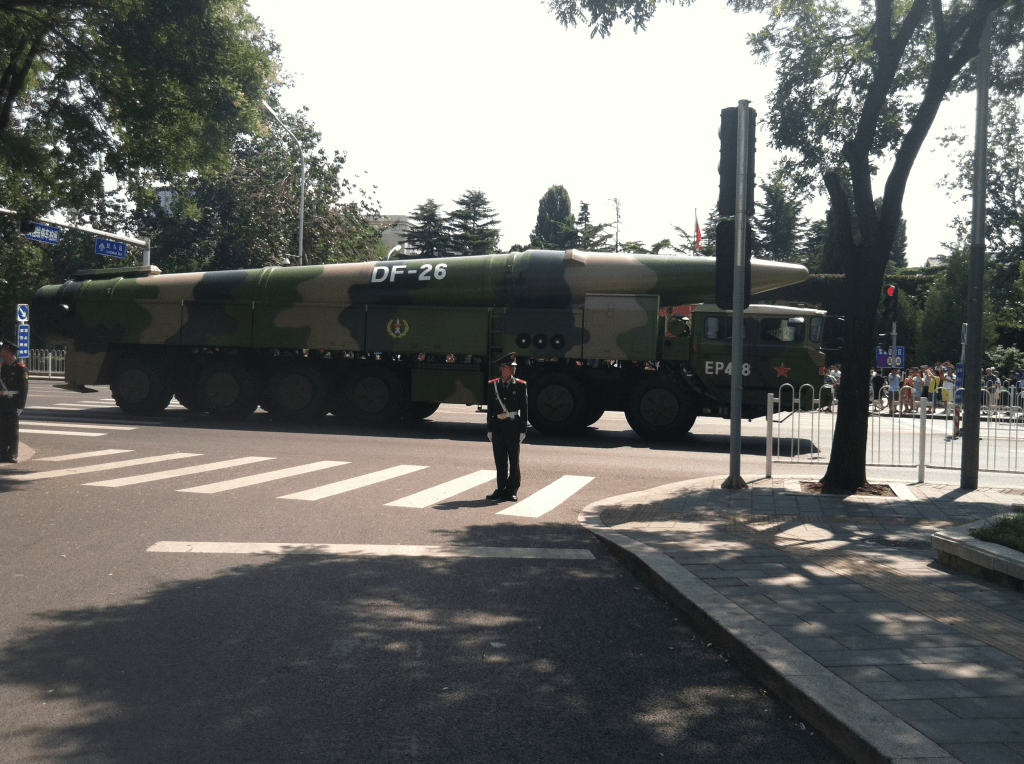
The PLARF is the primary tool for striking U.S. naval and air power in the first island chain. The DF-17 medium-range ballistic missile (MRBM) and its DF-ZF hypersonic glide vehicle complicate terminal-phase missile defense, while the DF-21D and DF-26 anti-ship ballistic missiles are designed specifically to hold U.S. carrier strike groups at risk as far out as the second island chain. PLARF exercises since 2024 have rehearsed integrated salvos combining ballistic, cruise, and hypersonic munitions across multiple targeting categories, a tactical pattern intended to saturate THAAD, Patriot, and Aegis BMD interceptors regardless of individual system capability. On the American side, limited stockpiles of TLAMs and SM-6s nullify the lethality of the Typhon Mid-Range Capability.
The Taiwan contingency is where these capabilities integrate. A blockade and a missile and cyber campaign against critical infrastructure may be combined to force Taiwanese capitulation without a landing or to open an attempted invasion and occupation of the island. Each element compounds pressure on a defense network of AShMs and coastal artillery sized to deny a crossing rather than to sustain attrition under severed resupply. A coordinated Taiwan operation would likely include simultaneous seizure of the Senkaku/Diaoyu Islands by PLA Navy and Marine Corps forces, both to force Japan to defend its own territory rather than support U.S. operations around Taiwan, and to establish forward air and sea exclusion zones that complicate U.S. force flow into Taiwan operations. The coercion threshold falls dramatically if the Kuomintang (KMT) party wins the January 2028 election under Cheng Li-wun, who has openly committed to inviting Xi Jinping to Taiwan and whose rhetoric on Chinese ethnic nationalism and skepticism of U.S. security ties signals willing accommodation rather than resistance. Internally, Taiwan’s defense posture is compromised by the KMT-led reduction of a special $40 billion defense stimulus to roughly $24.8 billion in May 2026, and it is uncertain whether the pro-independence Democratic Progressive Party will keep the presidency in the 2028 election. Taiwan’s vulnerabilities extend beyond conventional military balance. Roughly 98 percent of the island’s energy is imported, with LNG reserves covering only 11-12 days of normal consumption, and the agricultural sector is similarly blockade-exposed. The PLA’s amphibious and airborne assault on Taiwan would be supported by civilian ferries adapted for armored vehicle offloading in the event Taiwanese beaches are captured, and by over 200 J-6W drone-converted fighters at six airbases in Fujian and Guangdong, designed to saturate Taiwanese and allied air defenses and force defenders to expend expensive interceptors against expendable platforms. In October 2023, Russia agreed to equip an entire Chinese airborne battalion alongside training, technology transfer and a Russian-built maintenance hub in China. Per RUSI, the package is designed to enable Chinese airdrops of armored vehicles onto Taiwanese terrain to seize ports and airfields for following forces, with Dalnolyot parachute systems enabling preliminary special-forces infiltration into Taiwan, the Philippines, and other regional territories. Last November, China began sea trials of its new Sichuan Type 076 electromagnetic-catapult amphibious assault drone carrier, a critical capability for either a naval blockade or an amphibious invasion. Meanwhile, the Type 055 guided-missile cruiser has been regarded as one of the world’s most capable naval surface combatants, with hypersonic strike missile capability in its YJ-21 AShMs and a radar cross section designed for stealth, unlike our Arleigh Burke and Ticonderoga-class destroyers and cruisers, ships which trace their designs back to the 1980s.
China has achieved parity or superiority across several key dimensions militarily. Numerically, the PLA’s roughly 2 million active-duty personnel constitute the world’s largest standing military across all services, with a reserve force of roughly 500,000 and a militia structure scalable through the National Defense Mobilization System. The PLARF’s arsenal has reached roughly 3,500 missiles across the full range spectrum, albeit degraded by endemic corruption. The Royal United Services Institute projects 1,000 Chengdu J-20A/S stealth fighters in PLAAF service by 2030. Shipbuilding capacity dwarfs the U.S. industrial base, with commercial tonnage capacity roughly 230 times that of the U.S., and major naval combatant production outpacing American output by an approximate six-to-one ratio annually. China is also investing heavily in “intelligentizing” the PLA (AI-enabled targeting, networked unmanned systems, and the formation of the Integrated Command Platform) at scale despite its semiconductor fabrication disadvantage. The ICP is a digital joint-command coordination system augmented by increased robotic execution of commander-delegated orders.
However, significant Chinese disadvantages remain. The PLA has no combat experience since its 1979 loss against Vietnam, a gap that affects everything from joint operations to small-unit leadership. Indigenous semiconductor fabrication lags Western and Taiwanese capability. The top-down command structure inherited from Soviet doctrine constrains tactical flexibility, though the RAND Corporation warns that the PLA is experimenting with decentralized mission command in ways that may close this gap by the late 2020s. However, these weaknesses are insufficient to offset the operational advantages China would bring to a war over Taiwan.
In order to make the military more effective and reliable in preparation for the war, Xi has since 2023 conducted purges of PLA officers deemed corrupt and/or not in sync with the Chairman’s directives, specifically regarding force preparation on the 2027 timeline. This most notably includes former defense minister Li Shangfu and Vice Chairmen of the Central Military Commission He Weidong and Zhang Youxia. Vacant CMC and military positions will probably be filled by a younger, more hardline officer corps loyal to Xi. Defense industry executives and academicians have also been purged.
Iran
After the 12-Day War, Iran was rebuilding its forces with allied assistance to launch a far more devastating attack on Israel, USCENTCOM installations, and potentially America’s Arab partners. On December 28, 2025, President Masoud Pezeshkian presented a budget proposal to the Iranian Parliament’s budget oversight committee, which advocated for a whopping 62% tax increase to address debt and paying for ballistic missiles. This is even as the nation suffers from a 42.2% inflation rate and oil export revenues have decreased. Embracing self-reliance for kinetic firepower given proxy degradation, Tehran sought to be capable of firing 2,000 missiles, predominantly ballistic, in a single strike by the next war to overcome Iron Dome, Arrow 3, David’s Sling, and other air defenses.
Even if Iran decided not to close the Strait of Hormuz and attack the Gulf oil fields, the mere threat of doing so may have coerced the Arab states into not intervening, fearing the collapse of their economies. This planned attack was intended to sync with the greater global conflict, as evidenced by China’s supply of planetary mixers and the sodium perchlorate missile propellant precursor to grow Iran’s solid-fueled ballistic missile arsenal. Said arsenal was per the FDD once again on trajectory to number around 10,000 in 2028, comprising both liquid and solid-fueled missiles. Accompanying this was a production rate of roughly 34 transporter erector launchers per month, the stockpile increasing from ~200 to ~470 between June 2025 and March 2026.
As of April 2, 2026, roughly half of Tehran’s ballistic missile launchers were confirmed to still be operational after one month of U.S. and Israeli strikes, with most missiles and launchers merely buried. As a stopgap deterrent to Israeli strikes accounting for the country’s lack of nuclear weapons, Iran is developing ballistic missile-carriable chemical and biological payloads. In October 2025, then-Supreme Leader Ali Khamenei reportedly approved the designing of compact nuclear warheads, holding off on uranium-235 enrichment to 90% purity only to avoid provoking Israeli and American strikes. Russian assistance in laser technologies that enable nuclear warhead design validation without explosive testing shortens the post-enrichment warhead assembly timeline and reduces the political-risk window during which Tehran would be vulnerable to detection. However, there is still a gap between successfully testing a nuclear device and producing a credible stockpile of missile-deliverable warheads.
Iran’s air defense network was shattered during Operation Rising Lion in June 2025, with the Israeli Air Force eliminating roughly 120 transporter erector launchers, or about a third of the pre-war inventory, and effectively eliminating the four S-300PMU-2 battalions that had served as the country’s top air-defense tier. The indigenous Bavar-373 and Khordad-15 systems proved ineffective against the F-35’s stealth despite Tehran’s pre-war claims of S-400-equivalent capability. Reconstitution is now pursued along three tracks: indigenous Bavar-373 production with S-300 component cannibalization to recover lost capability, Chinese HQ-16 and HQ-17AE acquisitions in exchange for oil, which represent the largest Chinese air-defense transfer to Iran to date, and continuing pursuit of the Russian S-400, which Tehran reportedly field tested for the first time last July. To resist Israeli and American airpower, Tehran has been acquiring 48 Sukhoi Su-35 fighters from Russia, with the first two delivered in November 2024, and per the most recent reporting was in talks with China to obtain Chengdu J-10Cs. Per the Financial Times, Iran in December 2025 committed to buying 500 9K333 Verba MANPADS launchers and 2,500 9M336 missiles from Russia, to be delivered between 2027 and 2029.
Domestically, Iran has made heavy use of EW systems like the Russian Murmansk-BN and deep packet inspection architecture to jam Starlink, specifically during the January 2026 internet blackout. All of this said, there are caveats. There is no clear publicly available information on the status of advanced foreign equipment in light of Operation Epic Fury.
Our other adversaries view Iran as expendable even if Tehran provides oil to China and is a fellow autocratic partner, as indicated by Russia’s unwillingness to add a mutual defense clause to the Treaty on Comprehensive Strategy. Iran and its proxies have experienced a series of losses after the strategic blunder that was Hamas’ October 7, 2023 attack on Israel. Bashar al-Assad’s regime in Syria has fallen, Hezbollah’s leadership has been gutted by Mossad’s explosive pager operation and IDF airstrikes, and Fordow, Natanz, and Isfahan among other nuclear program targets were heavily damaged by American TLAMs and GBU-57 bunker busters. Even with the power of the IRGC’s patronage network and the volunteer Basij militia force, the Revolutionary regime is fragile given the socioeconomic status and cosmopolitan leanings of the Iranian citizenry, exemplified by mass protests in the wake of the killing of Mahsa Amini and during the inflation crisis of late 2025 and 2026.
Despite these setbacks, however, powering Iran’s military and security forces and stoking hostilities between the Israelis, Arabs, and Iranians and their proxies, and by necessity preserving Tehran’s regime, remains a strategic move the other players greatly benefit from, as a way of keeping a bulk of U.S. military force pinned down in the Central Command area of responsibility. Compounding this, as of mid-2026, Iran’s strategic position is improving. With further Israeli or American major offensive operations now less likely, Iran’s nuclear program has critical breathing room, while Tehran’s de facto control of the Strait of Hormuz, through which roughly 25 percent of global maritime traded oil and over 20 percent of global LNG trade transit, remains untouched, leaving Iran in a stronger strategic position than at any point since October 7.
For many years, Iran has supplied Hamas, the Houthis, Hezbollah, and the former Assad regime with missiles and weapons parts. This includes (usually through intermediaries such as the Assad regime supplied during the Syrian civil war) the Russian Kornet and North Korean F-7 anti-tank weapons, supersonic P-800 Oniks ramjet antiship weapon and other munitions, intelligence, and technical advice. Russian GRU advisors and Chang Guang Satellite Technology Company imagery helped the Houthis in striking vessels in the Red Sea, which coaxed the U.S. Navy into using Standard Missiles already in shortage for ensuring freedom of navigation. In the current war, Russian synthetic aperture radar satellites have provided GEOINT for Iranian strikes, while the BeiDou-3 satellite cluster reportedly guides Iranian weapons and Chinese satellite imagery distributor MizarVision has posted detailed analyses of U.S. and allied military positions on social media. The latter is Chinese intelligence assistance that operates through commercial entities, providing Beijing with the plausible deniability that is characteristic of its support for fellow U.S. adversaries.
Overall, using Iran and its proxies as a resource drain for the U.S. military has proven fruitful. During the 12-Day War, the U.S. used around 25% of its THAAD interceptors to defend Israel from Iranian missiles. On March 27, 2026, a Russian-enabled Iranian precision strike on Prince Sultan Air Base in Saudi Arabia destroyed an E-3 Sentry AWACS. Within the first 100 hours of Epic Fury, roughly 2,000 munitions were used, a number of which were precision guided weapons that are costly and time-consuming to build. For example, the stealthy Joint Air-to-Surface Standoff Missile (JASSM), of which over 1,000 of the Extended Range variant were used in the first four weeks of the 2026 Iran war, usually takes around 48 months to build and deliver.
The post-Khamenei regime architecture is built around IRGC dominance rather than clerical authority. Following Ali Khamenei’s assassination on February 28, 2026 and the killing of IRGC commander Mohammad Pakpour the same day, the IRGC orchestrated the rapid Assembly of Experts election of Mojtaba Khamenei on March 8. Unlike his father, Mojtaba’s power derives from the IRGC, the Basij, and the security apparatus rather than from independent religious legitimacy. Brigadier General Ahmad Vahidi, founding commander of the Quds Force and current IRGC commander-in-chief, now operates at the center of a collective leadership less susceptible to decapitation than the previous single-leader system. The regime’s survival hinges on the IRGC’s patronage network and the violence the security apparatus can inflict on dissenters, as seen with the slaughter of over 30,000 protestors in January 2026 with automatic rifles and, allegedly, chemical agents.
North Korea
North Korea has formally abandoned peaceful reunification efforts with the South, regularly calling the ROK “the most hostile state” and its “principal enemy,” and explicitly rejecting any framework of inter-Korean kinship or ethnic homogeneity. This domestically portrays South Koreans as a hostile and alien people, weakening South Korean cultural contagion that threatens regime stability through aspirational comparison, and by extension preventing unification by absorption under Seoul. The doctrinal shift also addresses the impracticality of DPRK administrative absorption of millions of South Koreans, whose democratic political consciousness and economic sophistication would render integration impossible for the foreseeable future. By reframing South Koreans as a hostile foreign enemy rather than co-nationals awaiting reunification, the doctrine enables territorial seizure without the obligation to absorb and integrate a population whose incorporation would itself endanger the regime.
The institutional groundwork for the hostile two states policy was laid as early as 2022 with the quiet elimination of the foreign ministry’s Fatherland Reunification Bureau. The shift was formally declared in January 2024 and culminated with the March 2026 constitutional revision, which refrains from overtly hostile language toward the ROK but deliberately leaves both the land and maritime borders undefined, preserving operational latitude for naval confrontation along the Northern Limit Line (NLL) and territorial operations across the Military Demarcation Line (MDL). Even before this doctrinal shift, an August 2023 Navy Day speech urged “preparations for a revolutionary war for accomplishing national reunification,” while a later speech per state media called for “strategic cooperation with the anti-imperialist independent countries.” Since June 2024, the DPRK has systematically fortified its side of the Demilitarized Zone (DMZ) with anti-tank barriers, reinforced roads, additional walls, and large-scale landmine deployment, as specialized engineering units from the Seventh and Eighth General Bureaus have been dispatched to accelerate construction.
The “principal enemy” doctrine is being implemented through ongoing political and information warfare against the South. The Reconnaissance Information General Bureau was reorganized from the Reconnaissance General Bureau in 2025 to fuse geospatial, cyber, signals, and human intelligence under a single command. It directs cyber operations against ROK financial, defense, and political infrastructure through groups including Lazarus, Kimsuky, and Andariel, which have infiltrated dozens of South Korean defense companies and in one series of attacks stolen 1.2 terabytes of data, including information on anti-aircraft weapons. The same units have conducted cryptocurrency theft valued in billions of dollars that funds Korean People’s Army (KPA) modernization. Pyongyang has also worked to exploit South Korean domestic political fissures, cultivating contacts in South Korean left-wing political circles to amplify anti-American narratives and splinter Seoul’s consensus on national security matters.
Kim may seek to invade South Korea with allied backing, using his increasingly diverse arsenal of nuclear warheads and delivery systems to deter ROK and U.S. counteroffensive and decapitation maneuvers under the Combined Forces Command’s OPLAN 5022. He may be interested in capturing the Northwest Islands in the Yellow Sea and pushing to the Han River on land, seizing political and industrial targets throughout the Seoul-Incheon-Gyeonggi metropolitan area, supported by mass sabotage in the South’s rear. Missile strikes and penetration south of the Han River to destroy key sites in the Gyeonggi semiconductor mega-cluster centered on Yongin, Pyeongtaek, and Hwaseong would deepen strategic gain by denying the ROK economy its industrial crown jewel. The strategic objective would be to create a fait accompli and force maximalist, perhaps vassalizing demands upon the South in peace negotiations, such as financial reparations or a limit on U.S. forces on the peninsula. This must be done while withstanding and defeating the ROK Strategic Command’s Three-Axis system (Kill Chain, Korea Air and Missile Defense, and Korea Massive Punishment and Retaliation) of military capabilities. In this scenario, Kim’s desired end-state is the de facto domination of the Korean Peninsula.
Beijing in May 2022 vetoed new UNSC sanctions in response to a launch of the Hwasong-17 intercontinental ballistic missile (ICBM) that March, and abstained in 2024 when Russia vetoed an extension of the UN Panel of Experts that monitored the enforcement of UN sanctions on the DPRK. Ships transport North Korean coal and iron ore to Chinese ports in violation of UN sanctions, and Chinese front companies hide North Korean cyberthieves harvesting funds for the Korean People’s Army from Western technology companies. As of December 2025, a manufacturer in Jiangsu province is reportedly producing drone assembly lines for export to the DPRK, while the Shenyang Machine Tool Company supplies CNC machines. This UNSC sanctions-busting commerce is not possible without state approval, and the supply of machinery and raw materials is essential for North Korea’s 20×10 macroeconomic development initiative. Most importantly, Beijing has not explicitly affirmed its support for denuclearization of the Korean Peninsula since July 2023, and in November 2025 omitted the term from its arms-control white paper for the first time since 2005.
Meanwhile, Russia has less incentive to keep its collaboration subtle. Per U.S. intelligence, it was Kim’s idea, not Putin’s, for North Korea to support Russian operations in and around Ukraine with troops. Pyongyang has supplied rockets and millions of artillery shells to lessen Russian ammunition expenditure by up to half while Moscow stockpiles for the wider war. The sale of old munitions from the 1970s and 80s has been accompanied by increased domestic production of newer, more reliable rounds, which North Korean state media in May 2025 claimed was four times its annual average. As of January 2026, Korean People’s Army personnel act as drone spotters for Russian artillery crews, and the KPA’s Storm Corps saw frontline combat in Kursk in the winter of 2025. Concurrently, tens of thousands of workers have been slated to toil in Russian drone factories in the Alabuga Special Economic Zone, facilities which are the epicenter of the Axis’ drone innovation per the ISW.
The North Koreans are making many gains from the sale of weapons and troop deployments and reciprocal Russian assistance: as much as $14.4 billion in revenue, equipment design solutions ranging from a likely modified Admiral Grigorovich-class frigate hull to an ICBM first stage of similar dimensions to that of the RS-24 Yars, crude oil, combat testing of ballistic missiles, hands-on production training on Shahed UAVs for localization, food, and modern high-intensity warfare lessons now being written into KPA doctrine. With allied help, North Korea hopes to create a modern drone-augmented force that can offset the Kill Chain and KAMD, plus the South’s superiority in mechanized forces. This is supported by the DPRK’s cybertheft of foreign companies for funds and intellectual property, and complements Pyongyang’s already massive volume of shell artillery, rockets, and quick-to-launch solid-fueled missiles. Modernized 240mm rocket artillery trucks fitted with an automatic fire-control system and guided rockets, augmented by new 60-kilometer-range 155mm self-propelled guns reportedly slated for deployment per KCNA to three border battalions by late 2026, give the KPA a terrain-mobile guided strike capability that complements the legacy Hardened Artillery Sites (HARTS), while compensating for their exposure to the thermal-penetrating KTSSM missile. Combined with the planned construction of Shahed-family attack UAVs, these modernized systems also keep credible North Korea’s conventional strike threat to Seoul.
Pyongyang has the world’s largest network of underground military facilities and factories, providing the leadership, industry, and armed forces with strategic depth and substantial protection against the ROK’s nine-ton warhead Hyunmoo-V IRBM, and other bunker busters in the broader KMPR arsenal. A massive cannon-fodder manpower pool of over a million conscripts, conditioned through propaganda and fear of shame and punishment to die for the Supreme Commander, as indicated in Kursk, also bolsters its strength. The 20×10 factory initiative may actually be intended as institutional preparation for war rather than ordinary economic development. By turning counties into self-sufficient dual-use light manufacturing and food reserve nodes, the program creates a dispersed wartime logistics network resistant to ROK precision strike under KMPR. This complements the expansion of specialized heavy industry facilities like the Hwanghae Iron and Steel Complex and February 11 Plant where Hwasong-11 SRBMs are produced. This industrial development is made possible by surging Chinese supply of raw materials and machinery, particularly after the September 2025 Beijing Victory Day military parade.
The gradual deployment of new technology with outside assistance further enhances capabilities, such as Pantsir-S1 SHORADS, Garpiya and Shahed-136/Geran-2 UAVs, second-hand MiG-29 and Su-27 fourth-generation fighters, reconnaissance satellites, AI-targeting, hypersonic glide vehicles, nuclear submarine propulsion likely from OK-650 pressurized-water reactors, and fiber optic top-attack ATGMs like the Bulsae-4. Pyongyang’s forces have trained in battle with night vision and modern equipment, such as the AK-12 assault rifle and Vepr-12 semi-automatic shotgun for anti-drone use. The DPRK is also mimicking proven Western kit, with the Saetbyol-9 UAV borrowing the airframe of the General Atomics MQ-9 Reaper. The KN-25 600mm GMLRS, which is nuclear-capable, is set to become the core of the nation’s land attack capabilities. Pyongyang holds an extensive chemical weapon stockpile comprising up to around 5,000 tons including the sarin and VX nerve agents. The DPRK drone and missile arsenal, advancing with SRBMs like the Russia-upgraded Hwasong-11A and KN-25 plus future Shahed-family UAVs, is increasingly capable of overcoming KAMD and can range all of South Korea. Without U.S. SM-3 interceptors, the ROK’s Sejong the Great-class Aegis BMD destroyers currently cannot intercept ballistic missiles beyond 20 kilometers. The same DPRK arsenal also threatens the ROK’s Kill Chain, which centers on detecting and destroying DPRK missiles before launch. Kill Chain was designed around liquid-fueled missiles whose fueling sequences took hours and produced detectable signatures. Solid-fueled SRBMs require no visible fueling preparation, can emerge from concealed positions and fire within minutes, and disperse before counterstrike. This defeats the ISR capabilities Kill Chain depends on for target identification.
At scale, the KPA constitutes a formidable conventional and asymmetric threat regardless of qualitative deficiencies in areas such as its air force. Active-duty personnel exceed 1.2 million, the world’s fourth-largest standing military, with a reserve and paramilitary structure bringing total mobilizable manpower to around six million. Pyongyang holds an estimated 50 nuclear warheads with fissile material for up to 90, with delivery systems ranging from KN-23/24/25 SRBMs to the Hwasong-18 solid-fuel ICBM. The Korean People’s Army Strategic Force operates over 360 ballistic missiles, with more than 17 ICBM transporter-erector-launchers. Conventional artillery exceeds 14,000 systems including an estimated 8,600 tube artillery pieces and 5,500 multiple rocket launchers, with thousands of systems forward-positioned in the HARTS in the mountains north of the DMZ.
With these factors in mind, the South would face devastation from a full-scale war regardless of the outcome, its Kill Chain and KAMD capabilities contending with offensive systems they were not designed to counter. The United States’ wartime operational control of the ROK/U.S. CFC and by extension the Republic of Korea Armed Forces may paralyze the South’s response to a Northern invasion given American activity elsewhere. Conversely, a CFC commanded by a South Korean officer may be restrained if the ROK’s political leadership is deterred from some actions by Northern nuclear saber rattling. The opening of a Korean front will be of critical use to China in the Asia-Pacific theater, pinning down U.S. Forces Korea and ROK military assets that under the strategic flexibility framework USFK Commander General Xavier Brunson invoked in December 2025 would otherwise be available in part for a first island chain conflict. Brunson has described South Korea as a “dagger in the heart of Asia” from Beijing’s perspective. DPRK nuclear weapons are intended to preserve the regime against allied counteroffensive, ensuring the Korean front remains a sustained pinning operation rather than an alliance victory. This also supersedes the peacetime concerns of peninsular stability and keeping U.S. forces away from China’s borders. On the other hand, while the DPRK can open the war and range every USFK installation on the peninsula on its own, it cannot sustain a prolonged campaign against the Greater Seoul Metropolitan Area without the Chinese economic base that fuels and supplies it. Even with the induction of reconnaissance UAVs into KPA service and the fielding of reconnaissance satellites with Russian help, Pyongyang would by necessity be heavily reliant on Beijing and Moscow’s wide array of space-based capabilities in any conflict.
Pakistan
China’s answer to limiting Indian strategic relevance to a Pacific war lies in the Pakistan Armed Forces, who have viewed India as their pacing rival since partition and become a strategic partner of China for that reason. Since the 2016 skirmishes at the Kashmir Line of Control, the military has turned to road-mobile fission warhead ballistic missiles to restrain the conventionally superior Indian Armed Forces. With Chinese military and surveillance equipment and intelligence support, the former comprising 81% of Pakistani weapon imports between 2020 and 2024, the Pakistan Armed Forces under hardliner Asim Munir may hope to deliver a knockout blow in the event of war that will deal India considerable damage and enable them and proxy militant cells to take Jammu and Kashmir, which under the war framework China could have dangled as a carrot. A counteroffensive into Pakistani territory by the Indian army commands may be deterred by the specter of Pakistan’s fission-warhead arsenal. While the arsenal predominantly consists of land-launched ballistic missiles, the Babur-III submarine-launched cruise missile has been in testing since 2017 and is likely compatible with the new Hangor-class attack submarine. Continuing, U.S. officials have accused Pakistan of, with Chinese suppliers, developing larger rocket motors that can support ICBMs capable of hitting the continental United States. Islamabad’s accusations of India supporting the Baloch Liberation Army shows it views its security affairs as interconnected issues. A conflict may also strengthen their political power internally, a goal made more urgent in light of the visible cracks formed by the political revolt of former Prime Minister Imran Khan.
Reliance on Chinese weaponry and satellite intelligence (per Indian Deputy Chief of the Army Staff Rahul Singh) so far seems to be credible in light of the reportedly successful performance of the PL-15 air-to-air missile and J-10C’s EW capabilities against French-made Indian Dassault Rafale and Mirage 2000 fighter aircraft in May 2025, and Beijing reportedly offered fifth-generation Shenyang J-35 fighters and HQ-19 ABM batteries to Islamabad following the 2025 war with India. Capitalizing on his surge in popularity after Operation Sindoor, Munir has rammed through a constitutional amendment to designate himself Chief of Defense Forces and make the military chain of command subordinate only to him, with a new Federal Constitutional Court handpicked by the figurehead civilian leadership. Whether he intends to use this increased political power to ensure personal control of any attack on India concurrent with the global war is not clear at this time.
India has a major vulnerability in its reliance on Russian weaponry, such as the S-400 air defense system, as well as its reliance on Russia for crude oil. Moscow accounted for as much as 40% of New Delhi’s crude imports in 2024. China can have Russia cut off the supply of all fossil fuels to India at any moment. On the other hand, it may develop Pakistan’s offshore hydrocarbon facilities, which among the littorals off Karachi and Gwadar could be protected via anti-access/area-denial by Hangor-class air-independent propulsion attack submarines against Indian naval forces, including the Kalvari-class submarine. Russia likely intends for India to increase discounted crude oil purchases, and therefore reliance on them rather than the Middle East for nonrenewables, to increase the potency of a refined oil shock concurrent with a Pakistani attack, while using them to evade sanctions, procure explosive materials, and generate war economy profits in the short term. Out of a desire to diplomatically retaliate against U.S. sanctions and tariffs over its purchases of Russian crude oil, as well as its desire to hedge against a Pakistan-supporting China, India may be manipulated into inking new Russian weapon contracts which will never yield equipment given the cost and non-Russian parts needed for said systems. Russia can stall Indian procurement of its advanced weaponry as well as sabotage or cut technical support, joint production agreements bureaucratically preventing India from switching to other countries’ kit.
With the U.S. viewing India as a potential tool for attacking China from the south and blockading the Strait of Malacca, Beijing views the Pakistan Armed Forces as a long-term strategic asset against India augmented by improving ties with Bangladesh since 2024. Pakistan could also divert Indian focus and joint military forces to the west in the event of a war between Beijing and India. Most importantly, the destruction Pakistan may bring to bear on India combined with an oil shock can also negate the latter’s potential as a great power rival to China in the years ahead. Pakistan’s naval forces may also menace U.S. and Australian forces in the Indian Ocean. Of note, as of February 2026, India is seemingly cutting back its oil purchases in light of a supposed trade deal with the U.S. The March 2026 disruption of trade through the Strait of Hormuz may reverse this, however.
This analysis does not suggest that China seeks a conflict in Kashmir or along the Line of Actual Control during an Indo-Pacific conflict. An India-Pakistan war over Kashmir would endanger the China-Pakistan Economic Corridor, which runs through the Pakistan-administered Kashmir region of Gilgit-Baltistan. However, the credible threat of an India-Pakistan war, combined with Russian leverage over Indian oil and weapons supplies, is sufficient to keep Indian military force tied down in the west and Indian political leadership reluctant to commit to a Pacific alignment that would invite Pakistani escalation. Because of India’s role as a strategic regional rival to China, it is in Beijing’s interest to cultivate Pakistani capabilities, both for the near-term contingency and the long term.
Malacca and the alternative Sunda Strait are China’s greatest geographic strategic problem. Beijing imports roughly 80 percent of its oil through the Strait of Malacca and has worked to manage this vulnerability since Hu Jintao formalized the “Malacca Dilemma” concept in 2003. A core priority is keeping Indonesia, Malaysia, and Singapore sufficiently neutral, making an effective U.S.-led blockade politically impossible. Indonesia under Prabowo Subianto has pursued strategic ambiguity, resuming bilateral military exercises with China after a nine-year suspension and conducting the Heping Garuda joint humanitarian and disaster-response exercise in December 2024, while continuing to absorb Chinese infrastructure investment that creates economic dependence. Malaysia and Singapore are constrained by their Chinese diasporas, their dependence on Chinese trade, and the recognition that taking sides in a U.S.-China conflict would invite catastrophic economic retaliation. Indonesia does not necessarily need to side with China for the Malacca Dilemma to be partially solved. Non-cooperation with U.S. blockade enforcement is sufficient.
Synthesis
To emphasize, adversarial attacks will broadly occur at the same time around the world. The effort must be coordinated to succeed; dilution of American force is the central strategy at play. Our military forces will be stretched so much that we will be incapable of focusing on any one theater of combat. What makes this coordination structurally durable rather than incidentally aligned is that each adversary’s preparation depends on at least one other’s contribution. China supplies the microelectronics, machine tools and dual-use components that sustain Russian munitions production; Russia supplies the satellite reconnaissance, electronic warfare systems and propulsion technology that have transformed Iranian and North Korean capabilities; the DPRK supplies the artillery shells that have allowed Russia to conserve and grow its own stock for NATO; Iran supplied the drone designs that Russia has localized and that Pyongyang is now building; and Chinese financial institutions keep the entire system funded under sanctions. Contrary to most Western commentary, the adversary coalition is not a brittle network of purely transactional partnerships. Instead, it is an interlocking industrial and financial system in which each member has structural reasons to sustain the others.
Of course, no plan survives the initiation of combat, and our regional allies will not crack immediately. However, the U.S.’s adversaries anticipate this and will use their superior industrial base, alongside the political and societal will to expend copious levels of blood and treasure, to nullify mistakes, setbacks, or inferior quality of training, logistics, discipline, and technological sophistication among their forces. With respect to the skill and technical capabilities of the U.S. and allied armed forces, even we will find it hard-pressed for our attacks to not be absorbed. Per Congress’ 2024 Report on the Commission of the National Defense Strategy, the U.S. military would “largely exhaust its munitions inventories in as little as three or four weeks” in a war only with China. Russia alone seeks to produce enough Shahed-family drones to use 1,000 a day in combat by the end of 2026. The dilution strategy will operate faster than the United States can replace what it loses. American capability, whether through Replicator, Silicon Valley innovation, or marginal procurement increases, cannot be added fast enough to offset the rate at which our adversaries are positioned to consume it. Increased defense spending alone cannot change the military balance in our favor on the relevant timeline, for the U.S. defense industrial complex lacks the human capital and infrastructure capacity to instantly absorb more money. A Third World War will be defined by the asymmetry between an industrial-base coalition built for prolonged attritional war and an American force posture built for short, decisive, technologically dominant operations.
Conclusion
In March 2022, Sergei Lavrov, the Russian foreign minister, spoke of the greater invasion of Ukraine at the Moscow State Institute for International Relations. Very early on in the speech was a quote that, while spoken in a monologue more broadly parroting Russian narratives, was in this case quite transparent. In Lavrov’s words, “The current developments in the world are not so much about Ukraine as about attempts to shape a new international order.”
The expectations powering the rules-based international order have become meaningless. As our President risks splintering U.S. alliances over the Iran war and his desire to dominate the Western Hemisphere as a strongman, our autocratic adversaries are ever more unified and brazen in their warfare against us and our allies, and many political entities around the world seek to overcome outside expectations on their conduct.
No single foe or group of them has ever before had the capability to strike the American homeland without nuclear-armed ICBMs. They are a collective that cannot be defeated purely through any number of sanctions, tariffs, or trade route interdictions, for their economies have strength of coordination and coercing a change in their behavior is impossible under feasible Western pressure. Their only meaningful economic vulnerability is China’s maritime energy dependency through the Malacca Strait, which Beijing is racing to mitigate through Russian pipeline imports and central Asia diversification and which the United States will militarily exhaust itself before it can capitalize on.
Our adversaries cannot be militarily countered entirely through piecemeal defense initiatives, for they, powered by the Chinese industrial titan, have the sheer mass of arms both cheap and sophisticated plus the manpower and research and development base to overcome any tactical obstacles. Nor are they a foe that can be split apart in mistrust; they have worked to lull us into a sense that we could do so.
Without evoking a Manichean good vs. evil worldview, the leaders of these countries and their compatriots are wicked men who subjugate and steal from others, whether Ukrainian, Uyghur, Russian, Iranian, or anyone else. Their collective goals are to destroy all threats to their power, internal and external, and carve up the world amongst themselves and their countries, and they have no qualms about killing untold numbers of men, women, and children in order to achieve their aims.
And worst of all? They’re winning.
Categories: Foreign Affairs


