
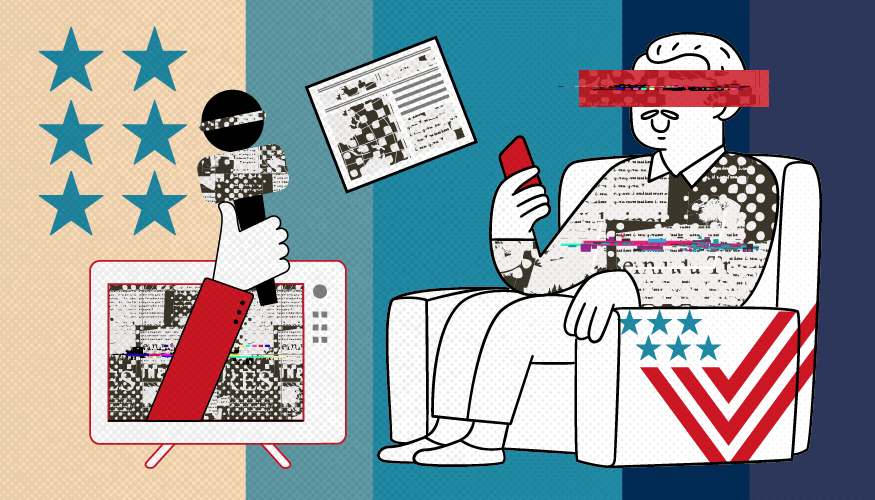
Once, diplomats, strategists, and officials trained to think in terms of long-term national interest shaped American foreign policy. These policymakers relied on historical precedent, intelligence assessments, and an understanding that international politics rarely offers clear or immediate answers. Today, that dynamic is changing. Viral narratives, public pressure, and real-time reactions increasingly influence foreign policy, often far from the institutions designed to manage global affairs. The shift is gradual, but its consequences are profound. Experts no longer guide foreign policy as decisively as they once did; increasingly, people who do not study international affairs shape the conversation around it.
This transformation is not simply the result of increased public engagement. Democratic societies have always relied on some level of public input to legitimize foreign policy decisions. The difference today lies in the speed, scale, and structure of that engagement. Social media platforms compress complex geopolitical realities into digestible, emotionally charged fragments. Conflicts involving decades of history, layered strategic interests, and competing narratives are reduced to simplified moral binaries. During the early months of the war in Ukraine, for example, online discourse often framed the conflict in absolute terms of good versus evil, leaving little room for discussion of escalation risks, nuclear signaling, or long-term strategic trade-offs. In this environment, the loudest interpretation often becomes the most powerful, regardless of its accuracy.
The problem is not that people care about foreign policy. The problem is how they are encouraged to understand it. Online discourse rewards immediacy over reflection, certainty over nuance, and outrage over analysis. A carefully constructed argument grounded in history and strategic logic struggles to compete with a thirty-second video that presents a conflict as obvious and one-sided. The result is a public conversation that feels informed but is, in reality, often deeply incomplete. This dynamic was also evident during the U.S. withdrawal from Afghanistan, when viral clips and commentary cycles reduced a twenty-year conflict and its strategic failures into singular moments of chaos, obscuring the deeper policy decisions that produced that outcome.
This growing gap between perception and reality places significant pressure on policymakers. Foreign policy experts are trained to think probabilistically. They weigh risks, consider second- and third-order consequences, and recognize that even the best decisions often involve trade-offs. Public discourse, by contrast, tends to demand clarity where none exists. It expects definitive answers to inherently uncertain problems. When policymakers attempt to communicate complexity, they risk appearing indecisive. When they simplify, they risk distorting reality. As a result, the incentive to simplify has never been stronger.
Political leaders are not immune to these pressures. In fact, they are directly shaped by them. Elected officials operate within a system that rewards responsiveness to public sentiment, even when that sentiment is volatile or misinformed. Foreign policy decisions that once unfolded over months of deliberation now must compete with the pace of the news cycle. Leaders must consider not only the strategic implications of their actions but also how those actions will be perceived, framed, and reacted to in real time. This dynamic was visible in debates over U.S. support for Israel following the October 7, 2023, attacks, where online mobilization, public demonstrations, and viral accounts rapidly influenced policy discussions despite often presenting incomplete or conflicting information.
This dynamic introduces a dangerous shift from strategy to reaction. Instead of shaping public understanding, policymakers often find themselves responding to it. Instead of setting long-term objectives, they adjust to short-term pressures. This pattern becomes especially evident during crises, when the demand for immediate clarity is highest and the margin for error is smallest. In these moments, oversimplified or uninformed narratives exert their greatest influence.
The implications extend beyond domestic political dynamics. Foreign policy does not operate in a vacuum. Allies and adversaries constantly observe not only what the United States does but also how and why it acts. When policymakers project inconsistency or reactiveness, they raise questions about American reliability and resolve. Allies may begin to doubt whether commitments will hold under pressure. Adversaries may interpret hesitation or inconsistency as opportunity. Russia’s calculus in Ukraine and China’s messaging regarding Taiwan both reflect careful attention to perceived Western unity and consistency.
Credibility, once lost, is difficult to restore. Deterrence relies not only on military capability but also on the belief that nations will uphold their commitments regardless of short-term fluctuations in public opinion. When policymakers allow those fluctuations to shape foreign policy too closely, they introduce uncertainty into relationships that depend on stability. Strategic ambiguity can serve a purpose when leaders employ it intentionally; however, it becomes dangerous when internal inconsistency produces it.
There is also a deeper structural concern. Experts continue to participate in foreign policy decision-making, but their influence is increasingly diluted. In an environment where many people treat all perspectives as equally valid, maintaining a distinction between informed analysis and uninformed opinion becomes more difficult. The democratization of information has not necessarily produced a democratization of understanding.
This erosion of expertise does not occur all at once. It develops gradually through small shifts in how people consume information, frame debates, and justify decisions. Over time, the cumulative effect becomes significant. Policymakers produce less coherent, less consistent, and less strategically grounded policies. External narratives and internal political pressures exert greater influence than long-term national interests.
None of this suggests that foreign policy should be removed from public discourse. Public accountability remains essential in a democratic system. The challenge is not participation itself but the conditions under which participation occurs. A healthy foreign policy debate requires more than engagement. It requires a shared commitment to accuracy, context, and intellectual seriousness. Without those foundations, participation becomes vulnerable to distortion.
Reasserting the role of expertise does not mean silencing public voices. It means recognizing that some issues demand deeper knowledge and sustained study. It means valuing analysis that acknowledges complexity rather than avoiding it. It also means accepting that the most responsible answers are often the least satisfying because they resist easy conclusions.
The United States has long benefited from a foreign policy establishment capable of thinking beyond immediate pressures. That capacity is now under strain. When policymakers allow reaction to replace reflection, the quality of their decisions inevitably declines. Over time, this trend affects not only individual policies but also the coherence of American strategy itself.
Great powers are not weakened only by external threats. They are weakened when they lose the ability to think clearly about their role in the world. If people who do not study foreign policy continue to shape it more than those who do, the United States risks more than policy mistakes. It risks losing the strategic discipline that has long defined its global leadership.
Categories: Foreign Affairs


