
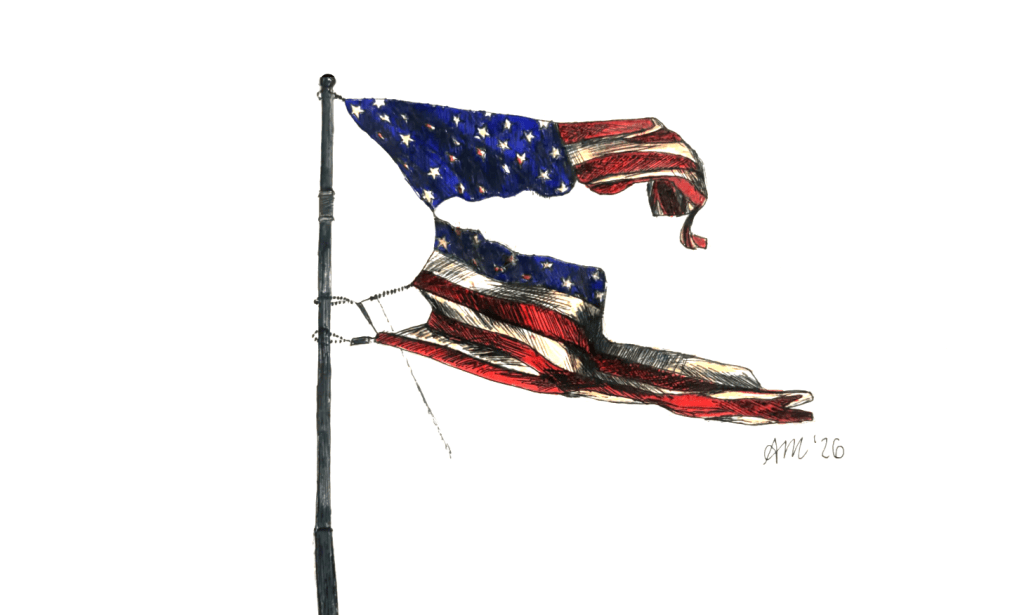
On July 4, 2026, in Washington, D.C., the 250th anniversary of the United States underwhelmed the nation. The Great American State Fair, consisting of rows of shoddy white tents, looked more like a petting zoo than a celebration of Independence Day. A handful of states sent volunteers to stamp visitor books and set up cardboard props. Paltry crowds at the state fair, baking underneath the 104ºF sun, sweat through their custom 250th polyester T-shirts with AI-generated images of stars, stripes, and bald eagles. The pathetic “Triumphal Arch” was taped over with obviously printed-out designs, and resembled something out of an unrendered video game. In sum, the whole thing looked like it ran on a budget of $30.
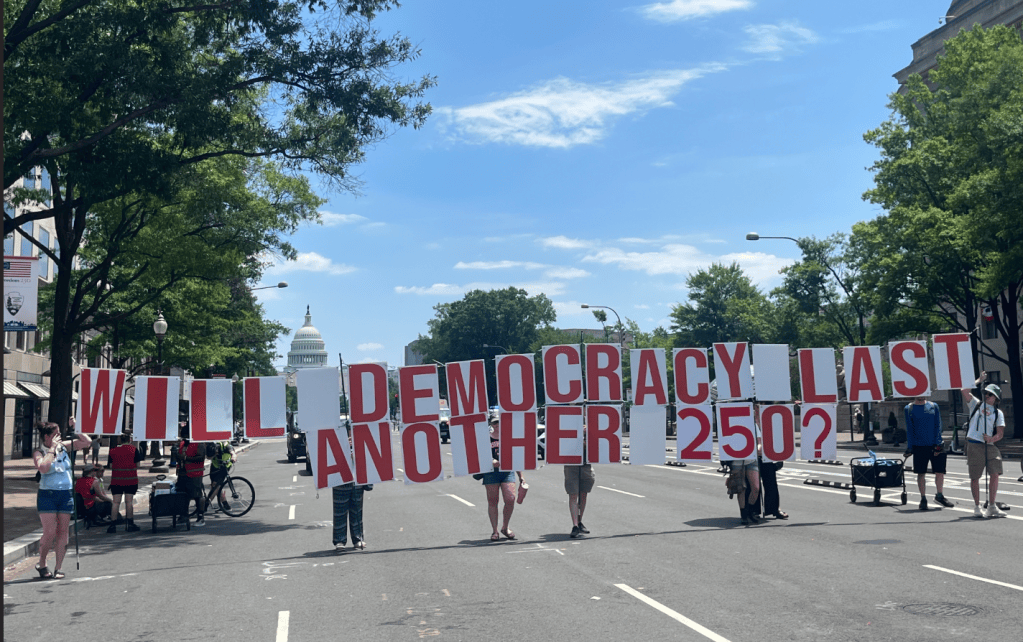
In the weeks leading up to America 250, Donald Trump’s face glowered across giant banners on federal buildings. Protesters around the National Mall paraded a 400-foot Constitution and held signs asking, “WILL DEMOCRACY LAST ANOTHER 250?” Humidity in D.C. thickened the uneasy feeling that something drastic and unprecedented could happen at any moment. Given the string of politically-motivated violence, I worried that I would become witness to the moment that tore our nation apart.
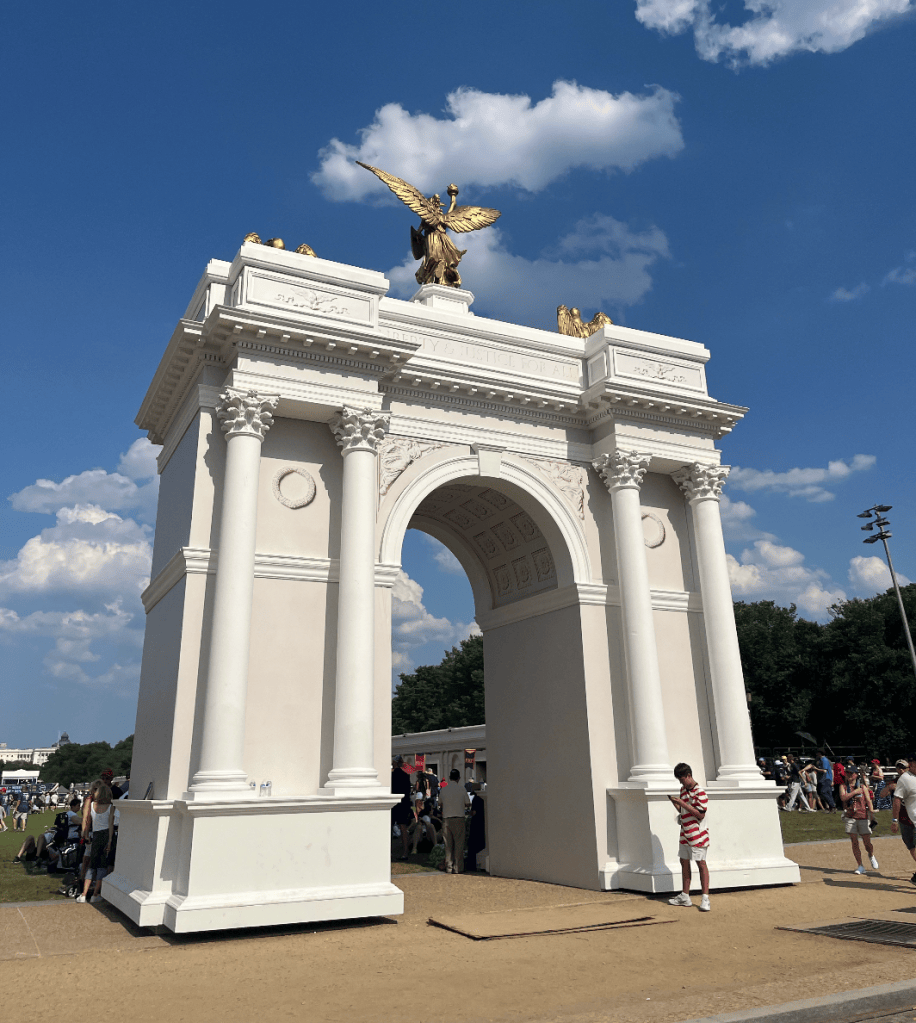
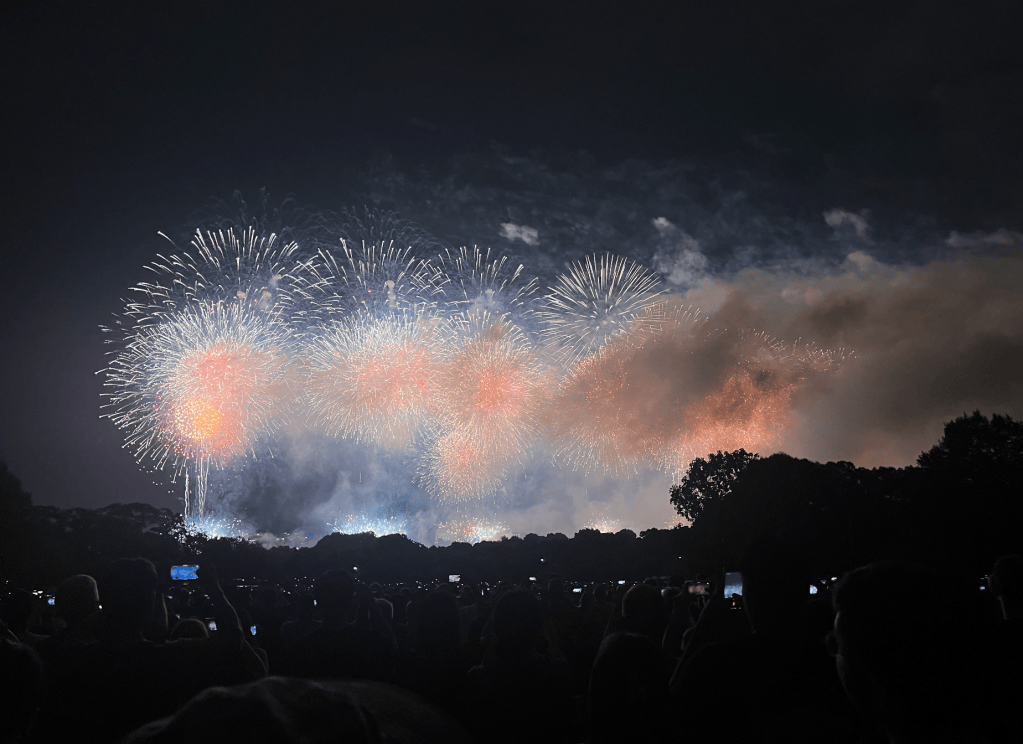
Walking around the nation’s capital forced me to wrestle with what it meant to be American. I wanted to feel patriotic, but not in that way. It boiled down to a convoluted mix of shame and hope—shame at inheriting a country with a violent and exploitative history, hope for that same country to protect liberty, responsibly wield power, and exercise restraint. I processed all of these emotions knowing that the primary audience for America 250 was the White Man. When they said “Happy Independence Day,” they were not talking to me. With MAGA posters covering up stone-inscribed quotes about freedom, justice, and equality, the irony speaks for itself. Even the record-setting fireworks show choked in its own smog. It’s on brand for this administration, which has, since day one, tried to obscure its fraud, abuse, and corruption with smoke and mirrors.
One New York Times reader lamented more poetically than I could:
And so, instead of a collective tribute to all we cherish and strive for, we get a human cage fight on the South Lawn of the White House. A vanity rally on the National Mall. The East Wing in rubble, the Kennedy Center in a tarp and algae creeping across the face of a Reflecting Pool that mirrors only the corruption and ineptitude of a failed and fraudulent presidency rent by reckless and useless war.
— Bob Deans
Bethesda, MD
In his July 4th speech, Trump boasted about the United States as “the hope, the promise, the light, and the glory among all of the nations of the world.” There might have been a time when Americans genuinely believed such grandstanding, especially during the rebuilding of Europe after WWII and creation of international organizations that required the U.S. to lead in good faith. Today, however, such statements ring painfully hollow and hypocritical given the U.S.’s repeatedly reckless, volatile, and violent behavior. Other countries, even long-standing American allies, have stopped listening. The United States derives its power from other countries’ belief that our leadership and proclaimed commitment to liberal values will protect a stable and predictable international order. As faith in American leadership erodes, so does its power.
Early this year, Canadian Prime Minister Mark Carney delivered a revolutionary speech at the World Economic Forum in Davos, Switzerland. After declaring the end of the liberal international world order, Carney stated that “The system’s power comes not from its truth, but from everyone’s willingness to perform as if it were true.” The illusion of American greatness is not only dissolving among countries. Even fervent MAGA supporters are starting to hesitate about the direction this country is headed, as support for Trump among self-identified MAGA Republicans dropped nine percent within this year.
Trump dedicated a major portion of his speech on the 4th to the sacrifice of military servicemen. One by one, old wrinkled veterans walked (or were wheeled) onstage to salute the American flags flown on the battlefields of World War II, Vietnam, and Korea. And though I respected the real sacrifices of the veterans and gold star families, I felt unnerved by Trump’s use of veterans for a patriotic spectacle, as PR fodder for his administration. I felt like I was sitting in the audience of a late-night talk show, watching the “Applause” sign light up. In a crowd of people unthinkingly clapping, stillness puts a spotlight on you. Don’t forget that Trump cut nearly 28,000 Veterans Affairs nurses, psychologists, and social workers in 2025, leaving 1.2 million veterans without their VA medical provider. And in response to reports about severe mental health concerns for USS Lincoln sailors deployed for almost nine months in the Strait of Hormuz, Trump said the deployment was “not nearly long enough.” How can I clap for their sacrifices, when clapping feels like I am excusing the Trump administration for what it has done? The communal instinct to applause derives from the pressure to perform patriotism, especially when it’s served to you on a gold platter with a generous side of guilt-tripping. Real patriotism, in fact, is critical and demands answers as to why our country has turned this way.
And what about ordinary American sacrifice? What about the undocumented mother working three jobs to keep her kids fed? The underpaid and overworked teachers battling against AI and state legislatures to teach critical thinking? The delivery drivers who work holidays and graveyard shifts to maintain the facade of convenience without cost? The student protesters risking their careers to call attention to global injustices? Any honest celebration of the American dream must include these American realities.
The 250th asked us to celebrate America and her history. But exactly what that history entails is unclear. Freedom? The United States is ranked 15th in the world for freedom, with nearly two million incarcerated in federal, state, and local jails and detention centers. Democracy? Federal and state-level elections are predecided by gerrymandered district maps and super PACs that funnel billions to influence election outcomes. In fact, the United States under the first and present Trump administration is listed as an authoritarian state on Wikipedia. Sometimes it feels like July 4th celebrations celebrate the colors red, white, and blue more than America’s founding principles.
The 250th anniversary of America should look beyond the present moment. The Trump administration’s disregard for democracy, equality, and freedom has stained our nation’s quarter-millennium. But we must not forget the history of Black excellence and innovation, of Hispanic contributions to labor rights, of the women’s suffrage movement, of artists and dissenters.
From the very beginning, America was born out of a resistance against tyranny. Ever since, we have fought uphill against different types of tyranny: the tyranny of race, the tyranny of the patriarchy, and the tyranny of class hierarchy. It is worth recalling James Waterman Wise, Jr.’s quote: “If fascism comes … it will probably be ‘wrapped up in the American flag and heralded as a plea for the liberty and preservation of the constitution.’” Declaring ourselves a democratic and equal country is not enough; we have to prove it in our continued fight against populist tyranny.
The 250th should not be overshadowed by a defeatist ‘end times’ mentality. It is indeed unsettling and dissonant that the celebration of the United States comes at a time when the nation’s fundamental principles are dismantled with reckless abandon. It feels out of tune to talk about the “greatness” of a nation folding under its own weight, rotting from the inside out. But the 250th should also remind us what it took to achieve American greatness. It is an opportunity to reflect, as a nation, on the brutal sacrifice it takes to protect democracy: whether that’s soldiers fighting abroad, protesters thrown into jail, whistleblowers threatened into silence, or independent journalists uncovering ground truth.
Think of the 250th as a celebration of our hard-fought freedoms and a call to continue this 250-year-long fight. When it feels like our basic rights are being taken away, I invite you to strip down what it means to be American to the barest core. Democracy is not an abstract, untouchable concept. It exists in the way we show up for each other. Whether that means choosing not to look the other way, acts of microresistance, or deciding to shed the nonchalance and care deeply is up to you. The fact that this administration is attempting to hijack and rewrite American history should anger us. We should channel that anger to transcend superficial divisions and boil down what truly matters: taking care of each other.
Categories: Domestic Affairs


