
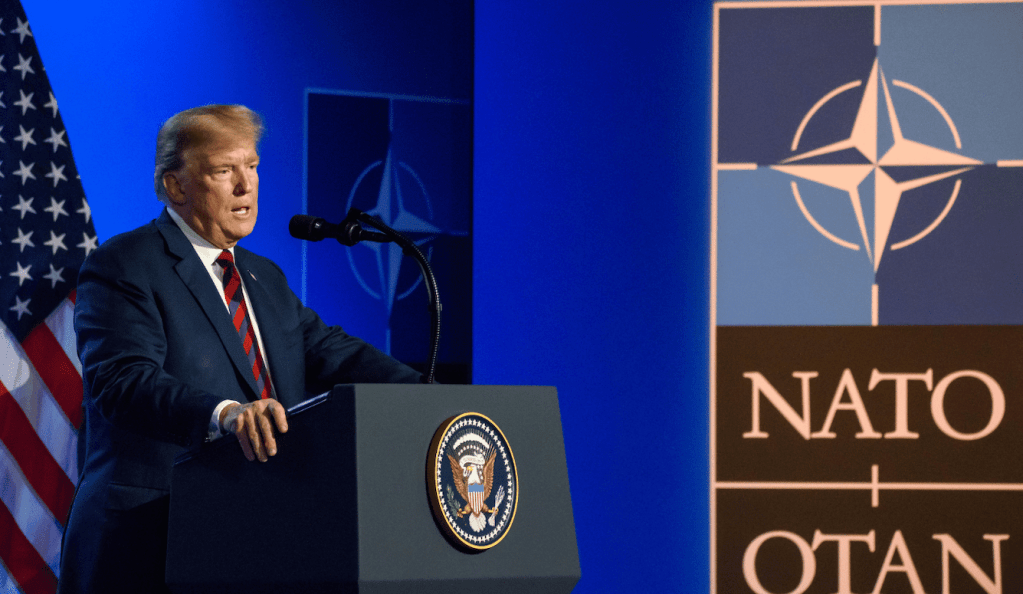
For nearly eighty years, the North Atlantic Treaty Organization (NATO) has served as the backbone of Western security, deterring great power conflict through the simple but powerful idea that an attack on one would be treated as an attack on all. At its core, NATO rests on a straightforward premise: security is strongest when countries stand together rather than bargain individually with adversaries, and it was never intended to function like a subscription service that members renew only when convenient. Established in 1949 as a collective defense alliance to counter Soviet expansion, NATO institutionalized the principle of mutual security through Article 5, its core commitment to collective defense. Throughout the Cold War and into the modern era, this commitment has been treated as a serious military and political obligation backed by credible deterrence, forward troop deployments, and nuclear guarantees. This credibility, built over decades of consistent commitment and strategic resolve, has been the foundation of deterrence and alliance stability.
Today, however, political rhetoric risks reframing this commitment not as a strategic necessity but as a financial transaction. If alliances begin to function like business deals rather than security guarantees, NATO risks becoming less of a deterrent and more of a negotiation. Taken to its logical extreme, collective defense could begin to resemble something closer to a subscription service for those who meet a certain payment threshold than a security pact.
Under such a model, NATO Basic might include strongly worded diplomatic statements and emergency consultations. NATO Standard could offer intelligence sharing and rotational troop deployments. NATO Premium would unlock the full Article 5 experience, complete with expedited deterrence and priority access to American military power. Smaller states on NATO’s eastern flank might be offered a family plan, pooling defense spending in hopes of qualifying for meaningful protection. While this may sound absurd, the satire highlights a real and dangerous shift in how alliances are sometimes discussed: not as strategic partnerships, but as transactions.
One could even imagine the next evolution of this model. Perhaps NATO members might receive automated reminders that their deterrence coverage is about to expire. Maybe Article 5 could come with a 30-day free trial, after which members must confirm continued eligibility. Countries on the alliance’s eastern flank might anxiously check whether their security guarantees are set to auto-renew, while Pentagon planners verify whether deterrence has been downgraded to a basic package. In this imagined system, invasion response times might depend not on strategic necessity but on whether a country’s membership status shows as “active.” The scenario sounds absurd because it is. Yet, the danger of transactional rhetoric is that it slowly makes serious security commitments sound like customer service agreements. Alliances are not loyalty programs.
Recent debates have made this concern more than theoretical. Donald Trump has repeatedly framed NATO through the language of financial obligation, questioning whether the United States should defend allies who do not meet defense spending targets and suggesting American protection should reflect what allies “owe.” While concerns about burden sharing are legitimate and long-standing across multiple administrations, framing alliances primarily through a transactional lens risks fundamentally misunderstanding their purpose. NATO was never designed to function as a protection contract. It was designed to prevent war by making the cost of aggression unmistakably clear. When alliances begin to sound like financial arrangements, the strategic logic that sustains deterrence begins to erode. Deterrence weakens the moment adversaries believe alliance commitments depend on payments rather than shared interests. If such a model were taken seriously, the implications would quickly become absurd. Would Estonia receive a warning email before deterrence expired? Would Poland need to verify billing information before reinforcement deployments? The questions sound ridiculous because they are, and deterrence depends on allies never having to ask them in the first place.
The burden-sharing debate within NATO is not new and is not without merit. For years, American policymakers across both parties have argued that European allies should increase defense spending to meet the alliance’s two-percent GDP benchmark. This is a legitimate strategic concern. Alliances function best when members contribute meaningfully to collective defense. But there is a critical difference between encouraging stronger allied contributions and suggesting that security guarantees themselves are conditional purchases.
Deterrence does not function like a marketplace commodity. Its effectiveness depends on adversaries believing commitments are firm, predictable, and not subject to renegotiation based on political moods or accounting disputes. If deterrence becomes conditional, it stops being deterrence. The strength of NATO has always been the credibility of its commitments. Article 5 works precisely because it does not operate like a contract negotiation every time a crisis emerges. The guarantee is meant to appear automatic, collective, and politically unquestionable. Once that perception weakens, adversaries may begin to test whether alliance commitments are truly as ironclad as they once appeared.
Imagine the strategic signal sent if adversaries began to believe NATO commitments came with terms and conditions. Imagine if Moscow calculated that alliance responses might depend on internal spending disputes rather than strategic necessity. Deterrence depends less on what is written in treaties than on what adversaries believe political leaders are willing to uphold. Turning alliances into transactional arrangements risks replacing strategic clarity with uncertainty, which is precisely the kind of ambiguity that invites miscalculation.
There is also a deeper misunderstanding embedded in transactional views of alliances. NATO was never designed as a protection racket where smaller countries pay larger ones for security. It was built on the recognition that American security is directly tied to European stability. The alliance was not charity. It was a strategy. Forward defense, intelligence integration, and coalition military power all served American national interests as much as European ones. Treating alliances purely as financial burdens ignores the strategic advantages they provide.
History reinforces this point. The only time Article 5 has ever been invoked was after the September 11 attacks, when NATO allies came to the defense of the United States. They did not ask whether America had met a spending target before offering support. They responded because, while the United States’ role as a primary leader and influencer within the alliance shapes expectations, alliances are supposed to function as commitments between partners, not transactions between clients.
This is what makes the subscription model satire uncomfortable rather than simply funny. If security guarantees begin to resemble purchasable benefits, the alliance itself risks becoming politically fragile. Credibility, once questioned, is difficult to restore. Allies may begin hedging. Adversaries may begin probing. Strategic competitors like China and Russia would likely welcome any erosion of alliance cohesion that reduces American global influence without requiring them to fire a single shot.
The real danger is not that NATO will introduce membership tiers. It is that the language of transactions may slowly replace the language of strategy. When alliances are framed primarily in terms of costs rather than interests, and when that happens, policymakers risk losing sight of why those alliances existed in the first place.
The greatest threat to NATO is not Russia, China, or Iran. It is the slow erosion of the political will that makes deterrence credible in the first place. If the United States begins to treat NATO less as a strategic necessity and more as a cost-benefit calculation based on a purely transactional view of security, it risks teaching both allies and adversaries the same dangerous lesson: that American security guarantees are negotiable. And once adversaries begin to believe that, the cost will not be measured in defense spending percentages. It will be measured in instability, miscalculation, and conflicts that deterrence was supposed to prevent.
Categories: Foreign Affairs


