
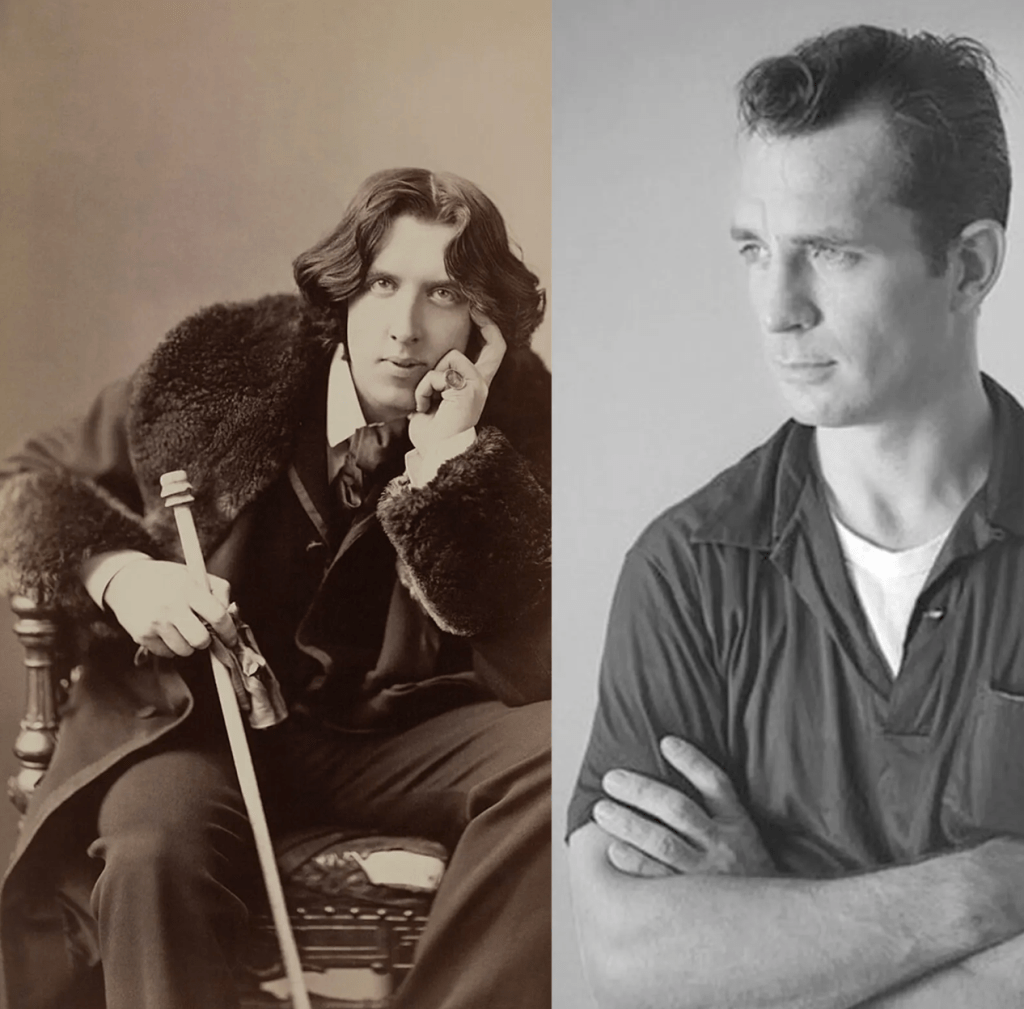
“Embrace your youth while you still can, and do not get so caught up in the details as to miss it.” That is the essential message of both Jack Kerouac’s On the Road and Oscar Wilde’s The Picture of Dorian Gray stripped down to the core. The unabashed commitment to push the limits of societal boundaries defined these two classic novels and the generations they influenced. Their approaches to the message, however, differed starkly. The cavalier attitude Kerouac took to his travels in 1940s and ‘50s America contrasted with Wilde’s admonishment of 19th-century British society. Despite the differences, the core message of both novels still impacts global culture decades later, creating controversy and debate. One question remains: What does it all mean?
As arguably the most famous piece of literature from the Beat Generation, On the Road serves as the archetype of a generation marred by controversy. This was further aided by Kerouac’s routine station as the leading figure of the movement. Moving past the basic debates of perceived quality, the message has been hotly debated. The generation as a whole has been accused of cultural appropriation, racism, and patriarchal attitudes. On the Road itself is full of the debauchery and casual racism that was not all too uncommon to see in the mid-1900s. After all, the novel, a story about the cross-country adventures of a college dropout and his best friend, a vagabond and habitual jailbird, is merely a fictionalized recount of a profoundly troubled Kerouac’s real-life experiences. Kerouac himself was driven to alcoholism after seeing his character, Sal Paradise, idolized as a paragon of generational counterculture. If you are looking for a novel to serve as a how-to guide to life, you will be sorely disappointed in what you find. However, the purpose of literature is not to become a character or claim a lifestyle as your own. Every novel is, whether subconsciously or consciously, a reflection of the author’s lived experiences; the vast majority of authors that wrote the time-tested classics did not live their lives by 21st century moral standards. By modern standards, they largely fall short of what society would consider good or even acceptable. Emulating Sal Paradise or Dean Mortiary—or their real-life counterparts—is not a viable course of action today, nor should it ever be, but that should not be the goal when reading in the first place. The goal is to experience their stories and gain glimpses into different backgrounds, whether they be moral, amoral, or immoral, possibly relating bits and pieces to your own story. Reading could also be solely for pure entertainment. Imitation, though, is almost never the objective.
Oscar Wilde’s The Picture of Dorian Gray faced a different kind of controversy, but not one that was any less bitter. At the time of its release, the reception was fraught with outrage over alleged undertones of homosexuality as well as the unambiguous portrayals of hedonism. Wilde’s fearless depiction of these then-taboo ideas were met with indignant literary critics. One critic, W.E. Henley, described it as a story that is “only fit for the Criminal Investigation Department” and that the novel is “for none but outlawed noblemen and perverted telegraph-boys.” Unlike On the Road, a story that has received controversy as it aged, The Picture of Dorian Gray was ahead of its time, receiving criticism for topics that are now written without shame. His portrayal of Dorian Gray, a handsome young man chasing opulence, perfection, and eternal youth, makes for a story that harbors relevant themes to this day. The depicted themes of an unrelenting avarice and a toxic obsession over youthful perfection are values that have always been largely opposed. Today we are able to speak freely about them to promote healthier viewpoints rather than cower in fear of even mentioning them. LGBTQ+ people have always existed. Today we are free to rightfully recognize them as human beings rather than monsters meant to be shrouded in shame. The relevance and truth in the words have not changed. The stigma around boldly facing these realities has.
The pertinent question then becomes: how and from where do we glean meaning in controversy? I am of the opinion that a novel must face some sort of controversy for it to be a true classic. Whether that be marginal, such as debate over the quality and enjoyment, or a much larger conflict as presented in the works of Kerouac and Wilde, there must be disagreement in art. Regardless of scale, art becomes meaningless without interpretation. I do not think that is a profound thought by any means; it is common sense to me, and I am sure it is to many others. Humans disagree often when it comes to the subjective. Disagreement in a field as subjective as literature is inevitable. Rivaling attitudes, controversies, are integral to the understanding of literature. However, I believe that inherent disagreement is an important baseline to set when discussing how controversy can be interpreted in literature. Kerouac’s freewheeling road trips will be admired by some, decried by others, and simply experienced by a third group; Wilde’s embrace of hedonistic imagery as a criticism will draw similar reactions; not to mention many more nuanced groups will form with overlapping feelings, as well as many groups with opinions wholly disconnected from them. That is the entire point.
For many, these novels have represented a message to embrace your youth. A message to avoid getting bogged down in a chase for unattainable perfection and to make the most of every fleeting moment. For others, they have only represented yet another example of vapid drivel from a racist white man of an era left behind or an author daring to spread the unspeakable sins of murder and opulent beauty. None of them are necessarily wrong. As much as the latter opinions may seem wrong to me, they are the real opinions of others. Each individual has a perception that drives their reality. The beauty in controversy is that there rarely is one single correct answer. It lies with each reader to take the lessons they wish in the way that they see fit. I will continue to seek the useful.
Categories: Culture

 The Texas Orator