
I’ve long enjoyed the novels of British novelist and academic David Lodge, so when I saw he’d written one about an academic exchange (Changing Places, 1975) I was interested. Here was a frame of reference through which to examine my own exchange—a year studying abroad here in Austin from my home in the UK. The novel charts a faculty exchange between two professors, Phillip Swallow from Rummidge University in the UK (based on the University of Birmingham), and Morris Zapp from the American institution of Euphoria State (modeled after Berkley). Cross-cultural negotiation and personal growth discovery follow as the two men grow into their new environments abroad.
I arrived in Texas, and I began reading.
“(Phillip Swallow) couldn’t drive anyway, he found it difficult to move around freely…He formed the habit of taking long solitary walks through the streets of Cambridge and environs, tailed by police cars whose occupants regarded gratuitous walking as inherently suspicious” (p. 19)
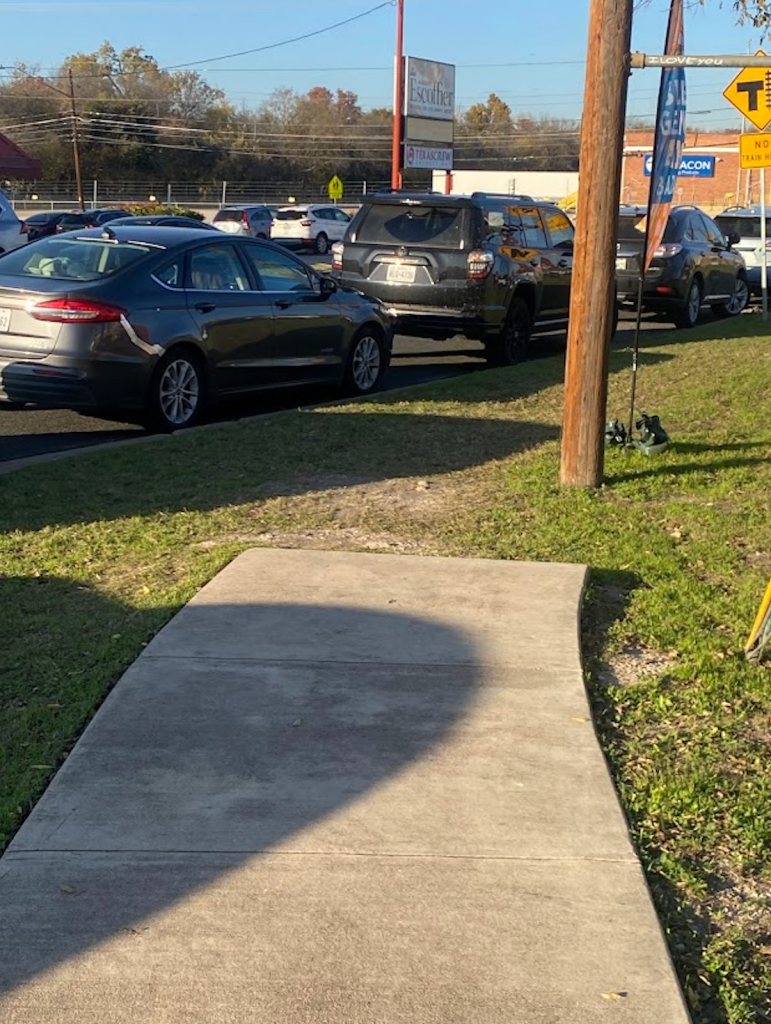
For all the talk of America as a car-centric nation, Austin has surpassed my wildest expectations. Sections of inner-city sidewalks randomly end with little regard for your destination. The pavement is often the first casualty of constant roadwork, making entire streets impassable without wheels. The waiting times for crosswalks rub it in even more. Rising traffic accidents mean that even drivers aren’t even safe. I’m struck by Megan Kimberly’s remarks in her 2024 exploration of city highway systems in Texas—this car-centric infrastructure is more than just inconvenient for pedestrians. When people don’t walk, local communities don’t organically form. Instead, you find yourself driving between individual locations, all floating in the disconnected City Limits. Don’t get me wrong—Austin is one of America’s more walkable cities, but with more highway expansion on the horizon, things aren’t going to get better. Jonah Lemm says it best, summarizing his time in Austin in the Chronicle late last year: “this city was made more for cars than for people.” The driverless taxis flitting around the city take this to the next level—cars can exist independent of people.
“(Colleagues) would fend (Zapp) off for six months with their little smiles and nods and then the waters would close over him and it would be as if he had never disturbed their surface” (p. 70)
An element of academic exchange that Lodge captures well is loneliness. So much of young adulthood revolves around establishing yourself in new places, but there’s something uniquely alienating in a foreign country. When I stepped out of the internet-connected, air-conditioned safety of Austin-Bergstrom airport in August, all I had to guide me was the address of my lodgings. The silent Uber journey to my apartment cruising down highway 111 was one of the loneliest moments of my life. I felt strangely detached from the single-occupant trucks and dented dusty hatchbacks thundering along the four-lane road around us. It was like I was watching an experience that wasn’t mine. In a way that was to be expected—I have no experience here. I have so little in common with these people.
This loneliness continued into my first weeks of class—being an English exchange student felt, at first, like a novelty. You are “an object of interest simply by virtue of being British” (p. 91). But such interest is shallow and unenduring. Beyond the same questions of which Merseyside team I support and how I’m finding the heat, the conversation fizzles out. As many people that I meet, and as many common-interest societies I throw myself into, I can’t quite relate to these people; they can’t quite relate to me. Maybe I was naive about how different American culture would be—shared language doesn’t mean common culture.
“They look hot and sweaty, but relaxed. They flop down on chairs, beds. ‘Thank God for air conditioning”‘ (p. 246)
AC is such an American contraption—this climate is unbearable, let’s just change it. The climatic whiplash I had walking into any American public building last summer was extremely disorientating. Coming inside from 100 Fahrenheit (or 40 celcius) heat to have your damp and sweaty clothes immediately refrigerated to a temperature just below comfortable was a unique feeling. Our West Campus flat offered no escape, with a temperamental fan that came on with little regard for our preferences and a frustrating immunity to resets, off buttons, and battery removals. Only America could respond to the the worsening effects of climate change with technology that also worsens climate change. Looking across the suburban skyline, the rectangular patterns of AC units resemble a city perched atop of Austin’s roofs, parallel neighbourhoods of coolers and ventilators.

“(Swallow) made the sandwiches with the ready-sliced, vitamin enriched, totally tasteless white bread they seemed to like” (p. 172)
Thanks to its proximity to Mexico and diverse population, Austin’s food scene is one of its crowning achievements. The taco trucks and Middle-Eastern delis here have fundamentally changed the way I eat and cook. But there’s still plenty of material for comment when it comes to groceries. Scallions (formerly spring onions) stay inexplicably fresh for weeks at a time in the fridge instead of promptly withering like back home. Affordability forces us to buy suspiciously homogenous rubbery loaves of one dollar bread that squeak when cut and last for weeks despite the heat. Entire supermarket aisles are dedicated to different editions of Lunchables, Cheez-Its, or gallons of radioactive coloured sodas. I’m deeply suspicious about beverages named simply for their colour. I’ll still miss the diverse culinary offerings of this city.
“Mentally, you brace yourself for the ending of the novel. As you’re reading, you’re aware of the fact that there’s only a page or two left… and you get ready to close it” (p. 251)
While Changing Places’ ending wasn’t intrinsically related to the exchange process plot, it’s a part of his book that has stuck with me. Lodge’s final chapter concludes suddenly in a protest against the predictable imminence of books’ endings, signaled by the “telltale compression of the pages” (p. 251). Isn’t there something deeper to be said here, though, when considering visits abroad? You’re on a timer. Your story has a set end point. In many cases, your flights home are booked before you even land.
Of course, the impermanence of your exchange frames the way you view it. This can definitely be positive—you throw yourself into more things as you won’t ever be able to again: you go to concerts, you attend events, you join associations. But I think at the same time, you remain a little withdrawn, with eyes always on the future. My British roommate and I have had the same version of this conversation time and time again: “There’s no point getting a car, we’ll be gone in a few months,” “do we need to decorate? We’ll be gone this time next year.”
This is something I’ve talked over with our new local friends as well, particularly in the context of America’s politics. “It’s easy for you guys, you can go home at the end of the year,” one friend reminded us during a conversation about Trump’s re-election. And it’s true. As exchange students, we have a unique position as insulated observers of American society and politics. It’s important not to lose sight of its very real consequences. One can’t view American politics as a spectator sport, or an object of study when it changes, prioritises, and invalidates individuals’ lives.
“The End” (p. 251)
A year abroad is a finite stage of life, but my ending in Austin is still a while off. It’s important to strike a balance between consideration for the future, and enjoying the now. When else will I have an opportunity to live in a vibrant and dynamic city like Austin? I should enjoy it to the fullest. I decorated my room.
Unlike my time in Austin though, Changing Places fell short for me. While entertaining and readable, its underwhelming denouement of a semi-misogynistic wife-swap completely disappointed me. Here was an opportunity to do something big, to chart deep differences between the UK and the US both on and off the campus. Granted, the book is a product of the mid-20th century. Much of US/UK culture has moved and even aligned in the contemporary, but Lodge even fails to make meaningful contemporary comparisons. It’s almost as if reading a book doesn’t provide all the answers. And experiencing Austin in real time has given me much more than a novel ever could.
Categories: Domestic Affairs


Very insightful Dom. Given your review of changing places I may not read that book, however, someday I may visit Austin!
LikeLiked by 1 person