
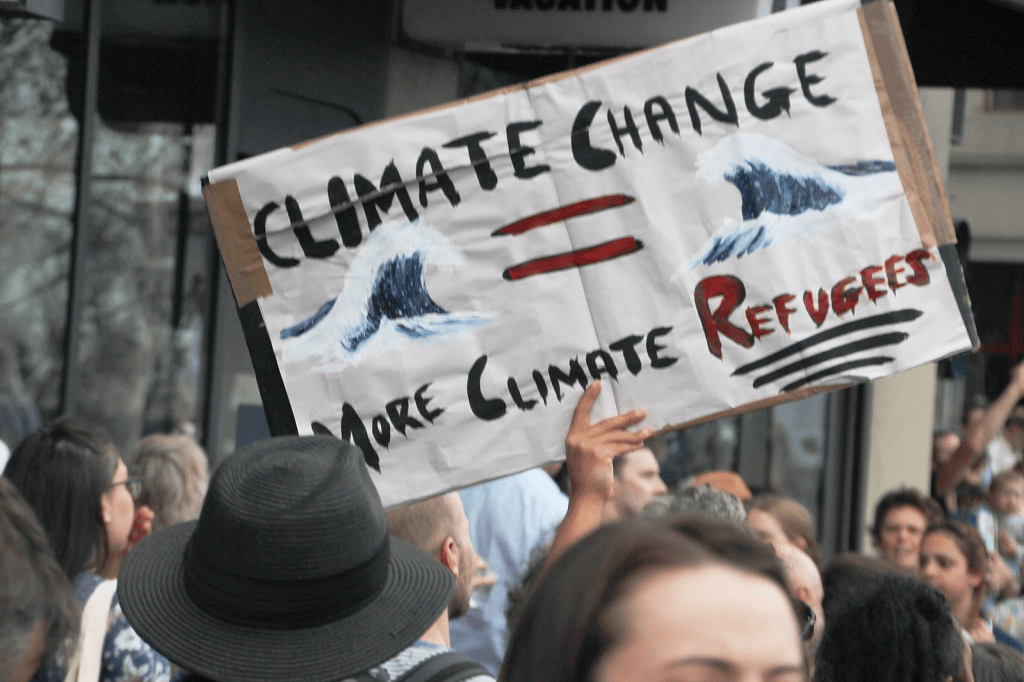
In 2007, Ioane Teitiota and his wife, citizens of the Republic of Kiribati, left their home on the small island of Tarawa for a new life in New Zealand. There, they had three children. In October of 2010, the Teitiotas’ visas expired and they lived in New Zealand illegally. In July of 2013, Teitiota approached the New Zealand government to avoid deportation. He claimed he and his wife were refugees of their homeland and were seeking asylum in New Zealand, but this was an unusual asylum claim. There was no ongoing war in Tarawa, nor had the government persecuted Teitiota and his wife.
Teitiota claimed that the reason for his immigration was the climate crisis. Specifically, he argued that he had a lawful claim to asylum “on the basis of changes to his environment in Kiribati caused by sea-level-rise associated with climate change.” In June of 2013, the New Zealand government declined Teitiota’s application for asylum. He continued to seek leave of appeal from the New Zealand courts. Eventually, the New Zealand Supreme Court upheld the decisions of its lower courts. Teitiota, his wife, and his three children were forced to return to the Republic of Kiribati.
Teitiota was not finished though. He filed a complaint to the U.N. Human Rights Committee and argued that by deporting him, New Zealand had violated his right to life under the International Covenant on Civil and Political Rights. Essentially, he contended that his country was under siege by climate change. Teitiota insisted that the government of Kiribati had been unable to effectively combat sea-level rise. In turn, land became more scarce, sparking violent conflicts over land that resulted in numerous deaths. His complaint further cited a shortage of fresh water due to increased salinization and overcrowding, and difficulty with subsistence farming due to environmental degradation.
The U.N. Human Rights Committee found that Teitiota’s deportation had not been unlawful because he didn’t face an immediate danger to his life in Kiribati. Crucially, however, the committee established a series of precedents that could shape the future of International Human Rights and Refugee Law. Although the Committee affirmed Teitiota’s deportation, they clarified that individuals seeking asylum status are not required to prove that they would face imminent harm if returned to their countries. On this point, the Committee “reasoned that climate change-induced harm can occur both through sudden-onset events (such as intense storms and flooding) and slow-onset processes (such as sea level rise, salinization and land degradation).” The Committee further argued that the international community must play a greater role in assisting countries harmed by climate change. Until Teitiota’s complaint, no U.N. body had ruled on the merits of asylum-seeking due to the effects of climate change.
Although it is rare for refugees to ground their claims for asylum on climate change, an increasing number of migrants are being forced to do so as Earth experiences a rise in catastrophic climate patterns. Especially for small island states like Kiribati, rising sea-levels and growing economic scarcity pose a dire threat to the lives and wellbeing of people. A report by the International Organisation for Migration (IOM) in 2008 predicted that by 2050 there may be as many as 200 million climate migrants. Insofar as the international community neglects to prevent the continuous rise in global temperatures, climate change will pose even greater threats to migrants’ wellbeing and spur mass displacements around the world.
As Teitiota’s case shows, the growing scope of climate-driven migration has begun to raise questions regarding law and public policy. With many already being displaced by the effects of climate change, and many more expected to be in the future, a crucial question arises: how do we create a legal framework that ensures migrants displaced by climate-change related disasters are protected and accorded proper dignity and rights? This legal framework, it seems, would need to be constructed from the ground up since most climate migration is regulated by a “non-regime” of environmental migration. In other words, there is currently no regime – or what we might also call a legal framework – that governs environmental migration or provides comprehensive international protection for this category of migrants. This is starkly opposed to the more concrete global regulatory regimes for statutory refugees and war migrants.
These regimes are undergirded by well-established laws, strong global consensus, and longstanding history. The framework for statutory migrants was established by the Convention Relating to the Status of Refugees of 1951, an urgent response to the practical problems posed by the migration crisis in the aftermath of the Second World War. The principles enshrined in the Convention of 1951, initially limited by geographical and temporal constraints, were released from such constraints in the seminal Protocol Relating to the Status of Refugees of 1967 which has been ratified by 146 signatory countries and is frequently referred to by international and national judicial bodies across the globe. The principles underlying this “strong regulatory regime” help guarantee statutory refugees concrete protections, including the guarantee that, once they are accepted in a country as a refugee, they will not be forced to return to their country of origin, otherwise known as the principle of “non-refoulement.”
If a migrant does not meet the legal requirements to be classified as a statutory refugee, they might also receive international protection under the category of “war migrants” or asylum seekers. These protections are grounded in two international legal documents: European Union legislation called the Directive 2011/95/EU and the 1969 African Union (AU) Convention Governing Specific Aspects of Refugee Problems in Africa. These documents extend the international protections offered to statutory migrants to war migrants in certain cases. These may include, as specified in the Directive, the risk of death, execution, or torture in their host country. Under the AU Convention, they may also encompass “external aggression, occupation, foreign domination, or events that significantly disrupt public order.” Thus, while opportunities for protection for war migrants may be more limited, there still exists a substantive international framework for their protection.
With so many established legal avenues for the protection of migrants and refugees, why are there no protections for environmental migrants? There are many answers to this question, but the main points of contention are as follows:
As a matter of practicality, if there is to be any kind of international legal framework for the protection of environmental migrants, there would first need to be some international consensus on the definition of an “environmental migrant” that would, in turn, qualify them as a distinct body of persons in need of adequate legal protection. Phrases such as “environmental migrant,” “climate migrant,” and “climate refugee” have all been used in discussion, sometimes interchangeably, even though they have distinct connotations. In a legal sense, the word “refugee” refers to the application of a “specific identification which carries with it certain rights and obligations,” and having, “a concrete meaning and acquired privileges.” The term migrant, however, tends to be broader and not necessarily imply some kind of protected legal status. The term, as defined by IOM is “An umbrella term, not defined under international law, reflecting the common lay understanding of a person who moves away from his or her place of usual residence, whether within a country or across an international border, temporarily or permanently, and for a variety of reasons.” Using the term “climate refugee” might therefore imply that certain persons who have been displaced by climate change-related events are deserving of the specific legal protections afforded to other refugees such as those accorded to statutory refugees fleeing persecution in their home countries.
Even if the international community is able to arrive at a clear consensus regarding the definition of “environmental migrants,” existing legal frameworks and regimes offer very narrow legal parameters for migrants seeking protection and relief. Though efforts have been made to extend such protections to environmental migrants, there has been little success in applying such legal provisions for the benefit of environmental refugees. In response to this problem, three general positions have formed within the Academic literature on this topic: “fitters,” “expanders” and “deniers.” Fitters argue that environmental migrants already fall within the classical refugee definition. The Expanders argue that the refugee definition should be expanded in accordance with human rights principles to include protection for environmental migrants. Deniers fall in between both Fitters and Expanders. They neither agree that the current definition applies to environmental migrants (like the Fitters) nor believe that there is a need for a new set of international legal rules (like the Expanders).
Teitiota’s case, and many others since, suggest that the existing legal regimes governing migration and asylum-seeking are ill-suited to accommodate the immediate needs of environmental migrants. If there is to be an adequate international framework that addresses the challenges posed by climate-induced migration, the existing international frameworks will either need to be seriously revised to expressly include environmental migrants, or entirely new legal regimes will need to be created to protect the world’s most vulnerable victims of climate change.
Categories: Foreign Affairs


