
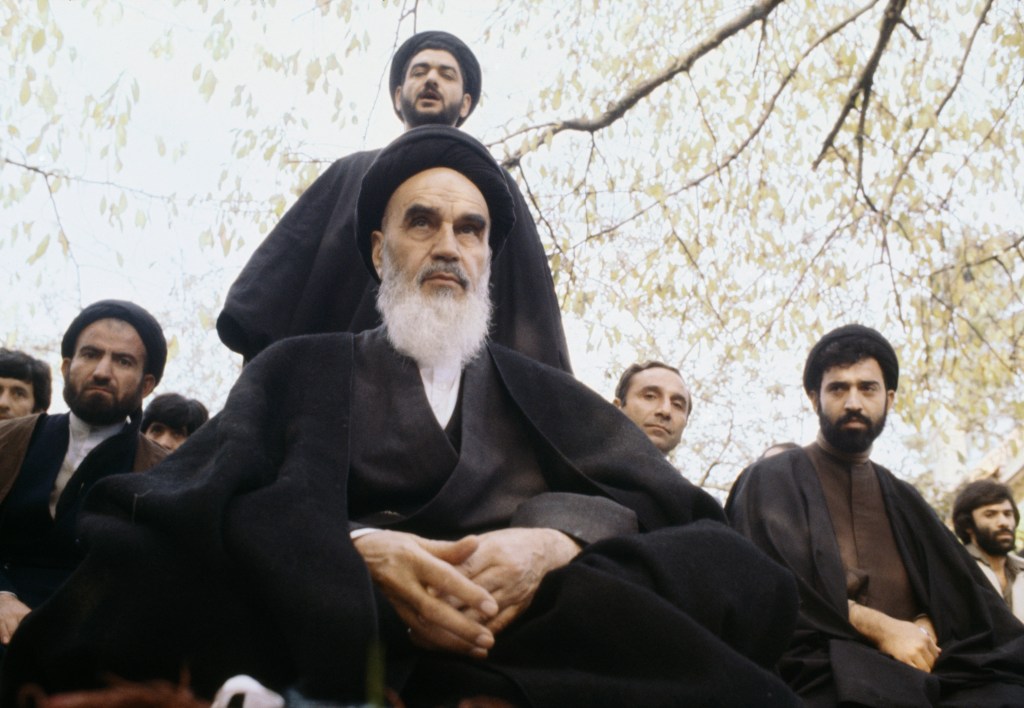
As I write this, the United States is embroiled in a war with Iran, in which Supreme Leader Ali Khamenei’s 36-year tenure was cut short when he was killed in an airstrike at his Tehran compound. Since the Islamic Revolution of 1979, the popular image in Western media of the Iranian regime has been the scowling, bearded face of a turbaned, aged cleric, issuing fatwas and spewing invectives towards the “Great Satan” of the United States and its proxy, Israel. It’s a face that belongs to two men: Ruhollah Khomeini, the ideological founding father of the Islamic Republic, and his faithful successor, Ali Khamenei. Although the average American might only know each as “the Ayatollah,” the power of both men existed through the office of the Supreme Leader. It’s a position unlike any other in the world today, and much like Iran’s greater regime, it has no real analogue. The Supreme Leader is separate from both the Iranian president and the Iranian parliament, the Majlis, both of which have only limited powers to run the country day-to-day. Rather, the Supreme Leader is a role that seems to float above and dominate what would ordinarily be enough for a functioning political system, setting the ideological priorities of the regime. [1]
The Supreme Leader is Iran’s head of government and state, elected by the clerical Assembly of Experts, with final say on legislative, executive, and military decisions. Part theocrat, ideologue, and commander-in-chief, Iran’s new Supreme Leader, Mojtaba Khamenei, will operate with an authority based on the principles and precedent of his predecessors.
In 1979, mass protests forced Iran’s US-backed royal autocrat, Shah Mohammad Reza Pahlavi, off the throne and into exile. Most prominent among those who overthrew him was a network of radical clerics, who, despite the Shah’s feared SAVAK secret police, devised and diffused a particularly Iranian brand of political Islam. The growing revolutionary ideology, taking cues from then-stylish Third Worldism, opposed Western cultural encroachment, which was labelled “Gharbzadegi” or “westoxification” by Jalal Al-e Ahmad, a disillusioned leftist. [2] Merging Shia thought and Iranian nationalism with New Left, anti-Western revolutionarism, this ideology called for rule by clerical authority. On February 1, 1979, the Shah’s effective replacement landed in Tehran, returning from exile in Paris. Ruhollah Khomeini had done as much as any other cleric to lay the theological groundwork for clerical authority, and his outsized influence led to the office of Supreme Leader effectively growing around his dominant personality.
The principle on which Khomeini and his followers staked their authority is a religious innovation in Shia Islam, veyalat-e faqih. Shia Islam is a branch of Islam that regards the legitimate leadership of the faith as passed down through the descendants of the caliph Ali. Since the Safavid dynasty conquered Iran in the early 16th century, Iran has been predominantly Shia, dominated by the Shia branch of Twelver Shi’ism. Twelvers regard Ali as the first of the Twelve Imams, or spiritual successors to Muhammad. The twelfth and current Imam, they believe, has been born, but has been concealed from the world, living in occultation until he returns to Earth as the Mahdi, a messianic figure who will establish justice. In theory, any earthly government in the absence of the Hidden Imam is illegitimate according to the hardline clerical view.
Khomeini’s doctrine gave himself and his successors, as Supreme Leader, authority to act as regents for the Mahdi based on their knowledge of Shia jurisprudence. In practice, this theological justification is a claim to political power and a justification of theocracy, rather than any widely recognized religious authority. This is what makes Iran’s system unique: despite having what would otherwise constitute the complete institutions of a government, all that authority is subordinate to the dictates of the Supreme Leader. Iran, for instance, has a president, but unlike other presidential systems, they are neither a ceremonial head of state nor a meaningful executive; if anything, the Iranian president is defined by a partial, limited power. The position is certainly important, as is evident from a periodization of the regime by presidential administration. The presidency of Mohammad Khatami (1997-2005) was defined by efforts at reform and detente with the US, while that of his successor, Mahmoud Ahmadinejad (2005-2013), saw a return to more conservative principles.
Despite the continual swinging of the presidential pendulum, Iran’s institutions find themselves unable to depart from the hardliner, revolutionary ideology of “sacred defense” against the United States, hostility towards Western culture, and clerical dominance in social and political life. Responsible for this is the office of the Supreme Leader, with its constitutional and ideological authority and control over several institutions of the state, most prominently the Islamic Revolutionary Guard Corps. They also have influence in the Majlis, judiciary, and other state bodies through the hardline Combatant Clergy Organization (JRM), a coalition of heavily revolutionary clerics. This was especially the case during Ali Khamenei’s tenure as Supreme Leader, from his election by the Assembly of Experts (a group of clerics) in 1989 until his death in 2026. During the elder Khamenei’s tenure, he was the focal point of Iran’s hardliner faction, opposing the more non-ideological, pragmatic efforts of presidents Rafsanjani (1989-1997) and Khatami, through what Iran expert Vali Nasr calls a “deep state.” In short, thus far, the Supreme Leader has been the keeper of Iran’s revolutionary flame, keeping the regime as committed to its Islamist, anti-Western views today as it was in 1979—perhaps even more so.
Whereas Ruhollah Khomeini largely defined the position through the force of his personality and singular dominance of the post-revolutionary regime, Khamenei was the one to institutionalize the position and assert its dominance over the balance of the state’s other institutions. The position has proven malleable to the personality of its holders and the context of their rule, and presumably will continue to be shaped further by Mojtaba Khamenei, Ali Khamenei’s son, whose election introduces a hereditary precedent to the position.
Categories: Foreign Affairs

 The Texas Orator