
“Look, the wages you failed to pay the workers who mowed your fields are crying out against you. The cries of the harvesters have reached the ears of the Lord of Hosts”
-James 5:4
Carnegie Steel and Martin Irons
In June, 1889, Andrew Carnegie began his summer vacation in his hometown of Dunfermline, Scotland, when he published Wealth. This essay is an observation about the state of industrial society and presents a defense for capitalism. Carnegie’s essay begins by addressing, “the problem of our age [that] is the proper administration of wealth, so that the ties of brotherhood may still bind together the rich and poor in harmonious relationship.” He advises his fellow millionaires against hoarding generational wealth and he promotes philanthropic pursuits as a counter balance to the “law of competition.” As the great steel industrialist of the 19th century, Carnegie recognized that “often there is friction between the employer and the employed, between capital and labor, between rich and poor.” Although generally, the whole of society was enriched by capitalism, the wealth was deeply unequal. He worried that this class struggle would cause humanity to “lose its homogeneity.” Carnegie’s solution was that “the millionaire will be but a trustee for the poor; intrusted for a season with a great part of the increased wealth of the community, but administering it for the community far better than it could or would have done for itself.”
Carnegie was one of the most compassionate millionaires of the Gilded Age. His desire to spend more time with his family compelled him to sell his steel company to the more empire minded J.P. Morgan for $480 million in 1901. True to his word, Carnegie distributed an estimated $350 million to various charities by the time of his death in 1919. He lies buried alongside his wife and three household servants in the famous Sleepy Hollow cemetery in New York.
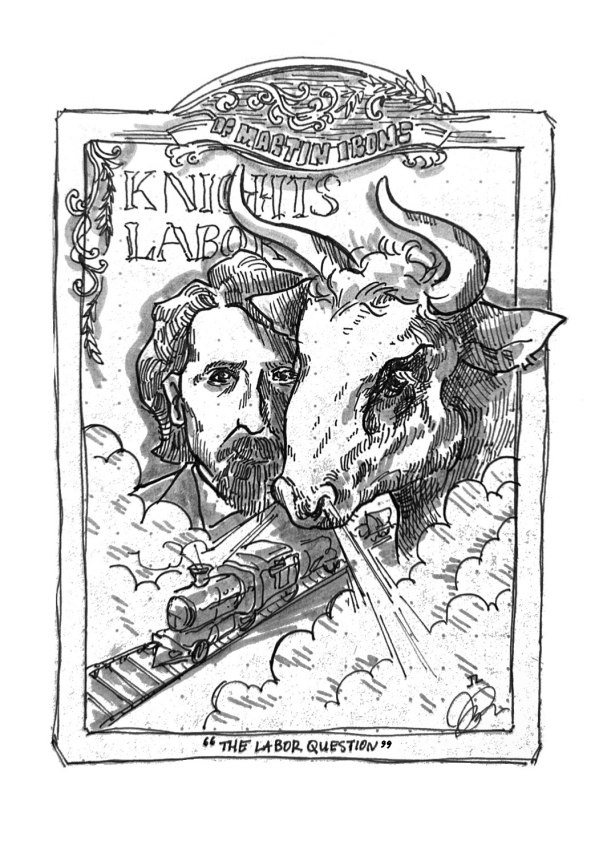
Three years before Carnegie’s Wealth, in May of 1886, labor agitator Martin Irons started his summer vacation in St. Louis Missouri being interrogated by a House committee. They gathered to understand the origins of the Great Southwestern Railroad Strike—the committee’s head was former Civil War governor of Pennsylvania, Andrew Curtin. On that day, Martin Irons had, “a weak, irresolute, half-cunning, half-frightened, face.” He wore a “dirty white collar held in its place by a brassy stud…and an unbuttoned vest” and “his first act, after taking his seat, was to draw a spittoon toward him, and take a huge quid of tobacco, which he chewed heavily while he listened to Chairman Curtin’s opening address.” An itinerant worker versus a career politician, Irons and Curtin had nothing in common. This was just another committee in Curtin’s twenty six years of public service, but this was the worst day in Martin Irons’s life. “Throughout the entire examination Irons adopted an aggravatingly listless attitude, chewed tobacco incessantly, and expectorated to a degree only to be described as filthy.”
“Q. What do you think about labor producing wealth?
A. Labor produces everything and capital produces nothing at all.
Q. So you argue that as God created the world and has a right to manage it, so as labor creates all wealth, it has a right to manage it?
A. Yes, with due respect to the rights of others.”
On March 1st, 1886, in Marshall, Texas, Irons acted as chairman of District Assembly 101 of the Knights of Labor and began the Great Southwestern Railroad Strike. This was the largest strike in Texas history, and over 200,000 railroaders across five states walked out to protest the wrongful termination of just one of their colleagues. Their motivation was to stick it to their robber baron boss Jay Gould, and live up to the Knights of Labor’s creed, “an injury to one is the concern of all.” The strike lasted two months and failed. Irons was made to testify the details of his unionist beliefs in front of an uncaring committee of representatives who had, in the first place, failed to represent the needs of their working constituents in the age of steel rails and steam trains.
Martin Irons’s failure weighed heavily on him for the rest of his life—it was said that he “looked ten years older than he did before the strike.” As a father of five, Irons struggled to secure work after the strike. He was nationally blacklisted by employers and failed to find pay as a result of his infamy; he moved from town to town, using fake identities and scraping by until, in 1900, he died alone in Bruceville-Eddy Texas. Irons is largely forgotten as an early labor organizer in Texas history. His botched strike against Jay Gould’s southwestern railroad empire enabled conservative newspapers to call him a terrorist and unionist newspapers to call him an extremist. However, in 1910, the Missouri State Federation of Labor erected a memorial on his grave, commemorating him as a labor martyr. Then, in 1984, the Texas Historical Commission put up a historical marker explaining his leading role in the Great Southwestern Strike. In 2025, Martin Irons’s gravesite remains, on a windy hill beside Interstate 35 as a lone, faint memory of industrial unionism deep in the heart of Texas.
Andrew Carnegie and Martin Irons were born in the same generation—Carnegie was born in 1835 and Irons in 1830. They both came to America poor in their early teens. They were born in Scotland less than 50 miles from each other; yet, despite dying in the same country, their spirits are separated by over 1,600 miles and irreconcilable ideologies. More than a century later, their lives each represent a side of what remains the most important question of the modern day, the Labor Question: who creates wealth and how should it be distributed?
Academic-ish Definitions
It is indisputable that labor creates real value and is the basis of wealth for society. However, in the modern day we are confused by the difference between wealth and money and surrounded by forms of wealth generation that are frankly obscene manners of speculation, lying, and theorizing. Economic theorists of any kind often overcomplicate any given topic and create a wall of dense academic text that at best disadvantages people, and at worst actively hides institutional theft from the victims themselves. I am not an academic, and therefore I will try not to play their game of smoke and mirrors, for my own benefit. Nevertheless, it is necessary to define terms in the means that I find most accurate and base:
Wealth is the accumulation of valuable material possessions or resources, and value is what something is worth to another person or to the broader market. Money represents value—it is the standardized currency used in transactions for wealth.
Lying
Wealth derived from investments and stock markets, while potentially tangible for many, fundamentally is a reward for lucky or savvy gambling. The prices of stocks, often inflated in the market, are at their core based on the perception of a company’s value generated by the labor done at that company. This perception may be skewed, may be manipulated, and may be completely wrong. Companies will “project” or lie about their own productivity so that they can sucker investors into paying them in the hopes of selling their junk stocks for more than they are actually worth. A textbook example of this blowing up is Enron. This Houston based energy company fooled investors with bogus profit reports, including predictions of what the company may make years in the future. Enron insiders, including the CEO, Kenneth Lay, sold over $1 billion in Enron stocks in the years leading up to the collapse, all while lying about the company’s financial health and encouraging employees to buy Enron stocks.
As a side note, in the United States, the amount of money (value) that someone holds in stocks is untaxed up until these stocks are sold. This is why millionaires hold much of their net worth in stocks, because they grow and are untaxable. In 2022 Elon Musk financed his acquisition of Twitter by selling about $20 billion worth of Tesla stock. Banks, on the other hand, do endure their share of taxation. However, considering banks have been lending money as much as their greedy hearts desire, since 2020, this is at least equally as unfair of a tax loophole.
Fabrication
The wealth generated from banking is nearly always entirely fabricated; which is to say, although it is as transferable as wealth generated from labor, it’s in fact a creation of money on the government’s credit. Reserve requirements are the only thing that mandates a bank have any actual money (value) to lend, and since 2020, reserve requirements have been set at zero. Banks are institutions that have the authority to give out loans of money they do not have and then receive actual money in payment back, with interest. Furthermore, if there is ever a crisis or run on the banks like in 2008, the government just bails them out with trillions of dollars.
Theorizing
On the topic of government, it naturally has the authority to generate as much money as it desires, but it does not by its existence inherently create value. Its employees, for the most part, provide services that do create value however. Since the U.S. government creates its own currency, and this currency is among the most powerful in the world, Modern Monetary Theory (MMT) argues that the U.S. need not worry about debt accumulation and can deficit spend to fund any project or war that it pleases. Taxation usually persists in some form under MMT, but it isn’t used to generate revenue, it is used as a perverted means of reducing inflation by taking money out of the market. By theorizing in this way, economists try to distance entire governments from acknowledging the origins of their power, their people. While I recognize that this theory may be nearly true, the government still taxes its citizens and businesses for their income, which is a tax directly off of the value they generate by their work. The taxation of this nation’s colossal number of productive workers is the true basis of American power. Perhaps, with MMT, you could eliminate all forms of taxation and operate on money the government prints or speculates, however the money generated by the government even in this way, is backed by the existence of a taxable populace. We the people.
Another issue with MMT is that even if a government were to completely run a deficit and print money to compensate, inflation would swiftly pose an existential threat to that irresponsible government’s standing with its people. Money is currency for value, and if there exists a sudden titanic disparity between the units of cash in an economy and the amount of real value, that same currency, which ideally should remain stable, is now inundated across its economy and is seen more and more like the cloth paper it is. It is paramount to remember that no government can print value itself. This is because money isn’t valuable so much as it represents value, therefore even a government as powerful as the United States requires a source of value that is independent of lying, fabrication, and theorizing. This source of value is labor.
A World of Labor and Capital
Imagine a world in which stockbrokers do not have the modern methods of communication necessary to successfully speculate, where commercial banks cannot create mostly reliable loans out of thin air, central banks don’t print money at breakneck speeds, and economists are not theorizing away the importance of having a population base from which to tax. This world is like ours in that it always takes one’s own intentional, time consuming work to create the value input into the society. However, unlike ours, wealth is not speculated upon, deceitfully fabricated or theorized into being, wealth is the reward for work. People work to provide goods and services which in turn are sold for their market value. This is a world of farmers, laborers, servants, clerks, teachers, artisans, and merchants. An apocalyptic scenario to many, but this world would look more like the world that the writers of the American Constitution knew. Andrew Carnegie and Martin Irons lived in the brutal and often violent transition between agrarian traditionalism and industrial modernity.
So, labor creates all value for society. This always has been and always will be, even if that labor is done by machines and artificial intelligence. The steam engine proved that humans are unfortunately optional. But what did Martin Irons mean when he said, “Labor produces everything, and capital produces nothing at all?” What is capital? Capital is the man-made tools and assets that produce goods and services. Capital is physical, such as factories. It is financial, as in loans and investments. It is human in the form of education and ability. It is social such as in networks or international relations that influence economic cooperation. If you are baking a cake, then the stand mixer and the oven is the capital which facilitates your work and provides you with the possibility of making a cake to begin with; but can it be said that the oven and the stand mixer produce cake? What use is an empty factory, an unused loan, an underemployed college student, an ally you don’t cooperate with? Without work being done, capital is idle. Moreover, who builds the factory, who approves the loan, who earns the degree, and who forges the alliance? Without work having been done, there is no capital.
“Labor is prior to, and independent of, capital. Capital is only the fruit of labor, and could never have existed if labor had not first existed. Labor is the superior of capital, and deserves much the higher consideration.” – Abraham Lincoln
The Capital Revolution
Beginning in the late 18th century, the Industrial Revolution can truly be said to have been a revolution of capital. Technological innovations meant there were new forms of capital that facilitated laborers to reach new heights of productivity. The men who innovated and owned these new forms of capital which revolutionized economies possessed immense leverage over their workers. Global markets expanded as global distances shrank. Millions of Americans with generational ties to yeomanlike farmsteads had their productivity out-competed by capital driven industrial consolidation practices. They migrated to the cities, bloating the population of industrial laborers and thereby lowering industrial wages. Society was richer than it ever was, but wealth inequality skyrocketed.
It’s under these conditions that Carnegie published Wealth, in which he writes, “the contrast between the palace of the millionaire and the cottage of the laborer with us today measures the change which has come with civilization. This change, however, is not to be deplored, but welcomed as highly beneficial…much better this great irregularity than universal squalor.” Carnegie further contends that, “The poor enjoy what the rich could not before afford. What were the luxuries have become the necessaries of life. The laborer has now more comforts than the landlord had a few generations ago.” Carnegie’s justification for this inequality may be acceptable to modern audiences, however the luxuries of the 19th century were not as effective of a diffuser for class tensions as the luxuries we now enjoy, despite today’s greater wealth gap. In Carnegie’s time, labor unions such as Martin Iron’s formerly aligned Knights of Labor were active, growing, and at times willing to mobilize an army of southern railroaders to strike against capitalist power for the sake of just one of their members.
Capital is a product of labor, and by its nature facilitates and expands worker capabilities. However, the steep wealth inequality engendered by private ownership of industrial capital led to the domination of capitalists over their workers. Class tension between worker and employer inspired the need to ask the Labor Question. It’s clear work produces everything, including capital, and honest work should be honestly compensated. This begs the question, how should the people who work to create and provide the capital be compensated? History shows that those who own capital are in such a powerful position, particularly in their relationship with who they employ, that they will often greedily abuse their power and wealth. However, it is not as if the sudden seizure or nationalization of all of the means of production would be a fair solution either. Capitalists do deserve a measured amount of credit for providing capital and increasing labor’s productivity. If no one is there to create capital, or willing to create capital, then laborers will struggle to increase their productive capacity to the detriment of all.
Capital is Uncaring
The United States is called an industrialized nation, but we are rusty. The U.S. workforce is 79% within the service sector. Since its peak in 1979, manufacturing jobs have declined 35% over the last four decades. America’s deindustrialization has destroyed communities that depended on wages earned on the factory floor. By abandoning American workers to set up sweatshops abroad. America’s industrial capitalists proved once again that they will prioritize profits over people. To add insult to injury, new waves of technological advancements threaten the service industry. As of February 2025, Google’s robotic taxi service Waymo was selling over 200,000 car rides a week, and the company is expanding into new cities fast. Capital in this case has become fully autonomous, rendering human drivers obsolete. Outrageously, Americans have been directed into service work, only for artificial intelligence to now threaten service jobs such as data analysts, translators, paralegals, sales representatives, and clerks. Returning to the 19th century, American folk hero John Henry died of exhaustion after just defeating a steam drill in a race to finish building a railroad track. In the battle between man and machine, John asked, “do engines get rewarded for their steam?”
I do not care for Carnegie’s dream of millionaires who faithfully serve as the “trustee” of my and my community’s wealth. Capitalists have proven time and again that they’d sooner kill or replace their workers than respect them as the invaluable human element of their wealth. Meanwhile, I admit to some admiration for Martin Irons and the Knights of Labor’s belief that, “an injury to one is the concern of all.” Regardless, Carnegie’s “trustee” solution to the Labor Question is in use today, whereas Irons’s brand of solidarity is perhaps even less successful than it was in 1886. An honest pay for an honest day of work, anything less is sinful. The solution to the Labor Question is consciousness of our economic past and present. While bread and circuses are enough for capital to remain global hegemon, we must never forget labor is the basis of all value. Workers are valuable. Cultivate your value, and keep it close, leverage it. Be aware of local forms of economic exploitation and injustice and be gutsy enough to confront it. Be smart, study history to understand what methods of bargaining work and when to use them. “Keep your hand upon your wages and your eye upon the scale.” It’s all too easy to forget these basic material truths that feed the world. We live in the most powerful nation in history in an era of unprecedented abundance. We are tranquilized in body and mind, but history never ends. There is always a storm coming in. Never lose sight of the Labor Question.
“Workers of the world, awaken!
Break your chains. demand your rights.
All the wealth you make is taken
By exploiting parasites.
Shall you kneel in deep submission
From your cradles to your graves?
ls the height of your ambition
To be good and willing slaves?”
-Joe Hill
Categories: Domestic Affairs

 The Texas Orator