
Note: This article is part one of a series.
Introduction
Before I begin, I want to make clear that there is no crystal ball guaranteeing that the events I am about to discuss will occur. I write with such certainty about the intentions and capabilities of our adversaries given their behavior for years as well as the current state of the United States’ hold on global power. However, I obviously do not know every event or detail. I write this from as nonpartisan a political standpoint as possible. This is not a work of political punditry; the work discusses domestic politics to explain American strength and weakness on a grand scale. There are strategies the U.S. can pursue to address American decline and our geopolitical situation. However, given the severity of the problems, I am doubtful they have a solution.
Many talk of our current geopolitical situation as a “great power competition” or “Cold War Two.” A resumption of competition and rivalry in the manner of the great pre-WWI European powers, or a “Thucydides Trap” of a rising China at odds with an established albeit declining America. Many picture Harry Truman and Joseph Stalin as analogous to modern U.S. presidents and Xi Jinping.
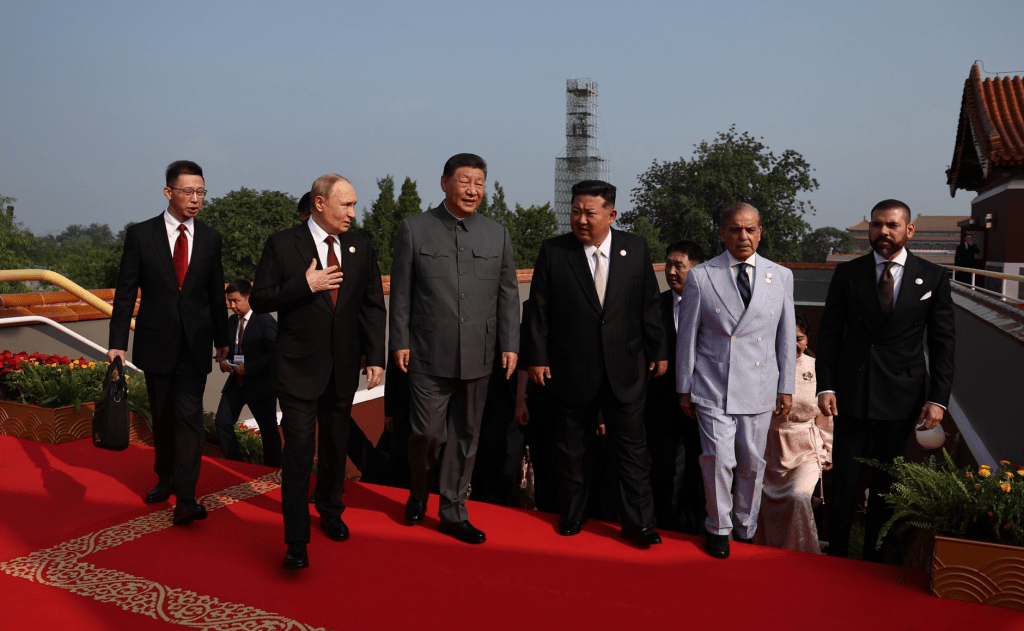
However, these descriptions are not accurate. The real story is much darker. The pacing threat to the United States is not just China, even if its great geopolitical ambitions position it as a peer rival. It is not Russia, Iran, North Korea, or any domestic forces seeking to upend our democracy. It is all of our aforementioned foreign adversaries combined. All of them have posed the same threat for a while now. Our reality is not simply that the world is degenerating into an arena of might-makes-right transactionalism. In actuality, we are under attack by a coordinating group of hostile actors who are collaborating, covertly and increasingly overtly, to destroy the liberal world order that has existed since 1945.
The Rise of The Axis of Upheaval
Around two years ago, I thought that given the U.S.’s supposed economic and military power, its adversaries would see each other as necessary partners in achieving their goals. After analyzing the behavior of these foreign nations and the political and economic health of our country, my fears seemed credible: that the U.S. would face a Third World War no later than 2030, and possibly by 2028. An informal alliance consisting of China, Russia, North Korea, and potentially Iran would coordinate militarily and economically in a high-intensity war of aggression, diluting U.S. military force across the world. The objective: to defeat America and its allies and partners, resulting in the collapse of the West’s political hegemony and the liberal international order. This war has been years in the making, with intent and planning potentially existing in some form at least as far back as the June 2019 summit between Vladimir Putin and Xi Jinping in Russia, when the two parties announced their “comprehensive strategic partnership of coordination for a new era.” Xi’s first official diplomatic trip as the President of China was to Moscow, and he has met with Putin over twice as many times as any other world leader.
China was privy to Putin’s decision to invade Ukraine. The greater invasion began only four days after the closing ceremony of the 2022 Beijing Winter Olympics, and 20 days after the Sino-Russian 5,300-word joint-declaration of a “no limits friendship.” With the Russian Ground Forces accelerating the buildup of troops and equipment around Ukraine following the Zapad 2021 military exercise in Belarus, Putin at the behest of Xi delayed the invasion until after the Olympics ended. Per U.S. officials, Beijing informed Moscow after the U.S. shared intelligence on Russia’s buildup to persuade China to talk the Kremlin out of war. Later in February 2023, only after consultations in Moscow did China’s Ministry of Foreign Affairs publish a vague peace proposal, which called for negotiations and did not advocate for the withdrawal of Russian troops from the Donbas and Crimea. The announcement of the proposal at the 2023 Munich Security Conference and the document’s publication were intended to boost China’s image as an alternative global security architect and nonbelligerent, as well as to manipulate Ukraine and the West into entering false peace negotiations with Russia. Putin certainly approved of Xi reaching out to Volodymyr Zelenskyy that April.
What is the nature of the adversarial coalition? Including but not limited to the immediate military belligerents, they are an informal network of capable, callous and calculating actors who for one reason or another, all boiling down to power and wealth, see the liberal world order as an obstacle to their aims. Some members, such as the Emmerson Mnangagwa regime in Zimbabwe, the Sahel and Myanmar military juntas, or until recently, Nicolás Maduro Moros in Venezuela, merely want to preserve their corrupt regimes. Others, including China, Russia and North Korea, seek to expand their power globally and regionally. The peoples of some of these nations have been steeled for war by revanchist ultranationalism. For example, Putin has revived Russophilia by means of all-encompassing Ilyinist and military propaganda glorifying Russia’s violent past. In China, the Century of Humiliation and U.S. interventions have been used to domestically justify the nation’s aggressive foreign policy. The network of autocratic U.S. adversaries operates in symbiosis, every member relying on everyone else’s support for its goals. There is no unifying ideology for the alliance, including the idea of autocracy as an inherently superior system of government to democracy.
However, all of the leaders of these nations and groups share one common denominator: an insatiable interest in political domination and economic enrichment. With that, the subjugation of their own citizens is not enough. As long as the West remains as the center of global power, their grand ambitions will be inhibited. As such, their goal of conquering the world through brutal domination would never truly be achievable, and the mere idea of democracy and human rights would always represent a threat to their control.
But what pragmatic considerations would make China and Russia think they need each other to defeat the West? For all of the U.S.’ economic troubles, for all of our political problems, we are still in control of the global financial system; the dollar is still the world’s reserve currency. We have the world’s most technologically advanced military capable of global power projection, and still have a soft power legacy in the form of the United Nations and other international institutions. Therefore, our autocratic adversaries deem collusion necessary to accomplish their objectives. Russia cannot defeat NATO on its own, and North Korea would commit effective suicide if it were to seek a one-on-three fight with the U.S., Japan, and the South. By militarily working together, our foes hope to dilute American forces across the planet enough to gain the upper hand against us and our allies, straining our forces to the extent that we cannot focus on any one region.
Furthermore, they believe the U.S.’ power cannot be overcome without the use of military force. Zhongnanhai has come to believe economic growth will stagnate before China’s gross domestic product surpasses America’s, due to its aging population induced by the country’s former one-child policy, middle-income trap, rising debt market, and property crisis. Stagnation in economic growth only adds an imperative for military confrontation as the primary means of obtaining hegemony against the U.S.
While U.S. adversaries have progressively built underpinning transactions and arrangements for decades, the alliance in its current form likely emerged more recently. The People’s Republic of China has sought to supplant America as the global hegemon ever since the paramount leadership of Deng Xiaoping. Leaders before Xi Jinping (Deng Xiaoping, Jiang Zemin, and Hu Jintao) followed a more subtle strategy of strengthening national power through Tao Guang Yang Hui, or “hiding strength and biding time,” largely by absorbing the West’s outsourced manufacturing capacity and intellectual property. Xi views himself as the great builder of the Chinese nation and is more aggressive than prior leaders, having established dictatorial control over the CCP and PLA. Vladimir Putin has had hostile intent against the West since the 1990s, even before officially assuming the presidency of the Russian Federation. At a certain point, Putin and Xi found a common ground in their geopolitical goals. Given the sheer scale of China’s economic power and Russia’s backward domestic chip-making industry, Putin has calculated that it is best for now to accept Russia’s position as a junior ally and focus on carving an empire in Europe, which a Chinese hegemony allows for. An economically dependent Russia with a sphere of influence in Europe can serve as a coercive extension of China’s global power, entrenching political influence to a greater degree than with the liberal-minded European Union. Other autocracies have subsequently joined the “mutual understanding” since then, with Putin and Xi offering effective regime preservation services to them in exchange for media reach, natural resources, and diplomatic complacency.
Why is China reluctant to openly supply arms to Russia and support their military trade with North Korea? They want plausible deniability, avoiding further sanctions and keeping the facade of being a responsible global player not building an anti-West alliance. This keeps the West reluctantly at ease. Beijing’s decades-old, ostensible no-alliance strategy buttresses the alliance’s informal nature: a diplomatically flexible, coordinated effort that succeeds by hiding in plain sight. Such pacts do not require summits and formal agreements to function. In fact, being unbound by a formal alliance agreement works to our adversaries’ advantage, especially Beijing’s. North Korea and Iran’s provision of drones, ballistic missiles, and millions of artillery rounds to Russia has enabled China to keep its support of Moscow’s war in Ukraine primarily covert in nature. Behind the scenes, China is the indispensable backer of Russia’s expanding war industrial machine, being the top buyer of Russian fossil-fuels and, as of April 2024, the source of roughly 70% and 90% of Russia’s imported machine tools and semiconductors. These Chinese exports are essential for Russia’s production of equipment ranging from T-90M main battle tanks to Kalibr cruise missiles. Beijing is also supporting Moscow tactically. For example, starting in late 2022, Chinese companies surged their supply of excavating equipment to help Russian forces create the Surovikin Line in occupied Ukraine, which was critical in thwarting Kyiv’s June 2023 counteroffensive. On October 5, 2025, Yaogan military reconnaissance satellites conducted preliminary flyovers for a massive Russian drone and missile attack centered on the Lviv region. This was part of a larger geospatial intelligence effort to help Moscow strike targets in Ukraine.
To be clear, our adversaries are not immune to making mistakes. Xi’s totalitarian control of the CCP and Chinese state has resulted in a lack of internal criticism of flawed policies. Namely, the failed “wolf warrior” diplomacy, which through confrontational, violent rhetoric by Chinese officials was intended to stoke nationalism internally and project the image of a strong, aggressive China externally. Consequently, “wolf warrior” diplomacy stoked anti-Chinese sentiment worldwide, and this policy has since been largely discontinued. In the run-up to February 24, 2022, Putin underestimated the will of the Ukrainian people to resist, alongside the importance of logistics and low quality of training, networking and planning in the Russian Ground Forces, resulting in the failure of the “three-day special military operation.” However, for the reasons described later in this work, any mistakes or setbacks will at most delay rather than prevent their victory.
So, how will the enemy defeat the superpower that is the United States in a military conflict?
American Decline
To understand the vulnerabilities our country has, one must know how they emerged in the first place. Polarization in our country hides a deeper phenomenon. For the past fifty or so years, America has been in a gradual social and economic decline. Starting in the 1960s and onward, the actions of the U.S. government and global events have instilled in the American people a seething storm of hatred and hostility towards all forms of establishment. The passage of the Civil and Voting Rights Acts, the Vietnam War, OPEC crisis, Watergate scandal, Church Committee, the North American Free Trade Agreement, the debacles in Iraq and Afghanistan after 2001, the election of a black person to the Oval Office, and so on, all coagulated into a toxic sludge whose miasma has festered hatred and destroyed Americans’ belief in the institutions that govern this nation.
Of course, these feelings were exacerbated by those who saw and appealed to them. Hatred for the system has been augmented and exploited over the years by many. In the 1960s and onward, distrust in institutions deepened. The GOP, initially individual politicians such as Barry Goldwater and Ronald Reagan, but quickly the entire party, has embraced jingoistic ultraconservatism. This style of campaigning appealed to the longing for hope in the wake of the 60s and 70s and perceived American exceptionalism, stoked aforementioned hatred and disillusionment, embraced the support of Christian nationalists and corporate interests such as the Koch family, and used other cutthroat tactics to win elections. This includes Reagan’s anti-government rhetoric and thinly veiled racism: the 1980 Neshoba County Fair speech pandering to white Southerners or his famous quote, “The nine most terrifying words in the English language are: ‘I’m from the Government, and I’m here to help.’” Continuing this legacy is the vitriolic 1990 GOPAC memo “Language, a Key Mechanism of Control,” the election of Donald Trump in 2016, and the numerous cases of partisan and racial gerrymandering by state legislatures exposed by Shaw v. Reno (1993).
My argument is not that the Republican Party is entirely responsible for every issue our country has faced in the past five decades, or that “conservatism” in the broadest definition is bad. The Democratic Party is just as much of a partisan organization and shares fault for the decay, by adopting Goldwater’s ideas during the 80s and 90s and helping enact the damaging economic policies I will soon discuss. The true origin of American decline is the gradual disintegration of our trust in institutions, which was not started by any one political force, but has been particularly amplified by the “New Right” movement within the GOP.
Non-governmental entities have also stoked this anti-institutional and hateful climate for their benefit, namely political commentators such as Rush Limbaugh, partisan news outlets such as Fox and MSNBC, and social media companies whose algorithms prioritize inflammatory content. Mere months before the 1995 Oklahoma City bombing, Limbaugh suggested a second American revolution was imminent in the rural southwest as a reaction to federal environmental regulations. More recently, Tucker Carlson’s Patriot Purge series claimed that the federal government orchestrated the January 6 riot. As Rupert Murdoch implied of Fox News’ financial motive, “It is not red or blue, it is green.” This quote, said in testimony during the Fox-Dominion lawsuit, is representative of what motivates right-wing media specifically to stoke hatred.
In the 1970s, Vienna-trained economists in the Chicago school and New Right think tanks took advantage of economic stagnation caused by the Vietnam War, Great Society debt spending, and the 1973 oil crisis by advocating for supply-side prosperity and personal economic freedom. Soon enough, bipartisan support for more laissez-faire economic policy emerged as a response to the seeming failure of the Keynesian postwar consensus established at Bretton Woods. While Reagan was the first president to implement the Laffer Curve into policy, and spearheaded the tax and subsidy cuts and regulatory rollbacks popularly referred to as “neoliberalism,” these trickle-down and free trade models of economics were embraced by both governing parties. For example, the Economic Recovery Tax Act of 1981, one of the largest tax deductions in American history and the first major “Reaganomics” legislation, was passed with strong bipartisan majorities in both houses of Congress, including the then-Democratic House of Representatives. Moreover, a Democratic President, Bill Clinton, signed NAFTA and the Gramm-Leach-Bliley Act into law and also promised to “end welfare as we know it” in his candidacy. And, despite a fiscal stimulus passed in the wake of the 2008 housing market crash, Barack Obama not only extended tax cuts passed during George W. Bush’s presidency, but also did little to prosecute the bankers behind the subprime mortgage crisis.
Neoliberalism is just as political as it is fiscal, with ideas advocating the privatization of society, deregulation of big business, and shrinking of government. The thinking goes that any government intervention in society is totalitarian, and that the limiting of government and privatization is required to attain both individual freedom and economic equality. However, this does not take into account that a private business’s only prerogative is to maximize its profits. The adoption of said policies in government was a symptom of growing hostility to the system within the American people. As time has gone by, the American economy has rotted from the inside, like a gigantic multi-branched tree suffering from oak wilt. Once the strain is great enough, it will collapse.
With all of the decay of the social and economic senses, we have many horrible results, all of which fuel the very grievances that led to them in a vicious cycle. Below is a list of the many symptoms flowing from the decay of institutional trust, grievance politics, and hubris following the collapse of the Soviet Union. They have been sorted into categories ranging from the purely economic to political.
Economy: Debt, inequality, and financial crises
First, the U.S. shoulders a $38 trillion-and-counting national debt due to cutting taxes without decreasing federal spending, thereby forcing borrowing. Everyone has federal programs they do not want cut. In 2024, approximately $882 billion was spent on interest payments, money which could have been dedicated to the federal budget. With the federal government having to borrow more money from investors to pay off interest on previous bonds alongside other areas of spending, the debt will never be paid. As such, the only ways to address this crisis would be for the United States to default on its debt selectively, on the money owed to foreign entities, or totally, alongside steep federal tax increases. A total default would be catastrophic for the U.S. and global economy, and with the subprime nature of the national debt, the U.S. government may be forced into saying it cannot pay for both interest and reconstruction if our critical infrastructure is ravaged by war.
Federal tax policies have also led to other issues. The erasing of most tax brackets with the Tax Reform Act of 1986, combined with the rise of the digital technology industry, paved the way for wealth inequality not seen since the Gilded Age. As a result, we now have a class of citizens with hundreds of billions of dollars in net worth. This disparity in wealth has been exacerbated by the gutting of the Internal Revenue Service, Social Security Administration, Securities Exchange Commission and other welfare and regulatory agencies, through legal and rhetorical means. This is why such agencies are chronically understaffed.
Blanket deregulation born from the fiscally conservative policies of the 1980s and 90s was the ultimate cause of the 2008 housing market crash. The financial crisis was spurred by rampant subprime mortgage fraud (and the resulting mass defaults by debt holders) by banks such as Goldman Sachs, Merrill Lynch, Lehman Brothers, Bear Stearns, and many other predatory lenders propped up by mortgage ratings agencies, all of which was legally enabled with the anti-regulatory dogma that dominated government at the time. All of the aforementioned federal policies were under the assumption that business has to be unchained to ensure prosperity, or that markets have to self-regulate to prevent government overreach. Numerous deregulatory laws preceded the crash. The passage of the Garn-St. Germain Depository Institutions Act of 1982, which deregulated adjustable-rate mortgages, and the Secondary Mortgage Market Enhancement Act of 1984, that among other things declared private mortgage-backed securities equivalent in quality to Treasury bonds. The 1999 repeal of Glass-Steagall Sections 20 and 32 allowed banks to consolidate with securities and investment companies, and the 2000 Commodity Futures Modernization Act deregulated credit default swaps. These laws were combined with low Federal Reserve interest rates that gave banks a risk-free pool of money from which to borrow. During and after the crash, the government proceeded to bail out most banks on the premise they were “too big to fail,” or that they had grown so large that their bankruptcy would severely damage the U.S. and global economy.
The idea of liberalizing our autocratic adversaries through privatization, trade and outsourcing of manufacturing was born from both the “neoliberal” political-economic climate and post-1989 euphoria among the Western democracies. Starting in the 1990s, we have relied on foreign countries, particularly those with an autocratic political bent, for all manner of raw materials and manufactured goods. The sale of Soviet state-owned enterprises to former apparatchiki and tycoons, encouraged to Boris Yeltsin by Westerners, resulted in the modern-day Russian oligarchy. Granting China “most favored nation” trade status in 1993 paved the way for the industrial powerhouse that threatens us today. Domestically, globalization and its effects fueled the grievances that led to U.S. voters choosing Donald Trump in the 2016 presidential election.
Industry: Competitiveness and foreign ownership
America suffers from a debilitating shortage of engineering and scientific human capital, leading to companies relying on foreign workers via H1-B visas to supply the labor needed for hands-on work and R&D. Tim Cook, Apple’s CEO, credited a lack of skilled workers in America as the big reason his company and others still rely on Chinese labor for manufacturing. The outsourcing of manufacturing to China and other foreign countries combined with the increased drive for Americans to attend four-year college caused the mass loss of blue-collar jobs, positions which are strategically vital to any economic and military superpower. Due to a stigma around blue-collar work and a surge in college attendance, too many Americans are in cushy service jobs, and not enough are in hands-on STEM and vocational specialties or resource extraction. A change in social mindset toward trades and engineering will take many years to accomplish. Meanwhile, China awards over 1.38 million engineering bachelor degrees a year. It also produces considerably more STEM PhDs annually than the U.S., with the 2025 annual rate being 77,179 vs, 39,959, respectively.
A global seafaring power cannot remain so without the means to produce naval and commercial ships at scale. The loss of U.S. shipbuilding started in the early 1980s after the Reagan administration ended the Construction Differential Subsidy as part of “Reaganomics.” Once the U.S. government stopped subsidizing up to half the cost gap between building a ship domestically and building one abroad, American shipyards became significantly more expensive for buyers. Without that financial cushion, commercial ship orders increasingly shifted to South Korea, Japan, and eventually China, where lower labor costs made construction far cheaper. This accelerated East Asia’s dominance in shipbuilding. As of 2024, China had 232 times the shipbuilding capacity of the United States, half of global production, while the U.S. had less than one percent. As such, not only does our lack of ship production erode our ownership of global maritime commerce, but the U.S. Navy has no practical means of replacing damaged or sunken vessels during a high-intensity conflict. As a related example, the U.S. and South Korea are currently in a dispute over the ROK’s planned class of nuclear-powered submarines, as the relevant Hanwha Philly Shipyard lacks the personnel and equipment for construction.
Also, it now may not be incorrect to say our country is owned by foreigners. Starting in the 1980s, foreign entities have acquired all manner of American property, most recently the acquisition of U.S. Steel by Nippon Steel, or the Saudis acquiring lots of land in the Southwest for groundwater sourcing and Chinese enterprises buying land around military installations. Lack of regulation has made foreign buyouts an easy method of profit for American corporate executives. General Electric Appliances is owned by Chinese company Haier, Lenovo acquired much of Motorola, and Chrysler is a subsidiary of the Dutch enterprise Stellantis.
Defense
The slashing of the U.S. defense budget, which started in 1986 and picked up under the George H.W. Bush and Clinton administrations, was the core policy of what has been called the “peace dividend.” Combined with the outsourcing of skilled labor and capacity throughout the years, a Congress that keeps outdated systems in service far beyond their original retirement schedules, COVID-19 supplier closures, prime contractor price gouging, and a lethargic procurement system, this resulted in the decline of U.S. force size, defense industry, innovation, and unit mission capability. In the ten years after the infamous “last supper” dinner between the Pentagon and defense company executives in 1993, the number of prime defense contractors in the U.S. fell from 51 to five.
Continuing are current examples of the decay of the U.S. Armed Forces and its industrial base, all originating from Washington’s force reduction and consolidation policies at the end of the Cold War:
- Combining procurement of Tomahawk Land Attack Missiles and Standard Missile variants through 2023 with their usage in the same period, the U.S. Navy cannot fully reload its roughly 10,000 Vertical Launch Systems even once.
- Domestic production of TNT, perhaps the most critical defense resource of all, has only just restarted in Graham, Kentucky after being on hold since 1986.
- The average age of U.S. fighter aircraft is 29 years, meanwhile U.S. Army and Marine Corps vehicles compete for maintenance components.
- All three legs of the nuclear triad are at the end of service life, with all replacement delivery systems save the Northrop Grumman B-21 Raider stealth bomber (of which a mere 100 are on order, this number covering both conventional warfare and nuclear deterrence) suffering from cost overruns and a lack of workers.
- The Department of Energy no longer produces weapons-grade plutonium-239 for its Teller-Ulam fission implosion primaries, thereby forced to recycle old cores from before the Rocky Flats Plant’s 1989 production halt to make new nuclear warheads.
With the state of U.S. industry, minimal technological superiority as in precision weapons and AI will not on its own overcome the numerically superior forces of a resilient peer adversary, the military industrial complex lacking the weapons and components to replenish losses. The collapse of the Soviet Union may have tempted us into believing history had truly ended, but as Thomas Jefferson is supposed to have said, eternal vigilance is the price of liberty.
In personnel, the end of military conscription in 1973 out of the Vietnam malaise, combined with the slashing of U.S. force numbers in the 1990s peace dividend, stringent health and drug standards, and disillusionment in military service has gradually resulted in an inadequate 21st century force. Today’s military was plagued until recently by missed annual enlistment targets in all branches save for the smaller Marine Corps and Space Force, alongside still present retention woes. Only an Act of Congress would authorize the Selective Service System to resume the draft. In today’s America, such a move would be near-impossible without strong cause, and the force still consists of less than one percent of America’s population.
Political polarization
These issues stem from the decline of institutional trust listed at the start of this chapter and related grievance politics, usually channeled by the Republican Party.
The election of hate-stoking politicians to the Oval Office and Congress. Richard Nixon, Ronald Reagan, Newt Gingrich’s cohort in 1994, Donald Trump, and so on. Dog whistles such as “political correctness,” “the silent majority,” “forced busing,” “Cadillac-driving welfare queens,” “quotas,” “reverse racism,” and “white replacement” appeal to suppressed hatred and fear that has lurked in the collective consciousness. The GOP strategy of pandering to racist white voters in the aftermath of the civil rights movement, especially in the Deep South, was summarized by Republican strategist Lee Atwater in 1981. The Republican Party came to dominate Southern states by pandering to their bigotry. Senator Strom Thurmond, an old Southern Democrat, switched parties just after the enactment of the Civil Rights Act of 1964. The turn of the Republican Party to the right extended to other social issues such as prayer in schools, abortion, and gay rights. Following Jimmy Carter’s 1976 interview with Playboy magazine, Christian organizations led by figures such as Jerry Falwell embraced the GOP, resulting in the modern Christian right. Nixon’s appeal to “the silent majority” and Reagan’s “Let’s Make America Great Again” slogan offered voters a patriotic, exceptionalist America recovered from the crisis of moral esteem and economic downturn of the 60s and 70s, accepting of hateful grievances, and clean of the perceived corrupt touch of government. In the wake of Obama’s presidency and globalization, Trump tapped into these same forces.
Grievance politics are but one facet of the modern GOP. There has arguably been an emergence of unfettered and autocratic political ambition. The lack of control of the House of Representatives from 1952 to 1994 was a motive for the Republican Party’s embrace of cutthroat tactics to prevail, including grievance campaigning and gerrymandering. This mindset coincides with our collective descent into hatred and distrust of institutions. It fuels undemocratic electioneering such as partisan and racial gerrymandering by state legislatures, and selectively limiting the types of IDs that qualify for voter identification. For example, a college ID card is not sufficient to vote in the state of Texas, but a firearms permit is.
Turning to the federal judiciary, the rise of originalism, first suggested by Robert Bork in the Yale Law Journal in 1971, coincided with and resulted from the increasingly jingoistic, reactionary nature and cutthroat politics, in this case Senate court packing, of the Republican Party. Throughout the William Rehnquist and John Roberts courts, many decisions have been made under the idea of constitutional originalism, notions in line with breakdown in institutional trust and reinterpretation of federalism. These decisions have curtailed federal power and arguably democratic function:
- Citizens United v. Federal Election Commission (2010), which endorsed corporate personhood in regards to political donations.
- Rucho v. Common Cause (2020), which legalized partisan gerrymandering.
- Brnovich v. Democratic National Committee (2021), which removed Voting Rights Act preclearance requirements for 15 states with a history of voter discrimination laws, no longer requiring them to seek permission from the Department of Justice or federal courts for election changes.
- The end of the Chevron doctrine in 2024, removing the precedent for courts to uphold Executive agency interpretation of ambiguous Congressional law (This may not be bad, but I digress).
Lastly, animosity towards the establishment is a major contributing factor in America’s firearms obsession, and in an indirect sense the gun violence epidemic. There are around 533 million privately owned guns in the U.S., largely due to Americans wanting power against a federal government that has supposedly oppressed them. In 2016, fear that Hillary Clinton, a pro-gun control candidate, would win the presidency led to a surge in FBI gun-sale background checks by 18% in the month before Election Day. Such easy access to firearms enables mass shootings and other violent criminal activities and instills in Americans a sense of power for retribution.
Information environment and culture wars
The hateful, grievance-filled political environment that has festered in this country for generations has also left its mark culturally, in many negative ways that are described below.
With the Reagan administration’s abolition of the Federal Communications Commission’s fairness doctrine in 1987, the 1980s and 90s saw the rise of a toxic 24/7 media cycle that has willingly fueled outrage and hatred to boost its ratings, with platforms no longer obliged to mitigate the formation of echo chambers by giving equal coverage to differing viewpoints. News Corporation, MS NOW (formerly called MSNBC), CNN, Breitbart, Infowars, popular talk shows and influencers, etc. Accompanying this is the acceptance of crude/vulgar language in mainstream discourse. It is easy to call out politicians such as Donald Trump for embodying this trend, but they merely stoked feelings of repressed anger which were already there for decades. In the digital realm, there has been a proliferation of disinformation, conspiracy theories and ideological echo chambers on the internet towards people of all political identities, particularly those suggesting the system is controlled by a cabal of elites. Obama’s birth, QAnon, 2020 U.S. presidential election steal, etc.
Next, the COVID-19 pandemic exposed deep seated animosity towards the natural sciences, not because of the theories themselves, but because they’re endorsed by the establishment. If the Surgeon General of the United States labeled COVID vaccines as ineffective during the height of the pandemic, many Americans would have taken them out of spite for the system. If climate change was a fringe theory, a sizable chunk of the American population would subscribe to it. This sentiment is perhaps best encapsulated by Reagan’s remark during his farewell address, “We the people tell the government what to do, it doesn’t tell us.” This paved the way for individuals complaining about mask mandates violating their constitutional and civil rights. Things would evolve, as personalities such as Tucker Carlson profit by depicting vaccines and climate change advocacy as attempts by the establishment to control the masses.
Conclusion
What does our current political climate and economy represent? An America that is jaded, complacent, hateful, inward-looking, and hostile to establishment, to the point that the only possible way to gather support for war mobilization may be catastrophic damage in a war. Our hatred is not merely towards “the other side,” but rather the system itself. Our descent fuels itself as subsequent presidents make their own errors and reactionary policies manifest their own damaging results. While we distrust our own institutions and elect craven power seekers, a greater threat shadows us from the outside.
The great tragedy is that for a 50-year period from 1941 to 1991, we were without a doubt the greatest country on Earth. We had the greatest economy in all of human history, an industrial juggernaut that, together with the Soviet Union and Great Britain, defeated Nazi Germany and Imperial Japan. We invested heavily in the sciences, so much so that we landed human beings on the moon in 1969. However, due to our hatred and complacency, we threw it all away. One story that has always struck me is that in 1993, the U.S. Congress canceled the construction of what would have been the world’s largest particle accelerator, the Superconducting Super Collider, because there was no perceived need for further domestic investment in scientific advancement after the collapse of the USSR.
Ultimately, our likely impending defeat is the fault of the American people collectively, of all political and economic backgrounds. The public, the politicians, the private sector, and the national security establishment. We have collectively blinded ourselves to danger, and even when it rears its head, we still do nothing to defend ourselves.
And when we do see the threat, it will be too late.
Categories: Foreign Affairs

 The Texas Orator