
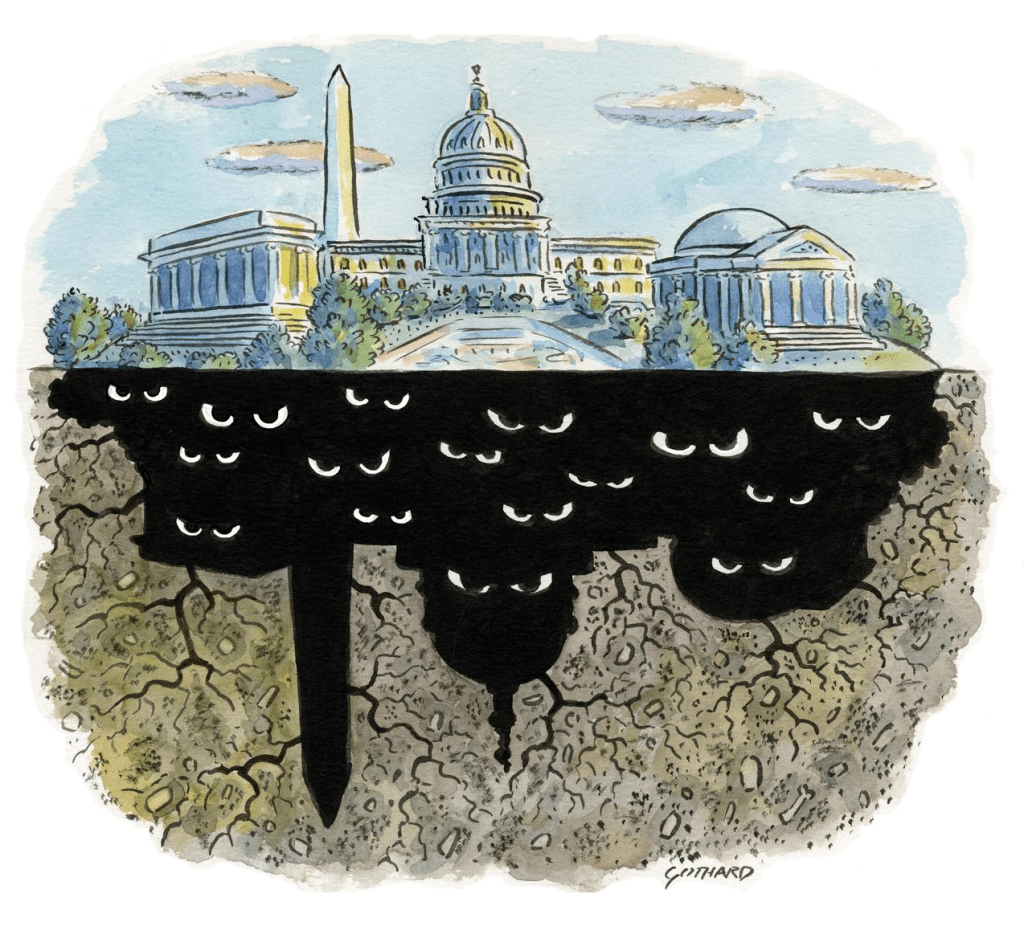
Who actually controls the vast bureaucracy of the federal government? If you ask most Americans, they would likely point to the President. After all, we elect him to lead the country. But for decades, the reality has been much murkier. We have allowed a fourth branch of government to grow, a sprawling web of independent agencies such as the FTC, EPA, the SEC, and dozens more that operate outside of direct presidential control, insulated from accountability. Defenders of this administrative state call it a necessary evolution; they argue that modern governance is too complex for one person and that these agencies act as a vital check on a potentially imperial presidency.
They are wrong.
The idea of a fragmented executive is a modern myth that distorts the Constitution, ignores history, and erodes the only power that voters truly have: the power to enforce accountability. Recently, the Unitary Executive Theory, or the belief that the President of the United States possesses sole authority over the executive branch, has been thrust into the spotlight by the Trump Administration’s efforts to curb the federal bureaucracy. Many have framed it as a partisan tool of hardline conservatives, but they are mistaken. The theory should not be vilified as a power grab. When the Supreme Court rules on this issue, as it soon will, it will not be merely in service of Donald Trump. Rather, they will be deciding the integrity of the separation of powers. I’ll be glad to see their ruling, and hopeful that it expands presidential power, because the Unitary Executive is the unambiguous design of the Constitution, regardless of who sits in the Oval Office. It is time for the Supreme Court to finish the job of restoring it.
The case for the Unitary Executive begins with the plain text of the Constitution. The Framers designed a simple structure, a trinity of powers: Legislative, Executive, and Judicial, each vested in distinct branches. There is absolutely no Constitutional basis for a fourth administrative branch insulated from accountability as exists today.
The difference in how powers are granted to each aspect of the trinity is stark and intentional. The Constitution is incredibly specific about this. Article I gives Congress “All legislative Powers herein granted,” meaning Congress can only do the specific things laid out in the following sections. But Article II is different, saying, “The executive Power shall be vested in a President.” The limiting phrase of “herein granted” is missing. The Founding Fathers wouldn’t leave a typo, so this wording is a deliberate decision to give the President all of the executive power without exception. There were no limitations given, no sections that followed listing specific actions that the President can take as in Article I. There was only the grant of broad Executive Power.
This structure of a unitary executive is reinforced by the “Take Care” Clause, which commands that the President “shall take Care that the Laws be faithfully executed.” This is an active duty, not a passive one. So ask yourself: How can a President “take care” of the execution of the law if he cannot control or remove the officials executing those very laws? He cannot, and if he can’t control them, he can’t uphold his duty.
Despite this very clear text, legal scholars known as functionalists argue that we should ignore the strict separation of powers. They claim the Constitution should be a living equilibrium, where judges and legislators can carve up the executive branch to suit the complexities of modern governance.
Their argument sounds reasonable on the surface: after all, it seems only necessary to have independent experts, insulated from politics, to manage the economy and regulations. The functionalists argue that the independent agencies, where the President is legally forbidden from firing the head of the agency without court-sanctioned “cause,” help to protect these experts from political interference.
But this functionalist view is a trap. It replaces the clear rules of the Constitution with a standardless test where a judge, not the leader elected by the people, gets to decide what counts as good governance. It assumes that bureaucratic “expertise” is more important than democratic accountability. This is not the American way. The Framers didn’t want a government of insulated experts, free from the scorn of voters. They wanted a government where policy is accountable to the people through their elected leader. When we allow experts and independent actors to run the government without presidential oversight, we effectively shield the most powerful policymakers in Washington from the voters they are supposed to serve. We’ve all heard the conspiracies about a nefarious “deep state” of individuals free from political accountability. But this administrative entity, composed of a maze of independent agencies with vast authority, answerable to no one, and rarely held accountable, proves that the ominous deep state isn’t some conspiracy, but is instead very real.
To many Americans, the Unitary Executive may seem like a novel invention of sorts, something touted by modern radicals. But the Unitary Executive is a concept deeply rooted in American history. In 1789, during the very first Congress, the Founders debated this exact issue. In the “Decision of 1789,” they affirmed that the power to remove officers, in that case the Secretary of Foreign Affairs, was an inherent constitutional power of the President, not a privilege that Congress could give or take away.
George Washington, our first President, exemplified this principle. He didn’t act as a figurehead. He aggressively controlled all of the executive branch, directing departments and asserting his authority from day one. Even the Treasury Department, often cited as a historically independent entity, was treated by Washington as a subordinate agency. He famously ordered his Treasury Secretary, Alexander Hamilton, to write up the defense of the national bank. The Framers, the First Congress, and President Washington all understood that the executive branch must be unified under one leader with broad authority.
So how did we get to the current reality, where a massive and unaccountable administrative state holds the executive hostage? We can blame the Supreme Court of the 1930s. In 1935, the Court was facing an executive that had expanded the federal government and who was politically at odds with the Justices. Just nine years earlier, in Myers v. United States the court ruled that the President had the power to fire executive officials. But the Justices, afraid of FDR’s presidency and angry at his attacks on the Court, made a remarkable and politically charged turn in a case called Humphrey’s Executor. In order to protect a Federal Trade Commissioner from being fired by FDR, the Court invented an opaque distinction, claiming that some officers were “quasi-legislative” or “quasi-judicial” and therefore didn’t have to answer to the President. This decision was constitutionally incoherent: an officer is either executing the law, or not. Following this decision, the power of the administrative branch grew rapidly, eventually culminating in Morrison v. Olson (1988), which upheld the independent counsel. Justice Antonin Scalia’s lone dissent in that case, now seen as a vision for the restoration of the unitary executive, warned that by fragmenting the executive, the Court was creating a “monstrous amalgam” that shattered the clear lines of accountability envisioned by the Founders.
Fortunately, the tide is turning. In cases like Seila Law (2020) and Collins (2021), the Supreme Court has begun striking down for-cause removal protections, affirming that the President’s removal power is the rule, not the exception. The recent oral arguments in Trump v. Slaughter (ongoing) regarding the removal of an FTC Commissioner suggest that the Court is finally ready to overturn Humphrey’s Executor entirely. Contrary to popular belief, The Unitary Executive Theory does not argue that the President should be able to personally fire a local postmaster in Alaska at will. The core, non-negotiable claim is about the heads of departments and agencies, the principal officers who set the policy and direction of the executive branch, like the FTC Commissioners in Humphrey’s or the Independent Counsel in Morrison.
So, why should you care? After all, this seems like a complicated debate for lawyers and constitutional scholars. But this matters to every single American who votes. Under the current system, if an independent agency like the FTC, HHS, DOJ, DOD, or the SEC fails spectacularly or puts up political resistance to a President’s agenda, no one is truly accountable. The President’s hands are tied by “for-cause” protections, and the unelected agency heads answer to no one, serving continuously through multiple administrations. This is the definition of autocratic power, a ruling class insulated from the voters.
The Unitary Executive forces responsibility back into the open. It places all executive power in the hands of the one official who must face the American people at the ballot box. Under this system, a President cannot blame a rogue director for disastrous policy—he must own it. That is the design. I look forward to seeing the Supreme Court’s decision regarding Slaughter, and if you (whether Democrat or Republican) care about rooting out corruption, holding politicians accountable, dismantling the real “deep state,” and restoring a Constitution of the people, by the people, and for the people, you should too.
Categories: Domestic Affairs

 The Texas Orator