
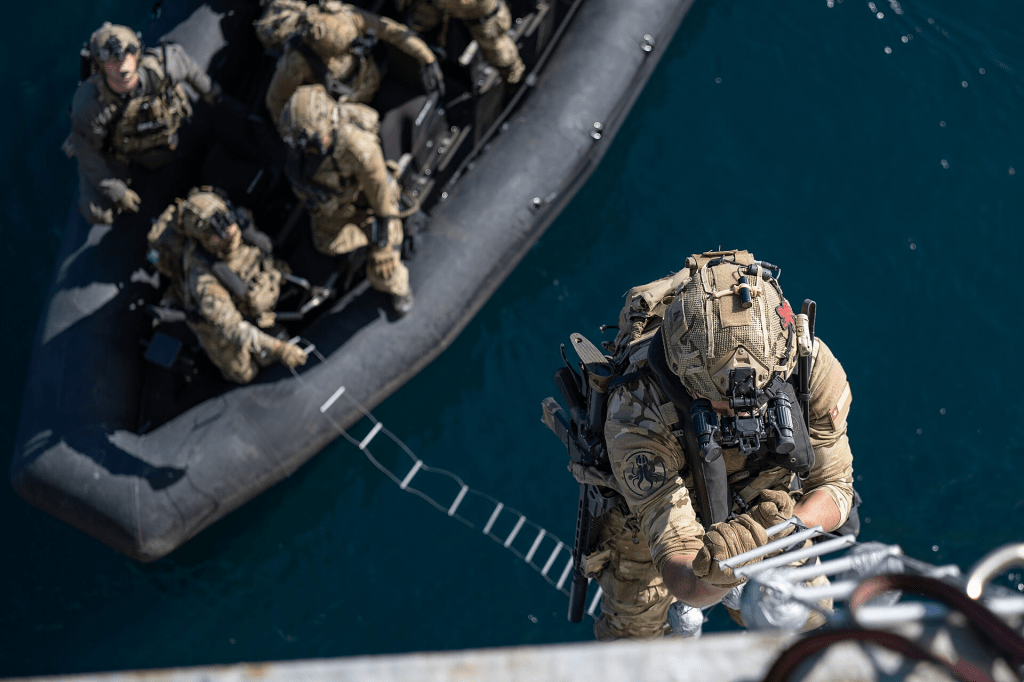
Few imagine diplomacy being conducted by soldiers and other practitioners of warfare. Running around open, grassy fields or urban landscapes, intercepting and boarding sea vessels near the coast, or conducting HALO (High Altitude Low Opening) jumps in the pitch-black of night are not the typical activities one associates with diplomacy. However, these activities fit under one definition of military diplomacy, where “armed forces use non-violent means to influence decisions and behaviors of foreign entities in pursuit of national objectives.” U.S. special operations forces (SOF) conducting joint training activities with other nations is a prime example of this. The importance of these specialized military forces is often underreported and underestimated in their potential to build trust and cooperation with new and existing allies. Interestingly, it can also portray the U.S. military operating in the realm of soft power, instead of the hard power perception that militaries typically exhibit.
In the modern day, the Department of Defense defines special operation forces as “those active and reserve component forces of the services designated by the Secretary of Defense and specifically organized, trained, and equipped to conduct and support special operations.” Additionally, “special operations” are defined as “activities or actions requiring unique modes of employment, tactical techniques, equipment, and training often conducted in hostile, denied, or politically sensitive environments.” Among them are direct action, special reconnaissance, counterterrorism, and others specified by the Department of Defense. In short, they are specially trained military personnel who can perform activities that ordinary military personnel cannot in places where the military is not welcome. A well-known example of modern U.S. special operations forces is the U.S. Special Forces or the Green Berets. They specialize in unconventional warfare and foreign internal defense, demonstrated by their advanced knowledge of foreign languages, cultures, and traditions. Furthermore, they maintain and update their knowledge of the political, economic, and cultural landscapes in which they operate. The specialized role of the Green Berets enables them to serve in any diplomatic efforts (or lack thereof), leaving little to wonder why they are nicknamed Soldier-Diplomats. Other U.S. SOF components include the famous Navy SEALS, Marine Raiders, Air Force Special Tactics Squadrons, and many lesser-known ones rarely mentioned in the media. Despite any levels of recognition, these forces also play important roles in U.S. defense, with many of them training alongside foreign forces, whether they are SOF or not.
To better understand when the U.S. SOF began training with foreign forces, we have to look back to WWII. U.S. Special Forces can trace their beginnings to the Office of Strategic Services, which used Jedburgh teams to support resistance fighters behind enemy lines. Although the Jedburgh teams trained, armed, and supported foreign resistance fighters effectively, the first teams would not be deployed until 1944. However, the very first joint SOF training effort in U.S. military history was arguably the First Special Service Force (FSSF). The highest levels of the Allied Command during WWII sought to create a force that could fight everywhere, particularly in the harsh winter. Formed by Lieutenant Colonel Robert T. Frederick, American and Canadian volunteers were recruited to train in the mountainous and harsh conditions of Helena, Montana. They learned to operate various weapons, fight hand-to-hand, and cross-country ski under Norwegian instructors. Despite their short service of two years, their special training earned them numerous achievements in the Mediterranean theater and the nickname “Devil’s Brigade” by enemy troops. While a small component of Allied manpower during the war, the FSSF demonstrated a unique and successful role in the joint training of forces of historical and cultural backgrounds and deployed them in theater operations. Furthermore, the unit showed how effective joint training with foreign troops can translate into real operational successes when put to the test.
From then on, U.S. SOF trained with a variety of foreign forces around the world, especially during the Cold War. Green Berets, starting in 1957, were deployed to Vietnam to train soldiers from the Army of the Republic of Vietnam (ARVN). Joint training allowed ARVN soldiers to gain knowledge of Ranger tactics while the Green Berets learned to work alongside them in jungle environments. This simultaneously enabled the U.S. to maintain a small military presence in South Vietnam under the guise of security assistance in the form of military advisors under their Military Assistance Advisory Groups (MAAGs). However, Southeast Asia was not the only region where U.S. forces were stationed. In Europe, the 10th Special Forces Group trained alongside European allies and could conduct partisan warfare in the event of a Soviet invasion of Europe. They have also historically hosted the Flintlock exercise, where U.S. SOF trains alongside European host countries and partners in areas where they may have to work together during conflict. Today, Flintlock has evolved into the largest annual exercise conducted by the U.S. Africa Command alongside various African countries such as Ghana and Côte d’Ivoire. The Flintlock exercise not only emphasized the expansiveness of the U.S. SOF’s joint training but also its diplomatic value as well.
In addition to Flintlock, there is a broader program known as the Joint Combined Exchange Training (JCET). Dating back to 1991, Congress to this day has authorized the Department of Defense (DOD) to permit the training of foreign troops and allocate a budget towards this training, so long as the U.S. SOF receives a majority of the training. In 2022, 149 JCET exercises were approved for the fiscal year (an increase from 136 events in FY 2021), with an approximate cost of $55 million. Although only a small portion of the U.S. Special Operations Command Budget and the overall DOD budget, the number of exercises demonstrates the importance these exercises have on both training U.S. SOF and partner nations. Since WWII, efforts to conduct joint training exercises among partner nations have shown little decline, but rather a substantial increase over the years, even after the end of the Cold War. Moreover, these joint training exercises have demonstrated two strategic benefits for the United States: the first, allowing U.S. SOF to learn and train in potential areas of operation, and the second, supporting U.S. foreign policy goals by acting as a soft power tool in competition against foreign adversaries.
Joint training with U.S. SOF has produced strategically important diplomatic effects, but one could make the same argument for joint training among non-U.S. SOF. These exercises/events are even more underreported, given the lack of awareness surrounding foreign SOF. The most publicly known training exercises among SOF after the U.S. are NATO’s exercises. Specifically, the Allied Special Operations Forces Command (SOFCOM) incorporates special operations forces from NATO member and partner countries while training them to support NATO’s strategic missions. In 2024, the exercise known as “Bold Machina” had SOF teams training with diving propulsion systems while operating near underwater detection systems. While there are no specifics on the participating forces and their nationalities, NATO exercises such as these are not US-centric and showcase NATO members working diplomatically together through a joint exercise by collectively tackling a security challenge.
Outside of NATO and the U.S., reports of joint training can signal different strategic dynamics. For example, in July 2025, China and Serbia conducted the “Peacekeeper 2025” exercise, which drew criticism from both the European Union and the United States. The exercise highlighted the potential Chinese influence in Eastern Europe, including many U.S. military allies in the region. More importantly, it signaled Serbia’s willingness to “sit on the fence” as part of a broader diplomatic strategy by not siding with one great power over another. In June 2025, Indonesia and Singapore conducted a joint exercise where their special forces seized a hijacked liquefied natural gas (LNG) carrier, emphasizing intelligence sharing as a key role. This level of regional cooperation, especially against a shared security threat of maritime terrorism, showcases how smaller countries collaborate without direct assistance from great powers. It also enhances existing diplomatic relations between their militaries and governments. Like the United States, these SOF units obtain practical training in potential areas of operation and act as a soft power to enhance diplomatic relations.
By allowing U.S. SOF to train with foreign forces and conduct joint exercises, the U.S. employs one of the many tools in its statecraft when it comes to U.S. foreign policy. Specifically, the training plays a potent role when one considers the history of the U.S. SOF training alongside foreign partners. Even in the case of non-US SOF training alongside one another in the world, these “under the radar” instances can signal emerging military relationships between other foreign nations. Paying attention to this lesser-known diplomacy could reveal bits and pieces of a nation’s strategic interests.
Categories: Foreign Affairs

 The Texas Orator