
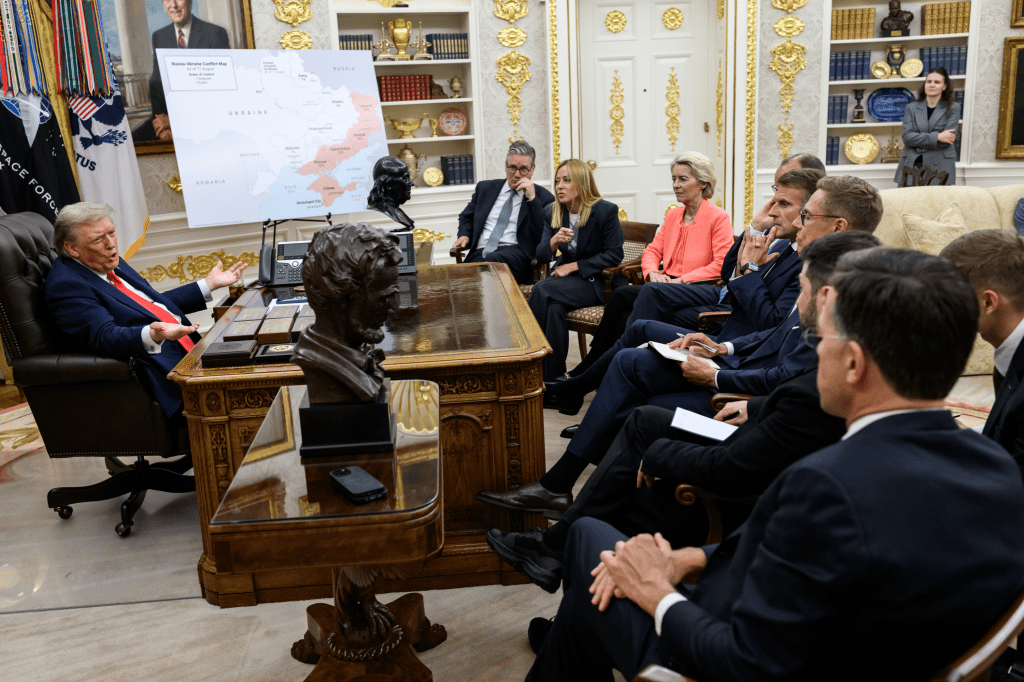
The Transatlantic Alliance. A marriage of the United States and Europe. A beautiful union of the rolling hills and supposed sophistication of the Europeans with American size, strength, and bluntness. For nearly a century, it has stood at the center of the liberal international order, celebrated by politicians, schools of diplomacy, and the media as something noble, enduring, and even exceptional.
That story is rapidly ending.
Embodied through the institution of NATO, the Transatlantic Alliance emerged from the ashes of the Second World War. Europe was economically destroyed, politically fragmented, and deeply scarred. The United States, comparatively unscathed and left as the world’s sole industrial power, stepped in to help its brethren, driven by its deep cultural ties to Europe, gratitude for past alliances, and ideological inspiration drawn from European political traditions. More importantly, the United States also saw the growing need to stop Europe from being dominated by the Soviet Union. So, with historical reverence and strategic realization, it stationed troops across Europe, extended its nuclear umbrella, and flooded the continent with economic aid and American goods. In effect, the United States bankrolled Europe’s recovery and security, purchasing the continent’s loyalty and achieving a substantial return on investment. The post-war American economy boomed, and Europe rebuilt itself into a continent defined by social welfare and political stability. The United States assumed its role as the world’s policeman with Europe as its primary station.
The Cold War began soon after. While the Soviets loomed, they could be managed. The United States bore the overwhelming share of the military burden, and Europe increasingly optimized for domestic prosperity. Over time, this disparity intensified. At times, European governments even began to undercut American positions on nuclear doctrine, military posture, and diplomacy. Arguments ensued, but the alliance held. The strategic logic of containment remained intact, and Europe, for all its dissent, typically deferred to American leadership. The Transatlantic Alliance held strong.
Then, the Soviet Union collapsed.
Now, NATO, and the alliance as a whole, lacked a clear mission. Rather than transform or adapt, it became vague and hubristic. NATO expanded eastwards, absorbing weak states that were more of a burden than a security partner and antagonizing a resentful Russia. Meanwhile, the Americans were still the primary source of financing and power projection. Alongside the United States, the alliance took on the supposed goals of democracy-building, moral leadership, and humanitarian intervention that defined the late twentieth and early twenty-first centuries. Yet over the decades, a pattern began to appear. In Bosnia, Kosovo, and later Libya, American forces did the heavy lifting. European governments, protected by the United States, preached legality and moral caution while benefiting economically. Iraq was an exception due to American coercion, but European corporations profited enormously from Middle Eastern markets shaped by American intervention and bore none of the long-term costs or responsibilities. Some resentment began to brew, but still, the alliance persisted. After all, the Americans were still the world’s only superpower. Liberal internationalism remained the dominant global framework. The costs were mounting, but they could be managed. There was no major threat.
Then, the Middle Kingdom roared back to life.
China’s rise shattered the core assumptions that had long sustained the Transatlantic Alliance. The United States is no longer the world’s sole superpower. It is saddled with deep internal issues on immigration, inequality, and its future. It carries a massive debt burden. It is in a fight for its role as a major superpower and leader in artificial intelligence, advanced manufacturing, and technology. In this environment, everything must be looked at through its opportunity cost; there is no room for nostalgia or goodwill. In such a world, alliances like NATO, in their current form, cannot exist.
Why? Because it’s a numbers game. After the end of World War II and with the rise of the Soviets, the United States’ defense budget saw little reprieve. It’s estimated that around thirteen trillion dollars were spent on the Cold War, defense analysts estimate that in the post-war era, the United States covers approximately sixty percent of allied defense spending. Even if we drop the number by ten or twenty percent, that’s around six trillion dollars spent on European security. Incorporate the cost of extending the nuclear umbrella, to such a degree that at one point thousands of American nukes lay ready across the continent, and the development of specialized weapons specifically for Europe’s theatre, and the numberjumps by another 2-3 trillion. Now incorporate the United State’s direct spending on European defense of thirty to fifty billion a year over the last thirty years, and the number jumps by another trillion. These calculations don’t include the fact that the trillions spent on the Vietnam and Korean wars were indirectly to protect Europe, nor do they include the potentially hundreds of billions in “dark” money spent by intelligence agencies. They also don’t include the billions, potentially trillions, that have been spent and continue to be spent on American bases and troops across Europe.
Most important of all, it doesn’t include the tens of trillions spent on America’s global military posturing over the last fifty years, which immensely benefited the European economy and allowed them to develop their modern states. Yet still, the total figure, even without all these additional considerations that may total another twenty trillion dollars, touches around ten trillion dollars. And that’s just a conservative estimate. Such a number represents more than just military expenditure. It represents foregone domestic investment in sectors like education, healthcare, and infrastructure that were theoretically affordable. Instead, the United States chose European security. It wasn’t a one-sided transaction, and estimates put overall European defense spending (including the UK) at thirteen trillion dollars over the same period. But that’s an entire continent, composed of dozens of nations, and for parts of the eighties and nineties, the European Union had a higher GDP than the United States. Still, the Americans contributed a massively disproportionate share for a single country. The reason for these calculations and comparisons is simple: the United States has footed an enormous bill. One that is truly incalculable. Europe’s high standard of living and expansive welfare systems were made possible in large part by American defense spending, and this is especially important after the Cold War, when European defense spending fell off a cliff.
Some will object to even considering the alliance in these terms. Europe is a major trading partner after all, but trade does not warrant defense. The United States trades extensively with Latin America, Asia, and dozens of other regions without underwriting their security. Trade is fungible. A military subsidy in the tens of trillions is not. And Europe need not pay the United States back. Instead, they must realize that in our changed world, protection without greater contribution is no longer sustainable.
Europe needs to wake up. Alliances structured like NATO are rare in human history. The continent did not achieve its lifestyle through some enlightened model of governance or the brilliance of its people. It was achieved because of a world order militarily and economically enforced by a thoroughly dominant United States. That era is over.
Europe likes to imagine it has alternatives, that some other power will give it a similar deal. That’s not the case.
It can cozy up to China, but that’s a path of brutal extraction. Chinese products will hollow out Europe’s remaining manufacturing base, its last crown jewel. And regardless, the Chinese would never agree to an arrangement like the one the Americans have, underwriting the security of an entire continent. The Europeans could consider working with Russia, but that idea barely deserves a response. Russia offers no future, no growth, and limited security. Just energy, and plenty of resentment, already seen through its actions in Ukraine.
The truth is harsh: Europe is running out of options because it has refused to adapt. As a result, its demographics are collapsing, its militaries are hollowed out, and its industries are shells of what they once were. The European Union, with their lack of high-tech systems and military reserves, can barely support a single ally Ukraine in its fight against Russia. And for some laughable reason, the continent continues to behave as though American protection is permanent and must be unconditional, as though the liberal international order is set to last for centuries to come.
And nowhere is this clearer than in Greenland.
Greenland is formally part of the Kingdom of Denmark and is covered by NATO’s security guarantees. Yet its strategic value via Arctic access routes, proximity to North America, missile defense relevance, and bounty of rare earth minerals matter overwhelmingly more to the United States than to Europe. Washington has recognized this for decades, and the United States has maintained military installations there since World War II.
Over the last few decades, Denmark has quietly ceded control of the island’s resources to Chinese firms, allowing them to purchase vast shares of critical mines. At the same time, they’ve given up on properly defending the territory’s waters, as the Arctic passages on the European facing side of the island teem with Russian icebreakers. All of this activity occurs within hours of American shores. Yet when the United States signals interest in greater control, including the potential acquisition of the island, European leaders respond with their typical moral outrage, framing the issue as a violation of norms and sovereignty. However, they ignore the more uncomfortable truth: the arrangement is deeply unbalanced. To the Europeans, the United States is expected to guarantee European security, absorb the costs of Arctic defense, and tolerate strategic encroachment by rivals in regions vital to America’s future as a technological powerhouse.
But there is one option, a difficult one. One partially echoed by the likes of Canadian Prime Minister Mark Carney at this year’s Davos Forum.
Europe could choose to contribute. It could rebuild its defense capacity, spend real money, and accept that a painful transition may need to occur as a world without American hegemony becomes a reality. It must forget the nostalgia of the liberal world order and its supposed “morality,” the norms, and rules.
And this article isn’t an endorsement of American conquest either. The United States, for its part, doesn’t need to conquer territory to secure its interests. But it does need more leverage and more control over what it considers vital as the next Cold War, one against an entity that makes the Soviet Union look like a joke, intensifies. Geography matters again. Resources matter again. Power matters again. Greenland is, at the end of the day, about resources, geography, and power.
Reducing this moment to the personality of Donald Trump and a brief period in American policy misses the point. Yes, Donald Trump may want territory, but the impulse for expansion predates him and it will outlast him, and it isn’t even relevant. What’s more important is the underlying message beneath Trump’s changing words. What is that message? It is that the United States can no longer afford to unilaterally uphold the global order, that liberal internationalism is dead, and that blunt transactional diplomacy and power politics, the norm for most of human history, are back.
Europe should listen carefully to the message, because America wants a bigger plate, and Europe is expecting the US to eat less and pay for dinner. That’s a recipe for disaster.
Categories: Foreign Affairs

 The Texas Orator