
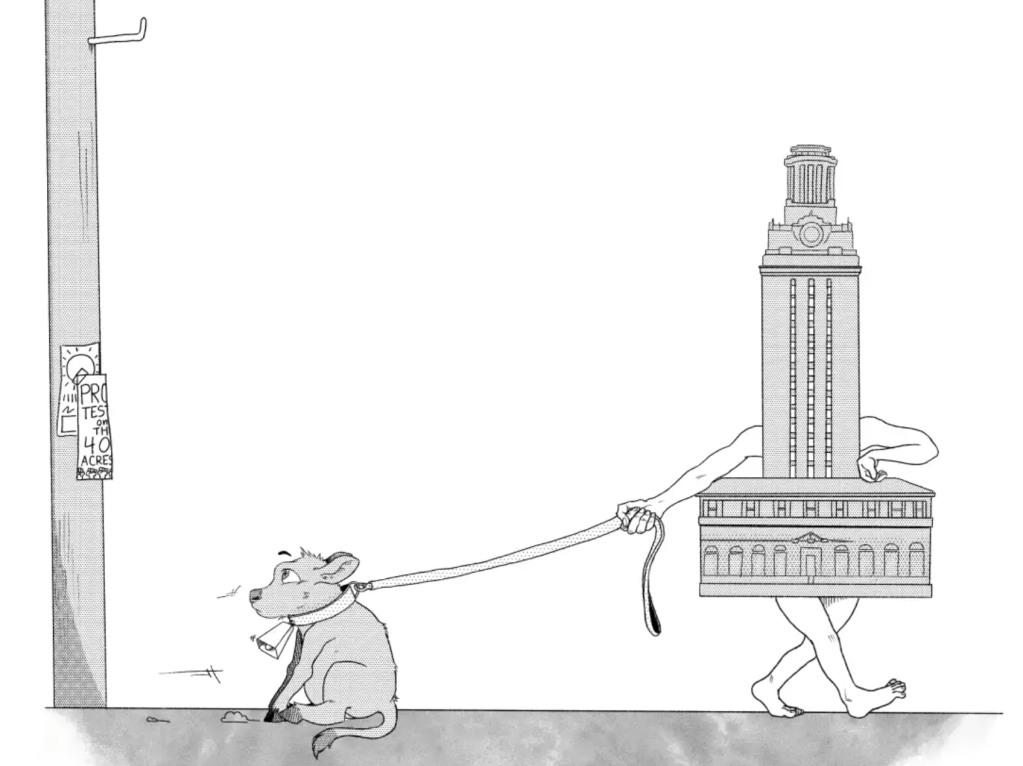
There are two types of student media at UT Austin. First and certainly foremost is The Daily Texan. It is an insurmountable media monster, kept alive by its master—Texas Student Media. Regardless of any pretense or protest, The Texan barks for the same ring of administrators and presidents that siphon $10,000 a year from every single UT student. Through The Texan, the university casts its influence and advances its interests. Do not be fooled. The University will always fervently posture to make us believe they care about our fates… but their mask of humanity slips.
Recall April 24th, 2024, when legions of boots, horses, and batons marched on our campus. Recall how scared then President Jay Hartzell was of his own students. We’re not on the same side. We’re just customers to them. This song and dance to President Davis is a laughable attempt at appeasement. Whoever’s in charge of a business that makes its money on siphoning and repressing youthful ambition doesn’t matter. I hope Davis enjoys his promotion.
When our University cannot be trusted to safeguard students’ liberties, you better believe the lapdogs at The Daily Texan can’t be trusted either.
As dozens of their fellow students were being intimidated, arrested, and brutalized by police, The Daily Texan’s Ren Leija followed the story. She wrote the Daily Texan’s first response, and she stuck to the script—a brief timeline of events. This kind of reporting may be appreciated by curious outsiders or future historians, but her milquetoast style did nothing to condemn the University’s actions. I don’t blame her. Daily Texan journalists like Ren have to walk on egg shells when reporting on the University’s faults. You can’t bite the hand that feeds you.
One year later, the Daily Texan’s Vivien Ayers, Katie Chang, and McKenzie Henningsen wrote “Silence on the South Mall.” This article is intended to be a collection of facts and reflections from the protests. In their letter from the editors they write, “while the University remained silent, The Daily Texan did not.” A powerful sentiment which is not reflected in the slightest even within the article it precedes. They don’t share any critical opinion of the University. They are too cowed to offer even an opinionated adjective. Despite their call for their readers to reflect on what “free speech means,” their meticulously polite way of covering brutality is its own form of censorship.
Fortunately, neither the University of Texas nor its Daily Texan gets to “define” free speech.
The Daily Texan may be full of tepid takes and politically correct opinions, but make no mistake, they do work hard in their University-sanctioned basement. They toil day in and day out, spending many late nights editing and writing their propaganda. They impose swift deadlines with the same carbon-copied writing styles that they inherited generations ago. This sort of Kafkaesque bureaucracy sucks the life and energy out of their own members, not to mention many of their readers.
I had the misfortune of collaborating with some students working with Texas Student Media on Tower Talks One week they were smiling and laughing along with me like friends. The next week, they cut my microphone and scrubbed their recordings of any and all appearances I had made. They feared some kind of contamination I might have leached out onto their show. To be clear, I spoke frankly about The Daily Texan’s own forms of corruption—on their episode about corruption. Apparently I hit too close to home.
Texas Student Media is a sad joke. I’d recommend it to those whose aspirations are to climb the ladder of sycophants and liars that leads right along to corporate media (the Travesty is cool, however).
Who can we turn to to keep the University accountable?
Independent student media. Student organizations, although technically affiliated with the University, do not have any of the same obligations to serve the institutional bureaucracy. You’ll often see this type of student media tabling out on Speedway, pitching to disinterested strangers. These organizations are small, thirty active members at their largest. They often have an overt political slant and/or a specific subject matter that their members must adhere to, such as law, the environment, or international affairs. In this way, independent student media is deeply fragmented. At first glance, students have a healthy pool of journals and blogs they can contribute to based on their own interests. However, because each organization is small on their own and will vary on their quality and commitment, it is impossible for them to make any major impact on campus; much less any chance to deliver serious competition with the Texas Student Media.
It was four years ago now that I joined one such student organization called The Texas Orator. Back then, it was a small band of mostly unenthused writers led by a hands-off Editor-in-Chief. I liked it. I wrote for it. But, it took six months for my first article to get edited and published. It’s funny looking back, because of how far we have come. The Texas Orator’s membership has multiplied in recent years, and it is brimming with some of the most passionate and intelligent writers on campus. The Texas Orator platforms their brilliance and empowers their inalienable freedom of expression. They freely write on any range of subjects and hold any opinion. They write fearlessly because the Texas Orator refuses to censor or suppress student voices.
The Texas Orator isn’t perfect. But it is The Premier Free Speech Platform On Campus. I sincerely believe that it stands the best chance of reviving truly independent student media on campus. The University of Texas at Austin is overflowing with such genius and creativity that if even 1/1000th of it was unified they could shake off their muzzles and apathies. We can compete with The Daily Texan, and we must.
Categories: Campus Affairs

 The Texas Orator
Extremely powerful read.
LikeLike
I’m confused as to what led to this conclusion? Is this a well researched and backed claim, or just convoluted conjecture on behalf of a disenfranchised individual? Would seem more like the latter; it appears to be an awful lot of barking for someone calling an entire independent organization a lap dog?
LikeLike