
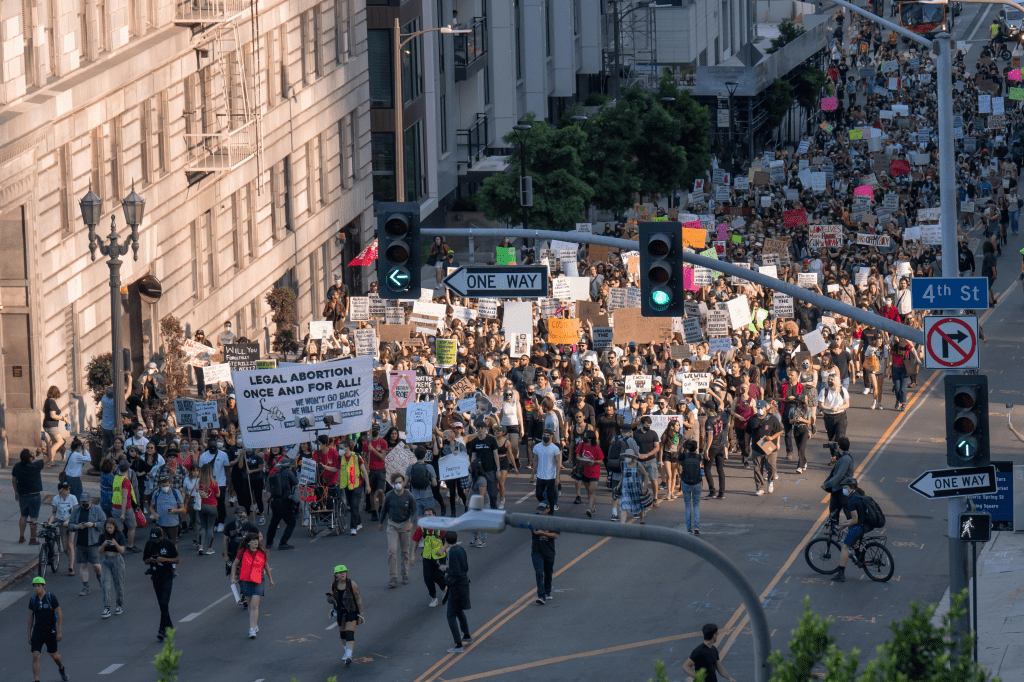
In the case Planned Parenthood of Southeastern Pennsylvania v. Casey (1992), the Supreme Court deliberated on a case that had the opportunity to overturn the previous ruling in Roe v. Wade that established abortion as a fundamental right in the Constitution. Amendments made in 1988 and 1989 to Pennsylvania’s Abortion Control Act of 1982 created several new restrictions on a woman’s right to abortion. These included a twenty-four-hour waiting period after the initial appointment, minors needing the consent of one parent (with a judicial bypass procedure), and spousal notification. Several abortion clinics and physicians joined to challenge the constitutionality of restricting women’s access to this medical procedure. The District Court ruled that these restrictions were unconstitutional under the standard set by Roe v. Wade (1973), but the 3rd Circuit Court of Appeals upheld all provisions except for one. Planned Parenthood then appealed the case to the Supreme Court to contest this decision. The impact of the Supreme Court’s decision in Casey was significant because the justices were not only ruling on these specific regulations, but also the constitutionality of abortion overall. The justices correctly upheld Roe v. Wade (1973), as abortion should be a fundamental right guaranteed by the Constitution.
Casey was the first major case calling into question whether the original ruling in Roe v. Wade in 1973 was correct, and it created widespread uncertainty on if the precedent would be upheld. The Supreme Court voted 5-4 in their decision to uphold the lower court’s ruling, which demonstrates that the decision in this case was not easy. A majority of the Court was appointed by Republican presidents, so the debate did not have an equal partisan split. Their previous rulings tended to be conservative, choosing to uphold precedent rather than overturning it. In that way, the vote was not divided by political alignment, but centered around if the right to abortion could be read from the implied constitutional right to privacy. This debate was apparent in several matters at the time, including the right to die, the right to marriage, and the right to sexual privacy. This reveals the justices had pre-established views on the extent of the right to privacy and were able to apply arguments from previously decided cases to the matter in Casey.
Majority Opinion
Justices O’Connor, Kennedy, and Souter wrote the majority opinion for this ruling together, upholding Roe and all but the provision of spousal notification in Pennsylvania’s Abortion Control Act. They used “stare decisis,” the practice of ruling based on precedent, to recognize privacy as a constitutional right. In the earlier case of Griswold v. Connecticut (1965), the Supreme Court effectively created a ‘penumbra’. This ‘penumbra’ was formed from enumerated rights in 1st, 3rd, 4th, 5th, and 9th Amendments, which all together implied the right to privacy. This framework was later used in Roe, the primary precedent establishing the right to abortion. The right to privacy had also been given constitutional protection in the cases:
- Loving v. Virginia (1967) in relation to marriage
- Skinner v. Oklahoma ex el. Williamson (1942) in relation to procreation
- Prince v. Massachusetts (1944) in relation to family relationships
- Pierce v. Society of Sisters (1925) in relation to child rearing and education
- Eisenstadt v. Baird (1972) in relation to bearing a child
As such, it is clear that this liberty existed many years prior to Casey, and the justices rightly dictated in this case that precedent must be followed. By using this precedent, the justices undeniably confirmed that the right to abortion exists in the Constitution.
In the majority opinion, along with upholding precedent, the justices also emphasize the importance of protecting the legitimacy of the Supreme Court. If they chose to overturn Roe, the Court would show instability in its decisions. This would diminish the effect of their rulings and make citizens less confident in the verdict. In controversial cases such as Casey, the justices correctly argued that instead of finding a new meaning, one should look to previous rulings. The implications of privacy had been applied in several other cases, but its existence was only contested in the extremely controversial issue of abortion. If the Court were to overturn Roe after nineteen years, it would be because of political pressure and faulty legal arguments, rather than a decision based on previously established rulings on the constitutionality of the subject. Although this argument focused on protecting the Court rather than the right itself, it gave space for several justices to agree that the right to abortion was implied in the Constitution.
While upholding the precedent of protecting individual liberties, the majority opinion in Casey agrees that there must be a balance between individual interest and the state’s interest. The Court established a framework to balance these interests, and the standard of looking for “undue burden” became an established principle. This principle requires that a state’s regulation must not create an extra barrier for a woman seeking an abortion. The Court also established in this case a new standard for when a state could begin to impose restrictions. Instead of the previously followed trimester guidelines established by Roe, viability (or the time in which a baby could survive outside of the womb) became the new determining factor. The justices established this standard as it was workable with evolving medical advancements, yet still restricted a state’s ability to limit a woman’s access to abortion before viability. Afterwards, a state could begin to make restrictions in the interest of the unborn child. This managed to protect both the mother’s right to choose and the child’s right to life. While ultimately limiting access, these changes were created to protect the constitutional freedom to get an abortion.
By creating this framework to examine the constitutionality of statutes limiting access to abortion, a decision was reached about whether or not the restrictions put into place by Pennsylvania would stand after applying the “undue burden” test. The majority opinion correctly decided that all but one provision in Pennsylvania’s act did not impose an extra burden on women who may be seeking an abortion: the rest of the requirements were able to be followed rather easily, and they did not risk keeping the woman from seeking out the care she desired. Spousal notification was the only provision struck down as unconstitutional. Requiring pregnant individuals to inform their partners of their decisions could lead to dangerous situations, such as domestic violence or coercion. Without spousal notification, women are better protected from abusers who attempt to limit their access to abortion. By implementing the “undue burden” test, the justices created a framework for protecting women’s right to terminate their own pregnancies.
Dissent
In his dissenting opinion, Chief Justice Rehnquist argues that the incorrect decision was made in choosing to strike down spousal notification and in upholding Roe. He points to the fact that while the main debate was about the constitutional protection of abortion, the majority did not choose to center its opinion on its constitutionality. Instead, they used “stare decisis,” which he argued proved that their arguments would not hold up if they tried to root their position in the Constitution. While it is true that the majority made this choice, it was actually to avoid arguing the same principles again as it was more crucial to emphasize the importance of upholding precedent in this case. Chief Justice Rehnquist also insists that the right to terminate one’s own pregnancy is not fundamental, and as such, should not be held to the standard of strict scrutiny. Even so, as the right to privacy is still upheld, anything falling within that right warrants federal protection.
Justice Scalia agrees with Chief Justice Rehnquist in his dissent that all of the provisions should stand and that Roe should be overturned. He also states that there is a procedural issue at hand. Justice Scalia argues that, as this is a political matter, it should not be ruled on by the judicial system. He continues to state that the ruling would be making a value judgment rather than using the Constitution to find evidence for the right to abortion. The majority addresses this substandard point, highlighting that overruling precedent requires undeniable evidence to make it an unbiased decision. Justice Scalia further argues that while it is a personal liberty, it is not one granted in the Constitution. He believes that it is never mentioned in the text, nor in any documents relating to its creation, and has historical evidence of being a regulated liberty rather than a protected right. Although women’s rights to abortion have been historically limited, this restriction only began in the mid-1880s with the declining birth rates of Anglo-Saxon women. While there were no laws protecting abortion, it was historically seen as a practice that individuals had the right to participate in.
Conclusion
The constitutional right to abortion, while debated, is an important liberty that women should be guaranteed. The ruling in Casey upheld this fundamental right, and the ramifications have been seen in several cases since. It created an important precedent with the “undue burden” test, which could be used in cases where a woman’s access to abortion is being restricted, removing obstacles in the way of their healthcare. While the creation of this test moved abortion away from being considered a fundamental right, it created a framework to allow regulation without total abandonment. The Supreme Court correctly used Roe as precedent and struck down spousal notification as unconstitutional. Though the Supreme Court recently overturned Roe and Casey with Dobbs v. Jackson Women’s Health Organization (2022), Casey protected women’s rights for many years and is still seen as an instrumental case in deciding the right to abortion.
Categories: Domestic Affairs

 The Texas Orator