
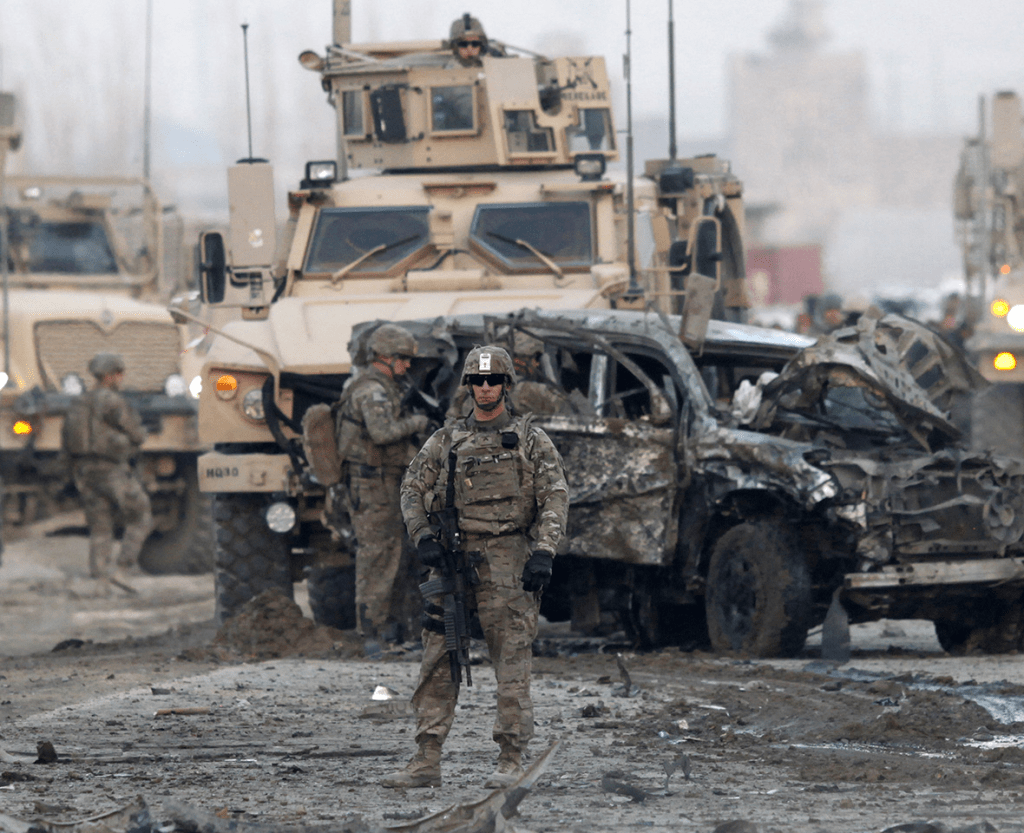
Afghanistan, Yemen, Iraq, Syria, Libya, Somalia, Uganda, Niger, Bosnia, and Haiti. These are just a few of the places where the United States has found itself militarily involved since the collapse of the Soviet Union in 1991. In that time, America stood as the world’s lone superpower: economically, culturally, and militarily dominant to a level that seemed mythical.
But those days are over.
Today, the United States shoulders tens of trillions of dollars in national debt, much of it accumulated during decades of foreign wars. Domestically, the nation faces severe inequality, a hollowed-out industrial capability, weakening middle class, and deep political divides. Because of the very wars it spent years conducting, it is now a target of resentment from billions who view its military interventions with hostility and anger. And now, for the first time since the Cold War, America faces a true peer rival: the People’s Republic of China.
Since the 1990s, the Chinese have been diligently rising in stature. The nation is now easily the world’s largest economy by Purchasing Power Parity, accounts for nearly 30% of global manufacturing, has the world’s largest standing army and navy, and continues to grow at nearly double the pace of the United States. Its influence stretches across Africa, Asia, and the Pacific. Its clearest objective is to reclaim what it considers part of its homeland: Taiwan. As China seeks to expand its dominance in the Asian theatre and present the option of an alternative world order, the Chinese have now become the single biggest threat to American dominance.
Yet, if you ask the average American what “foreign policy” means, their mind will likely drift to deserts in the Middle East: to oil, Islamic terrorism, and counterinsurgency. They’re not wrong. Topics like these have defined the military and foreign policy discussions in recent American history. This has been the United States’ foreign policy focus. The military has spent decades training to fight low-tech enemies who are using guerrilla tactics, possess weak communication systems, and have limited intelligence. In Iraq, Afghanistan, and the rest of the Middle East, American troops could rely on total air superiority, constant supply chains, and rapid medical evacuations. The focus was on finding the enemy, building governments, and discerning between civilians and combatants. The U.S. military was so laughably dominant that it could deploy a Burger King and Taco Bell to Bagram Air Base in Afghanistan.
The next war won’t be anything like that.
A serious conflict with the Chinese would force a reckoning of modern American military thought. Air dominance would be difficult to obtain. Losses would be heavy and constant. Aircraft carriers, widely seen as untouchable symbols of American power, would be sunk by hypersonic missile barrages. There would be no Burger King deployments, constant replenishment, or rapid medical evacuations. The enemy would be highly advanced, well-funded, with deeply resilient platforms and a high degree of battlefield intelligence.
So when earlier this year, Pete Hegseth called for a military shake-up after the Trump inauguration, he had a point: the military needs to change. It has become complacent, trapped in the wars of the past that will not be anything like the wars of the future. To give an example, Under Secretary of Defense, Elbridge Colby, faced extreme opposition from Central Command and the Joint Chiefs, after he pushed for a further pivoting of American forces and focus to the Pacific theatre. Such a decision was seen by a majority of policymakers as necessary and long overdue, but the generals who kept the United States in the Middle East were unwilling to let forces pivot. The people that guided this nation through the costly, and oftentimes misguided War on Terror, are not the ones needed for future conflicts with a real adversary like the Chinese.
But Hegseth’s reasoning for a military shakeup as stated in a September address at Quantico, that the military’s problem is purely “wokeness” or diversity programs, misses the deeper issue. Yes, those things shouldn’t be the primary focus of the nation’s warfighting force, but the real shake-up must come from replacing the Cold War–era belief in eternal American dominance. The next generation of military leadership must prepare for a world where the United States cannot assume superiority, whether that be technological, economic, industrial, or even moral. The coming conflict won’t be against terrorists or tribal militias. It will be against an adversary with equal, and in some areas, better capabilities. The U.S. military’s biggest focus should not be on internal politics, diversity programs, terrorism, or the status quo. Instead, it must focus on the real threat at hand, confrontation with an equal power. To compete, the United States must increase industrial readiness, mass mobilization, adaptable platforms, low-cost technologies, advanced intelligence. Above all else, it must confront the reality that the next war will not be easy.
So yes, Hegseth has a point, but it’s not enough. The military needs a shake-up, but not solely to satisfy political grievances or eliminate diversity programs. The true shake-up must be an internal reckoning, that the world has changed, and America’s military thinking hasn’t caught up.
Categories: Domestic Affairs

 The Texas Orator