
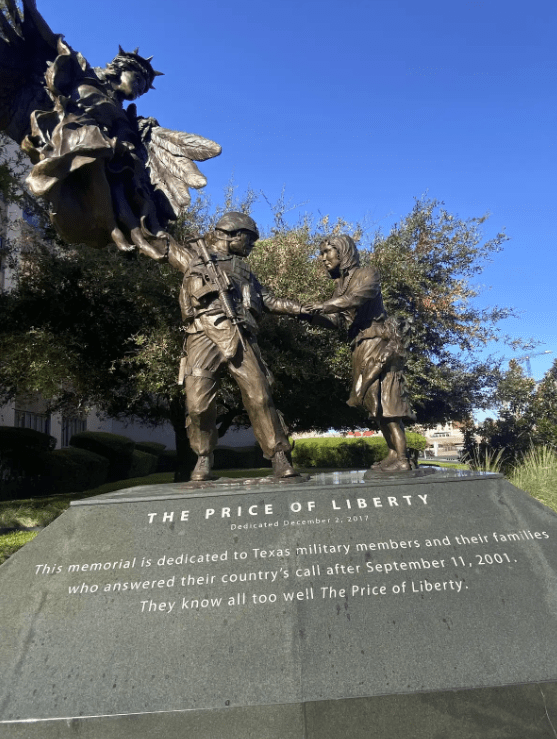
“We lived, felt dawn, saw sunset glow,
Loved and were loved, and now we lie…”
-John McCrae, In Flanders Fields
I hate International Relations and Global Studies (IRG) majors, but I have only recently realized why. The field of study is fine, and, in an increasingly globalized world, is useful. It’s a shame I know so many IRG students—ironically, our interests often overlap. After all, I have studied two different languages and studied abroad multiple times while at UT. I used to enjoy teasing that they’d all be spies one day. My cheerful classmates, serving as undercover CIA operatives in some Tajik black site. I have always enjoyed this kind of banter, but with graduation approaching so soon, it’s no longer easy for me to fake laughter.
Truthfully, I don’t care as much about which of my IRG friends jumps out of airplanes for the CIA—I’ll never know it anyway. What upsets me are those who hold diplomatic and national security ambitions. Unfortunately, this breed of IRG friends is much sharper and much more ambitious. They work hard to advance and defend the liberal world order, and they will one day save us from threats, domestic and foreign. They hope to secure “democracy,” topple “tyranny,” and counter “terrorism.”
I’ll be the first to admit that I am jaded. Maybe I would also like to trust in their unwavering idealism, as they vigilantly guard principles I’m told require constant and costly sacrifices. I see their smiling faces and hear their professional dreams, and I suffer from an aching melancholy in my chest. Through my own eyes, I see them: my own generation’s class of warmongers. What are they willing to sacrifice? How far are they willing to go?
I have a grudge, and I know now that it’s because I didn’t get a choice in what I sacrificed. When my father went down to Houston’s recruitment station, he volunteered, signing up with the Army 20 years ago as of this September. I was 18 months old. I can’t imagine the pain his decision inflicted on my mother and sister, because I can’t accurately put into words the gaping holes the Army burned in my childhood. For years, I didn’t see him, didn’t know him. The reality is that he came back from his first deployment a different man, one more comfortable holding an M4 than his own son. I will never know who my father was before he killed someone.
I don’t blame my father. There are two reasons to join the military: you are stupid or you are poor, maybe both. He had a young family and needed to put food on the table. He was an immigrant, not even a citizen yet, and the degree he earned in Mexico was practically useless here. In 2005, the US needed infantrymen, not veterinarians. He retired this September, and the Department of Veterans Affairs says he is 100% disabled. They admit that they broke my father, and for that, they give us a pittance. For the longest time, I pretended he wasn’t in the Army at all; it was easy to do when he had been deployed for half of my life fighting America’s wars. But it’s impossible to pretend when I see my father break down into tears as he tells me that shooting at human beings is like popping balloons. It’s impossible to pretend that every Memorial Day, my family receives a basket of cherries from the sweetest old Michigander couple imaginable. Growing up, I saw them as a third set of grandparents, but I know now that they are one example of too many Gold Star Families. Their son, my father’s friend, was killed in Afghanistan in 2005. I am not a boy anymore, and I am sick of pretending. The war in Afghanistan is not in the past; it continues to be waged in the heads of its veterans, and it’s seared into the hearts of those who’ve heard the final trumpet play “Taps.” What was it all for?
Nothing. After 20 years of occupation, all pretenses of trying to “liberalize” or “westernize” Afghanistan were abandoned alongside trillions of dollars worth of modern infrastructure and military equipment. The death and destruction were for nothing, so why did it even begin? Although none of the hijackers were from Afghanistan, the story goes that 9/11’s main architect, Osama Bin Laden, was allegedly protected by the Taliban government in Afghanistan. The truth is that even before 9/11, Afghanistan offered up Bin Laden for trial. Then, in October 2001, the Taliban foreign minister, Wakil Ahmed Muttawakil, offered that Bin Laden be tried for his crimes by the Organization of Islamic Conference, but former President George Bush was on the warpath and arrogantly declared, “They must not have heard. There’s no negotiation.” Despite such a grandiose waste of human life, it took 10 years to find and execute Bin Laden—and he wasn’t even in Afghanistan. It took another decade to leave Afghanistan, but just 10 days for the Taliban to regain power.
The tragedy of this all is that the Pashtun fighters who ferociously defended their country and way of life against American invaders could not even tell you why the Americans were there. The wealthiest, most powerful country in history, was committed to a forever war with one of the poorest countries on Earth. Kids growing up in Detroit and Querétaro never should have met a Pashtun farmer, much less had to kill one. Furthermore, we invaded a country whose median age is now 17 years old, but in 2005 it was just 14. Half of them haven’t even finished going through puberty. Those dangerous Al Qaeda terrorist commandos were kids. But as the military recruiters in American high schools are aware, kids make good soldiers.
How does one define a soldier? Strip away the uniform and the parades, and it’s the only profession that creates nothing. Since time immemorial, soldiers destroy. There is nothing more; no glory, no privilege, and no forgetting what you are or what you have done. It takes immeasurable destruction of oneself to be able to destroy others. It’s the ultimate sacrifice. Our moral failure is in perceiving such devastation as honorable. But it’s easy to do when that sacrifice is left unfelt.
This is the deepest suspicion that I hold against my peers, the future diplomats and politicians of America: that they are wholly unfeeling. Their unique combination of astuteness and apathy both terrifies and frustrates me. Every time I hear them enumerate “America’s adversaries” or create a fanciful list of their future casus belli, I feel in my heart all the suffering their ‘diplomacy’ will wreak. Death is written in the margins of their perfectly tailored resumes, an invisible recommender; like a friendly mentor, Death follows their professional growth with interest, because he waits in the wings to welcome his diplomats into their dream jobs, and to at last press the next generation of innocents into his service.
I really don’t hate IRG majors, but how can I ever trust them? How can I trust my own government? I want to appreciate the ideals of democracy and freedom, but every time I hear that our soldiers “die for our freedom,” I feel a sickening rage. As a child, I lived in Fort Drum, New York, and I waited on the windowsill with my mother. I saw her anxiously watching the street for the all-black government car. She dreaded the sight of those two stoic, uniformed men approaching our door. I saw one too many of those black cars turn on our street, and each one delivered despair and destroyed families. Human lives are ravenously sacrificed at the altar of mammon. The blood of soldiers is spilled for a global liberal order heralded by pompous politicians who have never waited on the windowsill. Our leaders swear up and down that the system they command, and theirs alone, is the best solution for mankind. Deviations must be demonized and destroyed with prejudice. I’m kept up at night, knowing Death’s next generation of henchmen are chomping at the bit to dehumanize the enemy, and Life’s next generation of creations is lined up waiting to destroy and be destroyed.
When I hear the standard bits of military glorification, I feel disgust, because even unknowingly, we celebrate a bloodstained shrine and perpetuate the Old Lie.
“In all my dreams before my helpless sight,
He plunges at me, guttering, choking, drowning…”
-Wilfred Owen, Dulce et Decorem Est Pro patria mori.
Categories: Foreign Affairs

 The Texas Orator