
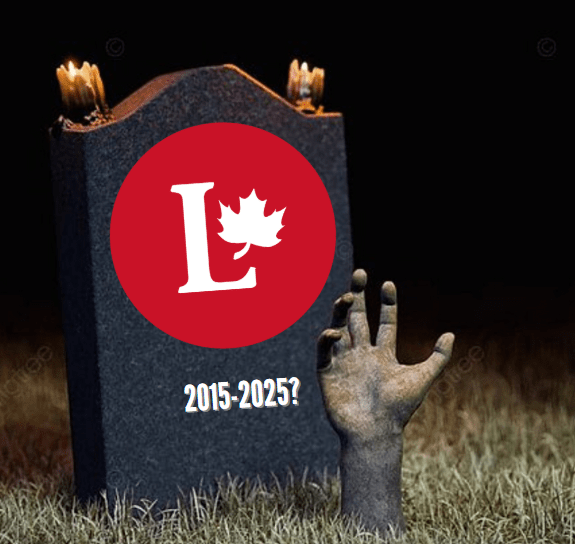
Disclaimer: This piece was written before Mark Carney’s election as leader of the Liberal Party and the onset of the Canadian General Election–to be held on April 28th—but the analysis is still relevant.
Introduction:
Around three months ago, on a cold Ottawa morning, Justin Trudeau announced that he was resigning as Prime Minister and leader of the Liberal Party of Canada as soon as his party had selected his successor. Although Mr. Trudeau resigned only months away from the next general election—the Parliament’s term expires on October 20th—the new Liberal leader may still have a chance.
This new assessment is very different from what I believed a little over a year ago when I thought a late resignation by Mr. Trudeau would leave his successor with little time to rebrand—leading to shellacking the likes of which the Liberals have not seen since 1984. However, one very big, dare I say “huge,” factor has shifted the dynamics towards the Liberals, and that factor is Trump. So, why has Trump’s presence helped the Liberal Canada surge from a 10–20-point deficit to near even, how has the presumption that Mark Carney will win the Liberal leadership race impacted the surge, and why have federal Conservatives struggled in the face of these new geopolitical dynamics?
Governor of the 51st State:
On January 20th, 2025, Donald Trump took the oath of office after a comfortable electoral victory in November. Although Trump had been President before, his election victory this time around emboldened him to disrupt diplomatic precedent far beyond what he did in his first term. Signs of the new President’s emboldened approach grew clearer to many Canadians as Mr. Trudeau visited Mar-a-Lago in November of 2024 to try and foster goodwill with Mr. Trump.
Although the President described the meetings as “very productive,” he also took jabs at the Canadian delegation by suggesting they join the Union. He later described Mr. Trudeau as the “Governor of the Great State of Canada.” Although Trump’s desire to expand US territory is nothing new, even in relation to Canada, the Prime Minister and the Canadian people seem to have noted Trump’s push this time as his persistent pressure points to more serious desires to incorporate the nation. Furthermore, Trump’s decision to levy 25% tariffs on all Canadian goods, although not implemented as of the writing of this paper, has led many Canadians to reconsider the reliability of the alliance with their southern neighbor.
The impending tariffs, coupled with the insults to and perceived machinations against Canadian sovereignty, resulted in an upsurge in Canadian nationalism and unprecedented hostility towards the United States. The booing of the Star-Spangled Banner at a hockey game in Ottawa, the removal of American liquor at Canadian stores, and the brandishing of “Canada is not for Sale” hats by many Canadians’ including the Premier of Ontario, in a show of Canadian unity and defiance that has rallied the people around their nation in general and the Liberal party more specifically.
The Central Banker:
However, the Liberals would not have been able to galvanize the unpredictability of Trump and the surge in nationalism it has caused to the extent that they have without Trudeau’s resignation and the popular perception that he will be replaced by Mark Carney.
Mr. Carney is an economist by trade who served as Governor of both the Bank of Canada and England for a combined stint of 12 years. Although he is running for the Liberal Party’s leadership, Carney served as Governor of Canada and England’s central banks under Conservative administrations. Additionally, he served as Canada’s chief central banker during the Global Financial Crisis (GFC). He is credited with Canada’s quick recovery from the GFC as he anticipated the impacts of financial contagion before the crisis hit Canada.
Carney’s economic chops have given him credibility amongst the Canadians whose primary complaint against the Trudeau administration is that they have poorly managed the economy. Although inflation has moderated in Canada since its post-pandemic highs, sluggish growth—around 1.6% —has meant that income increases have not kept pace with inflation — around 2%. This means that many Canadians are spending more and more of their disposable incomes on essential goods, and there has been a perception that the government has not handled inflation or sluggish growth well.
However, Carney’s technocratic and serious personality is more beneficial to him and the Liberals than his economic expertise. These personality traits, coupled with his pragmatism, are seen as well-equipped to handle Trump. The perception is that Carney can act as the “adult” in the room, as he can be cordial and tough simultaneously, possibly resulting in the best outcomes as Canada faces an unpredictable neighbor to the south.
Poor Pierre:
On the sidelines of all this is the man who would be prime minister, Pierre Poilievre. Before Trump’s re-election and Trudeau’s resignation, Poilievre dominated the polls and practically picked out the new drapes for 24 Sussex—the Prime Minister’s official residence. However, the rise of the Trump factor, more than anything, has left the Conservatives flatter-footed than ever and struggling to develop a strategy that resonates with Canadians and reduces the competition they face from the Liberals.
Although Poilievre’s pugnacious and quasi-populist personality served him well before November, he has struggled to rebrand as many Canadians fear he will be unable to handle Trump. Many believe that he will be too servile to the American president, who some say Poilievre has drawn inspiration from rhetorically. However, it is yet to be seen how Trump’s recent attack on Pierre Poilievre as not “a MAGA guy” will impact the dynamics of the impending election.
Furthermore, Carney’s election to the Liberal leadership is not set in stone. Even though Carney is the favorite to win, he still faces stiff opposition from Chrystia Freeland, the former minister whose resignation can be viewed as responsible for causing the mutiny in the Liberal Party that caused Trudeau to resign. However, polls would suggest that Freeland does not have as broad of an appeal and economic credibility as Carney has, which could be a boost for Mr. Poilievre if she is elected.
Conclusion:
I stand by my statement that Justin Trudeau should have resigned over a year ago, a move that would have helped his successor rebrand enough to avoid the merciless swing of the political pendulum. Even so, the geopolitical dynamics after the election of Donald Trump and the rise of Mark Carney as the leading candidate to win the Liberal Leadership election has made the Liberals far more competitive than I had anticipated. Carney’s background and relative distance from the Liberal government give him the skills and credibility on economic issues that Canadians desire. In contrast, Trudeau’s general demeanor gives Canadians confidence that he has a safe pair of hands to deal with Trump. Meanwhile, Poilievre has struggled to disassociate himself from Trump and prove to the Canadian public that he can be a safe pair of hands to lead the nation in the second Trump era.
However, this is not to suggest that the Liberals are in any way poised to win the next election. Although they have regained their competitiveness, the Conservatives are still up in the polls, and it remains to be seen how the election will play out once the new Liberal leader is selected and the election is called. But for now, the Liberals can be grateful that despite Trudeau’s belated resignation, they have a Hail Mary play—or whatever the equivalent is in hockey—in the form of Trump that has significantly increased their chances of making a loss-reducing, or maybe even game-winning touchdown.
Categories: Foreign Affairs

 The Texas Orator