
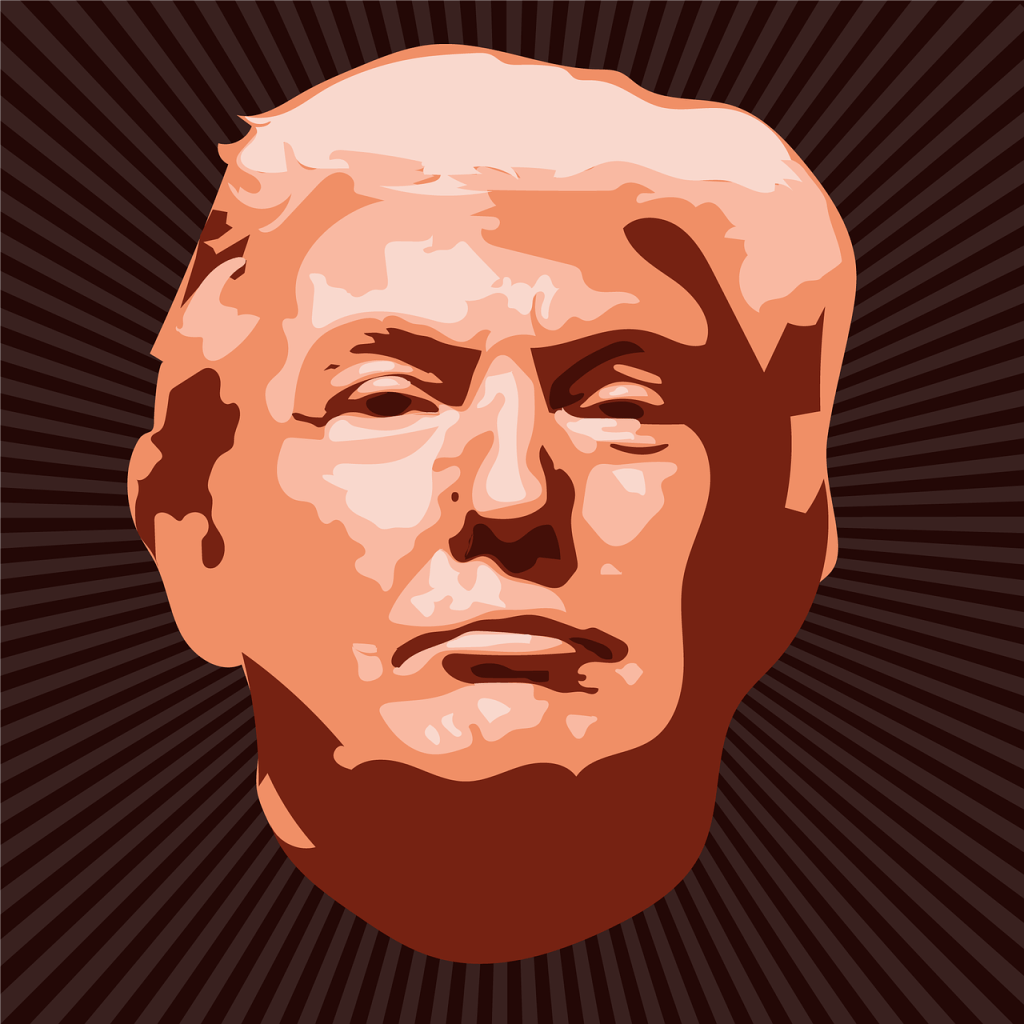
MIGHT MAKES RIGHT
As promised, Trump became a ”dictator on day one,” unleashing a blitzkrieg of executive orders this past month. The administration commenced with a Machiavellian tone, violating carefully crafted foreign policy, institutional guardrails, and democracy for the sake of power. The scope and audacity of Trump’s opening moves are unlike anything America has seen before; his goals and ambitions are far more focused than during his first administration.
Despite accusations of sexual misconduct, criminal convictions, hypocrisy, and bigotry, many Americans are drawn to the image of Donald Trump as an aggressive leader who projects strength and speaks his mind. Yet, Trump lacks a consistent political ideology with which voters can align. His strategy revolves around the “story,” not the effect. By capitalizing on public unrest, he used feelings of resentment and defiance to secure victory. On January 20th, the 47th President’s inauguration speech echoed the fundamental tenet of his political philosophy: Might makes right.
The Constitution contains three checks on a president: legal checks from the Judicial branch, legislative checks from Congress, and an electoral check from the people. All three of these, at present, do not exist for Donald Trump. Last year, the Supreme Court ruled in Trump v. United States that acts done in an official presidential capacity were immune from criminal prosecution. The conservative supermajority in SCOTUS also does not lend optimism for Trump opponents insofar as any challenge that reaches the Court will likely be ruled in Trump’s favor. As for the electoral check, Trump was elected by over 77 million voters last November. The final check is eroding as Republicans in Congress coalesce to become “Trump’s political party.” Plagued by conformity, the GOP has been held in a tight MAGA chokehold since 2015. Moderate Republican politicians are afraid to oppose Trump under the belief that doing so is a career death sentence. Even prominent figures, like Mike Pence and Liz Cheney, have been ousted from the party and cast as political enemies for voicing criticism. Trump’s trademark leadership style revolves around his cult of personality, where one is rewarded for blind loyalty. The best example is the President’s cabinet nominees, a mish-mash of high-standing officials and unqualified yes-men whose appointments are eerily reminiscent of a spoils system.
The Democratic party, on the other hand, has been hindered by hesitation and ineffectual pragmatism. Over the last decade, Democrats failed to maintain a standalone narrative for their platform. Messaging focuses on opposing right-wing extremism yet offers little for substantial policy alternatives. In the absence of an organized narrative, Republicans are able to consistently push forward their issue agenda: to ban abortions, infuse church in the state, promote businesses, and put America first. As a result, Democrats are left playing defense; their strategy leaves them with a dual burden of first having to disprove Republican politicians and then articulating their platform in the haze of misinformation.
Project 2025, the conservative magnum opus, raises urgent questions about the direction of the Trump administration. Although Trump chose strategically to distance himself from it during his presidential campaign, the question remains: is Trump driven to do whatever benefits him at the moment? Or does he have a deeper, more meticulous plan to shut down America from the inside out? One can argue that Trump himself has not changed. What has changed are the people around him. In the words of a former State Department official, “the institutional guardrails are gone and the adults have left the room.”
DOGE: DISMANTLING OUR GOVERNMENT ENTIRELY
The Department of Government Efficiency, or DOGE, was formed by Trump to serve as an advisory committee and satisfy his top billionaire donors. In Constitutional reality, DOGE has no power because a Congressional act did not create it. However, as a torrent of headlines show, Elon Musk has bull-DOGEd executive departments, shut down federal websites, pushed employees to take resignation deals, and fired over 90% of USAID employees—all without legitimate authority. Trump’s order to suspend trillions in federal aid also created widespread uncertainty. Official communication channels went dark, putting more than $489 million of food assistance at risk of spoilage and leaving millions in Africa, the Middle East, and war-torn regions at risk of starvation (a federal judge has since ordered the administration to temporarily lift the funding freeze). Nevertheless, words like “illegal” and “unconstitutional” mean nothing to men like Trump and Musk, who are drunk on the fantasy of limitless power. “You can’t do that” isn’t a directive; it’s a challenge to them. President Trump believes not just that he’s above the law, but that he is the law.
The administration’s slogan of eliminating “waste, fraud, and abuse” stems from legitimate governance concerns. Bureaucratic red tape, departmental redundancy, and endless chains of communication are symptoms of a bloated government. Despite this, our government cannot and should not be at the whim of a billionaire who is fueled by narcissism, conspiracy, and controversy. While Musk is a veteran of the mass layoff technique, entrepreneurial logic cannot be transposed onto the government. Governing structures are not intended to be streamlined at maximum efficiency. In Federalist 51, James Madison wrote that
“The great security against a gradual concentration of the several powers in the same department consists in giving the necessary constitutional means and personal motives to resist encroachments of the others…ambition must be made to counteract ambition.”
The slow, time-consuming nature of government might be a source of frustration, but that is because the government bears the weight of representing every single American, not just the shareholders of a company. Political polarization might be a vice, but thoroughness is a virtue; democracy crawls while tyranny sprints. The growth of the “alphabet soup” of executive agencies can be understood as a symptom of the U.S.’s increasingly expansive role in a complex, globalized world. But Elon Musk doesn’t care; his end goal is complete deregulation. That means deleting agencies getting in the way of his corporate empire, particularly those that would regulate his companies.
Musk’s rampage through executive departments aligns with Trump’s current policy priorities. But a billionaire’s appetite is not easily satiated—his urge to puppeteer the government is unlikely to sit well with Trump’s ego. But power doesn’t split; it devours. Both men cannot win. Perhaps Madison’s analysis that ambition will counteract ambition will be reborn as a new, unexpected check on the President and his men.
FOREIGN POLICY & IMMIGRATION
Trump has vocalized an isolationist standpoint in foreign affairs, marked by his disdain for the NATO security alliance and withdrawal from the Paris Agreement. But Trump’s fixation on outlandish goals like claiming the Panama Canal, renaming the Gulf of Mexico to the Gulf of America, acquiring Greenland, and turning Gaza into a dystopian luxury resort paints a different picture. While these assertions are ridiculously imperialist, fighting these symbolic statements is the political equivalent of flailing in the shallow end of the pool. He may or may not be serious about taking over sovereign territories, but Trump’s claims accomplish two things: they rile up world leaders and distract from his more dangerous, materially effective policies.
Since his first term, Trump has consistently prioritized immigration policy. In the first few weeks, he has followed through on promises to deport undocumented migrants and close the border. Most notably, he signed the Laken Riley Act, declared an invasion at the border, deported thousands, and ordered Guantanamo Bay to house detained migrants. The U.S. government has a unique constitutional duty to “protect each of [the States] against Invasion” via the Guarantee Clause, which is the basis of Trump’s executive order. Yet, the “invasion” at the southern border is only an invasion in the sense that Trump said so. An invasion exists in rhetoric but not in reality. In reality, those arriving at the border are not intent on “violent conquest or plunder” but families of refugees, asylum seekers, and economic migrants. On the other hand, because his order is based on an affirmative duty, it makes for much tougher legal battles. Challenging a constitutionally-recognized duty will be an uphill battle in the courts, even if the basis for the exercise of such a power is flimsy (or non-existent).
The story of Trump’s immigration policies is one of putting “America first.” But the underlying strategy is to paint immigration as a war-like crisis so that Americans turn inward. If public energy is consumed by protecting themselves against a common enemy, Americans are distracted from domestic concerns like poverty, healthcare, and inequality. Because the U.S.’s hegemony is slipping on the global stage, the government is grasping for any semblance of national identity and power. In reaction to this, politicians have criminalized migrants as “illegal aliens” to drive a wedge between “us” and “them.” In regulating information, money, and people, the war on migration is as much about controlling Americans as it is about national security.
ECONOMY & TRADE WARS
Trump’s favorite wars to wage are economic. As a businessman, his deep conviction that the U.S. is being cheated by friends and enemies alike informs his suspicion toward trade. He has frequently proclaimed that “free trade is terrible,” which is why his policies are distinctly neo-mercantilist and autarkist. On the 12th day of office, Trump declared a national economic emergency for tariffs under the International Emergency Economic Powers Act (IEEPA). His economic agenda features his signature move, tariffs, on key trading partners. So far, he has targeted Canada, Mexico, and China. The indiscriminate treatment against allies and adversaries alike could position the U.S. as an unreliable trading partner, resulting in fewer trade agreements with other countries, a net negative for U.S. foreign diplomacy. The justification for Trump’s tariffs is rooted in a demand for “reciprocity” with other countries, yet the U.S. has maintained a substantial trade deficit for over 50 years. In fact, this deficit allows the U.S. to finance its expenditures with foreign credit, something that no other country is able to do at such a massive scale.
The idea of protecting “American jobs” through tariffs sounds patriotic but hurts American consumers. During election season, twenty-three Nobel economists signed a letter stating that Trump’s economic plans would lead to “higher prices, larger deficits, and greater inequality,” as nearly half of American consumption, from coffee beans to crude oil, are imported or produced abroad. Although tariffs are placed on foreign producers, sellers hike prices to pass costs down to American consumers. Thus, tariffs effectively act as a tax on Americans, hurting middle-to-low-income households who buy more imported goods. Ideally, a protectionist trade policy would strengthen domestic industries and stimulate demand by limiting foreign options. Historically and empirically, tariffs cause inflation, lead to unemployment, reduce consumer demand, and invite retaliation from other countries.
We might think of threatening a trade war instead as part of a strong-arm foreign policy tactic. For example, after Trump announced the blanket 25% tariffs on Canada, Prime Minister Trudeau agreed to beef up border security for a 30-day pause on Canadian tariffs. Likewise, Mexico’s President Sheinbaum agreed to send troops to Mexico’s northern border. Even if tariffs are not economically beneficial, they are a powerful negotiating tool. The logic goes: it’s okay if tariffs hurt, as long as they hurt the other guy more. But if Trump keeps disrupting North American relationships, it’s possible that Canada and Mexico will distance themselves from the U.S. and damage U.S. credibility among other global partners.
DEMOCRATIC BACKSLIDING
Aside from his policies, the method by which Trump has risen to power sets a dangerous precedent for the world. His barrage of executive orders has sent courts scrambling and people asking, “Can he do that?” One order attempted to de facto amend the Constitution by ending the 14th Amendment’s birthright citizenship protection. Another creates a “Schedule F” category, changing the classification of federal employees and allowing Trump to replace career bureaucrats with operatives loyal to his cause. Such a directive politicizes civil servant positions that are meant to be stable, nonpartisan pillars of governance. In doing so, Trump is trying to remake the fabric of the United States government.
After 2020, Trump rebuilt his empire on claims of election fraud, the January 6th riots, alleged political weaponization of the Justice Department, and his martyr status after his almost-assassination. His rhetoric and behavior seem to have lit a reactionary spark in the global landscape, from the 2023 Brazilian Capitol riot to the South Korean President declaring martial law in late 2024. Trump’s hawkish, fascist-colored rhetoric is already normalized in the media and has become something that people no longer take at face value.
It Can’t Happen Here, Sinclair Lewis’ novel written in the 1930s, paints a picture of a democracy-turned-dictatorship that uncannily maps onto our present political moment. It almost seems to spell out the playbook of Trump’s presidential strategy, only a century in advance. The book follows an ignorant demagogue’s ascension to power by championing a faux-populist platform. The leader speaks before a fully packed Madison Square Garden rally, orders the invasion of Mexico, and satiates millions of impoverished and angry voters with empty promises. There is a shocking presidential overthrow, a voter base that seems to be voting against their interest, and big, flashy spectacles that hide sinister intentions. If the President contradicts himself, backtracks on policy, or spews out a torrent of lies, he regains favor by telling the masses what they want to hear.
DISILLUSIONMENT AND REALISM
While the Trump Administration’s unlawful maneuvers will dominate news headlines in the months to come, we cannot let our moral standards erode as well. Morality upholds the law, not the other way around. Others can break the law, but the one thing they cannot take away is hope. Our shock and repulsion are a sign that we still hold precious the fundamentals of democracy. The Trump administration’s strategy is to wear down public outrage with confusion and fear until we are silent, until progress feels impossible. It is okay to feel disoriented; it is not okay to let yourself become disillusioned. We cannot let them win. In the end, right makes might.
Categories: Domestic Affairs

 The Texas Orator