
THE VIRTUAL WALL
Long before Trump vowed to “build a wall” at the US-Mexico border, a virtual wall was built. Unlike steel and barbed wire, this wall was made of eyes and sensors. It is impenetrable.
Most Americans think of the Southern border as the “scary” one, always in crisis, always in the headlines. Border security is an abstract concept, materialized only by the fear-mongering rhetoric of politicians who have long called ours a “broken immigration system.”
The Biden administration has come under fire for causing an unprecedented surge in crossings despite his attempts to champion a more humane approach. As waves of migrants entered the country, even Democrats advocated for more stringent border control—adding a strange new dimension to American politics during an election year. Even stranger, Senate Republicans blocked a tough border security bill after campaigning for the need to fight chaos and crime at the border. In response to burgeoning national pressure, Biden eventually imposed asylum restrictions that led to a significant drop in illegal border crossings.
Though border security may seem like a deeply polarizing issue, the militarization of the border is a decades-long bipartisan project. Funding for border security increases every year, irrespective of which party is in office. In 2024, surveillance at the border has been heightened, unlike ever before, as budget increases have appropriated over 61 billion dollars to Homeland Security. Included in the package are funds to increase ICE, Border Patrol, and Port of Entry agents as well as to arrange transportation to deport non-citizens—all while slashing funds for Shelter and Services programs.
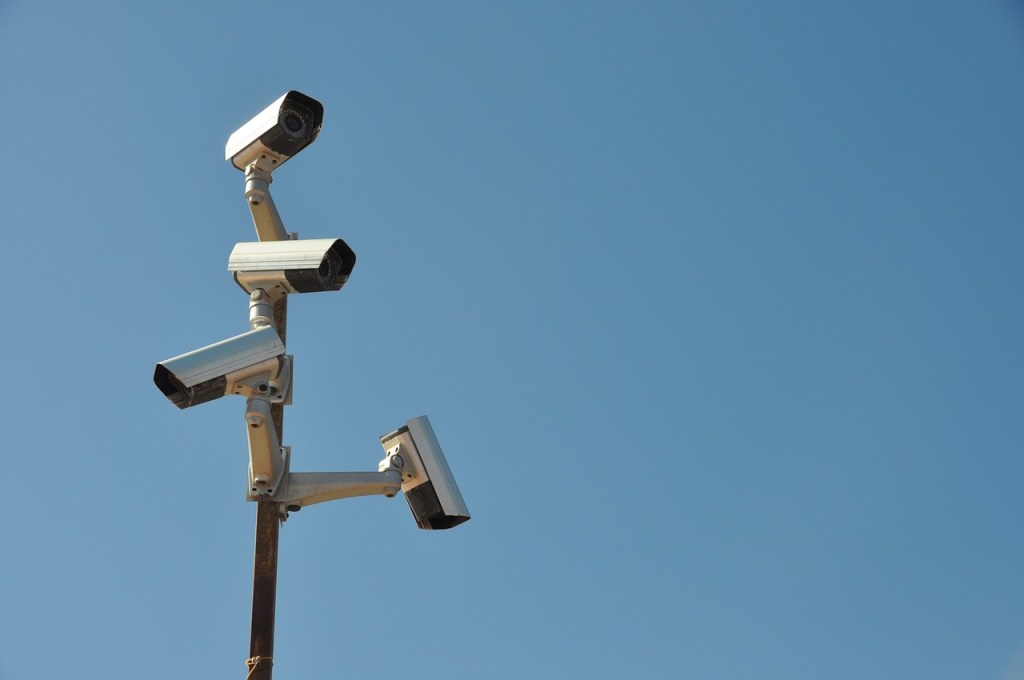
Most worrying is the growth of innovative border security technology: aerial drones, biometric scanners, surveillance towers, infrared cameras, license plate readers, AI lie detectors, and even robot dogs. The Electronic Frontier Foundation’s report on technology deployed at the border finds that “much of this technology was either originally developed for military use or is a direct hand-me-down from the U.S. Department of Defense.” Surveillance towers monitor up to a five-mile radius; infrared cameras and unmanned drones track movement in rugged and remote areas; checkpoints use license plate scanners and searchable databases to intercept illegal border crossings. The sheer amount of security infrastructure surrounds migrants and borderland residents in an Orwellian surveillance state. With heavy razor-wire fences and 30-foot beams, the US-Mexico border closely resembles an active war zone.
Taken together, these technologies weave a draconian network of surveillance tools to track migration movements and inspect people crossing the border. No footprint is left unseen.
The Southern border no longer represents a legal demarcation between two sovereign nations; it has morphed into an entity to which American politicians attribute threats of illegal immigration, of terrorism, of drug cartels. To recognize this, we must begin to rethink threats of the “border crisis” and “broken immigration system” as socially constructed rather than objective reality.
Ole Wæver of the Copenhagen School of International Relations finds that “something is a security problem when the elites declare it to be so.” After declaring something a threat, policymakers can then orient the public towards a common enemy, an ‘other’ to the ‘us,’ to justify extraordinary policy responses. As Princeton Sociology Professor Douglas Massey explains, calling for more border enforcement is the “all-purpose response to whatever threat happens to appear in the public consciousness…there’s a history in this country of projecting our fears onto the border.” In this sense, the U.S.-Mexico border has become a theater for symbolic violence.
THE BORDER-INDUSTRIAL-COMPLEX
Because of the immense demand for high-tech security, government contracts have wedded defense primes and surveillance companies to the Department of Homeland Security (DHS), Customs and Border Patrol (CBP), and Immigration and Customs Enforcement (ICE). The deadly marriage has evolved as the “Border Industrial Complex,” where corporations profit from the hyper-militarization of the border as more money is spent under the banner of ‘enforcement.’ A classic narrative of industrial complexes uses euphemisms to generalize and abstract victims of such technology. The language of “solutions to combat adversaries” or “security for the American people” is easier to digest before realizing most cross-border activity consists of families, refugees, and impoverished immigrants looking for better opportunities. The real question underlying the Border Industrial Complex is not whether border security actually increases safety but rather which policies boost company profits.
Border security contracts are dominated by companies like Accenture, Boeing, Elbit, General Atomics, General Dynamics, IBM, Lockheed Martin, Northrop Grumman, Raytheon, and UNISYS. It is no coincidence that border security giants are the same giants of defense contracts—a direct consequence of militarizing the border. Border-security corporations lobby politicians, donate large sums of campaign contributions, and act as legislative advisors to push for hostile border security policies. This, in turn, ramps up demand for more technology, guaranteeing more government contracts, which adds hundreds of millions of dollars to company pockets. These companies engineer our border policies to maximize profits.
In addition to opaque contracts between executive agencies and companies, there is no incentive to regulate this technology if companies continue to profit from it. Petra Molnar, a migrant justice lawyer, remarks that the Southern border serves as a laboratory where new surveillance technologies are “tested without public scrutiny, accountability, or even knowledge.”
Some may argue that a “smart border” approach is more objective and neutral than humans. Yet, the “dizzying panopticon” of technology used in border policing only obscures liabilities, deepens discrimination, violates human rights, and demonizes migrants. Because facial identification softwares are trained on existing police data, they reinforce systemic racism by inaccurately identifying dark-skinned people and preventing them from applying for asylum. The invasive nature of data-driven technologies hurts migrants who are already at high risk of exploitation and marginalization from crossing borders to escape dangerous circumstances at home.
Beyond the tangible harms, a report by Aizeki et al. in the Immigrant Defense Project’s Surveillance finds that smart borders are embedded in a logic of deterrence, which seeks to make unwanted migration so brutal and painful that it will dissuade people from trying to enter the United States without authorization. A “smart” border aims not to increase humaneness but to greater efficiency in advancing the violent enterprise of regulating bodies. Though budgets for immigration and border policing have jumped 2,000 percent in thirty years, policies never seek to address the root causes of migration, such as global economic inequality, the climate crisis, neoliberal trade policy, and political violence.
When the government criminalizes something, the result is most often not a deterrent but rather a funneling or black market effect. In the case of immigration, the “funneling effect” is when migrants are pushed into remote, rugged terrain to avoid being detected by border surveillance. Aggressive border security forces migrants to take dangerous routes, leading to a fivefold increase in deaths since 2000. Border security also has the countereffect of making migrants more dependent on organized smugglers and cartel regimes to enter the United States. As per the logic of any black market, greater risk leads to a higher price point for smuggling services, entrenching migrants in debt and leaving them vulnerable to trafficking or exploitation. This, in turn, only strengthens the power of transnational syndicates and criminals—the exact opposite goal of border hawks.
In the context of the Border Industrial Complex, nothing succeeds like failure. The dynamic of increased crime waves and chaos is convenient for border and immigration enforcement agencies, which can justify outlandish requests for greater budget appropriations. These budget requests then fuel companies, whose business model is driven by increased government appetite for security contracts. But, as Aizeki et al. note, this cyclical dynamic makes for terrible public policy.
WHEN THE EYES TURN UPON YOU
Technology deployed at the border is not a threat to migrants only, nor is it isolated to borderland communities. Border surveillance technology threatens all Americans due to the phenomenon of “technology creep.”
Technology creep is where systems pioneered for certain locations slowly integrate into mainstream society, where they could be used to surveil the public at large. The prime example of technology creep was Section 215 of the USA PATRIOT Act of 2001, a surveillance law that allowed the NSA to collect billions of the private phone records of Americans. After the 9/11 attacks, individual privacy was put on the back burner for the sake of national security. Though the Patriot Act aimed to monitor and prevent terrorist activity, technology used for foreign purposes turned on domestic citizens.
Similarly, border security is not limited to the border; the CBP has the authority to surveil within 100 miles of the border, where two-thirds of Americans live. This spans the entire US border, including the US-Canada border and East and West coasts. Although surveillance is primarily deployed at the Southern border, we certainly can’t expect it to end there—as long as companies manufacture threats to manufacture profitable technology. Once the surveillance market is saturated at the border, the next target may well be Americans themselves. What seems distant and peripheral to us now will define our lives tomorrow.
SURVEILLANCE STATE
Many scholars have echoed their concerns about the growing surveillance capabilities of high-tech giants, one such scholar being Shoshana Zuboff, professor emerita at Harvard Business School. In her book, The Age of Surveillance Capitalism, Zuboff warns that corporations exploit personal data to predict and shape our behavior. She describes private surveillance as a “one-way” mirror, where companies can see and take information while consumers are left in the dark. As surveillance technology continues to advance, the digital economy will turn data into a commodity more valuable than gold. The consequences of a surveillance state would abrogate our privacy, civil liberties, autonomy, and democracy.
Across the globe, we already see surveillance states in authoritarian countries like China, Iran, the U.A.E., and Saudi Arabia. Citizens in those countries are subject to constant yet hidden surveillance as a tool of government control, whether through telecommunications hardware, advanced facial recognition technology, or data analytics. Though facial recognition in China initially rose to monitor the spread of COVID-19, it is now used to shape behavior, such as tracking political dissidents and silencing protestors in the criminal justice system. A surveillance state forms gradually by first developing and deploying technology for external purposes until it is normalized and then repurposing it in other spaces. The rise of a surveillance regime in the United States should not be taken lightly—it is the precursor to a totalitarian technocracy.
Security and surveillance concerns at the Southern border are not tangential or outside the scope of our livelihoods. If we do not pay attention to the rapid development of surveillance technology now, we will find ourselves encased in a nation that went from watching the wall to watching us all.
Categories: Domestic Affairs

 The Texas Orator