
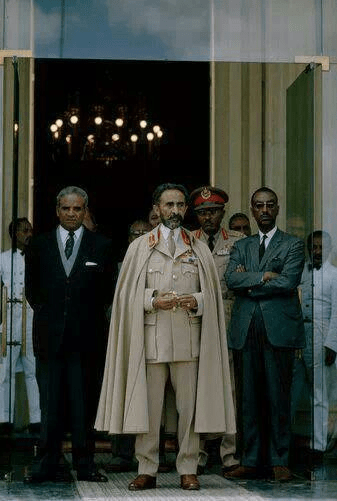
Disclaimer: This article discusses a sensitive topic in history and is meant to simplify the issue discussed. There are many notable names—Aman Andom, Mengistu Hailemariam, etcetera—and events in the revolution that were excluded for practicality, with this article focusing on the main drivers of the revolution. For further reading on the subject, you can consult The Quest for Socialist Utopia: The Ethiopian Student Movement, c. 1960-1974; The Emperor: Downfall of an Autocrat; The Ethiopian Revolution, 1974-1991: From a Monarchical Autocracy to a Military Oligarchy; or a host of other books and research papers dedicated to the subject.
“Thief, thief, thief!” shouted a group of young students as they chased after the Volkswagen that carried the now deposed emperor of Ethiopia, Haile Selassie, from the Imperial Palace to a detention center. The students who shouted after the car, along with their contemporaries among the urban educated youth, had idealistic hopes of modernizing Ethiopia’s institutions to create an egalitarian society. With the emperor’s fall, many believed their time to seize the reins and bring about this change had finally come.
September 12, 1974, would mark the start of the institutional breakdown that the students hoped for. However, these students would play less of a role in shaping post-imperial Ethiopia than they initially imagined. Now, 50 years after this monumental event, it is worth examining what caused the revolution, what the dissatisfied groups demanded, if those demands were met, and how those changes impacted Ethiopia both positively and negatively.
“Minlitazez Getaye?” (How may I serve you, my lord?)
To understand the Ethiopian Revolution and the demands of the different interest groups that brought it to fruition, one must understand the root of the institutional woes in the eyes of the dissatisfied groups: feudalism. The feudal system acted as the backbone of Ethiopian society since the 13th century, with the Solomonic restoration under Emperor Yekuno Amlak. The feudal system established the basis of Ethiopia’s complex and often disorganized systems of property ownership. Through this system, Ethiopia developed a class system that could be rigid at times and flexible at others.
Although the rigidity of Ethiopia’s class system and the lack of social mobility decreased as Ethiopia attempted to reform and modernize, the landed elites still maintained their control of this largely agricultural society. In the 1960s, about half of Ethiopia’s farmers were tenants who could be deprived of up to three fourths of their crop yield by the landowners as payment for rent. The inability of this inequitable system to adapt to the changes of the 20th century would later cause the system to collapse.
The impending collapse was foreshadowed fourteen years before the revolution began when members of the Imperial Bodyguard attempted to topple the emperor and elevate the crown prince to a less powerful role as monarch. Although the members of the coup were unsuccessful in their goals, the aim of their movement, to kill a “feudal and backward Ethiopia,” as Brigadier General Mengistu Neway—a leading figure in the coup—put it, would become the chief aim of the student movement that was so vital in bringing the emperor down.
The students’ movements, like many other student movements of the era, based their efforts on utopian ideals and sought to build a more equitable society, a society without the feudal system and with more emphasis on democratic principles. Despite divisions within the student movement on issues such as self-determination, their primary goal of remaking Ethiopia into an egalitarian society pushed the movement forward.
This movement would lead to the publication of newspapers espousing revolutionary ideas by assessing issues in society and offering radical solutions for these issues. Furthermore, forums of like-minded students gathered to protest institutions and policies at home and abroad in the late 1960s and early 1970s. Although these groups were numerous and had proliferated to encompass many of the higher education institutions within Ethiopia, they all shared a defining rallying cry: “Land to the tillers.” Such a phrase epitomized the views of many students that the source of Ethiopia’s woes lay in its despotic land system. Their critiques were legitimized when a famine struck the Wollo province in 1973.
“Way, Way, Way, Silu.” (As they cry out in pain.)
Ethiopian officials were warned that drought would grip the Sahel Region in the late 1960s and early 1970s, possibly leading to famine. However, little was done to mitigate the possible calamity. As a result, anywhere from 40,000-80,000 people starved from the drought and scarcity of food in Wollo.
Government officials were privy to the information that a famine had taken hold of the province, as evidenced by the growth in destitute migrants making the long trek from Wollo to Addis Ababa. Still, they did little. The emperor visited the provincial capital, Dessie, and images of his visit were distributed to make it appear as though the government was efficiently managing the situation. Radio messages of his visit were also distributed by the Ministry of the Interior to undersell the seriousness of the situation, with a Minister of State of the Interior going on national radio to claim: “There [was] no famine in Wollo, and it [was] in the nature of the people of that province to be refugees.”
This claim was soon undercut when thousands of starving peasants reached the capital and flooded the streets. The arrival of these people in the capital, coupled with a documentary by Jonathan Dimbleby released in 1973, ended the ignorance of urban Ethiopians to the dire nature of the situation.
Student groups organized to help provide relief, while the government attempted to save face by increasing efforts to provide aid to the impacted populations. Nevertheless, reports that the landed elites continued to demand peasants’ rents had exacerbated the issue. Coupled with the government’s neglect of the problem, feelings of vindication among the student groups arose. These students now believed they had evidence that the backward nature of Ethiopia’s economic system—based on the feudal land tenure system—wreaked havoc on most of its population and that the Imperial system’s disregard of the issue proved the need for major societal changes. Furthermore, these revelations alienated the urban middle class from the Imperial System and led to their tacit support of the students’ less radical yet reformist ideas.
“Neguse Negestu leshi amet yingesu!” (May the emperor reign for 1,000 more years!)
Despite the middle classes’ lukewarm support for reform, the early 1970s would see increased support amongst the rank and file armed forces for more radical change. Although these calls were partly a result of the government’s incompetent handling of the famine, they largely stemmed from the poor living conditions and low wages of the rank-and-file.
These non-commissioned officers mutinied in three of the four military divisions in Ethiopia during February of 1974. These soldiers sought higher wages to mitigate high inflation, among other demands related to living conditions, while continuing to swear allegiance to the emperor. Although Prime Minister Aklilu Habtewolde and his government initially agreed to moderate wage and benefit increases, the non-commissioned officers demanded even greater increases to pay and conditions. This demand resulted in the arrest of many high-ranking officers by these non-commissioned officers as a bargaining tool.
The non-commissioned officers, who were instrumental in advocating for these changes, organized into a committee that was initially led by Alemzewde Tessema. However, divisions emerged within this committee, as its goals grew to encompass broad reforms in Ethiopia. The moderates, led by Alemzewede, wanted to reform the current system. Meanwhile, the radicals, whose most prominent member was Atnafu Abate, sought to destroy the existing order and rebuild Ethiopia from its ashes.
The new Prime Minister, Endalkachew Mekonnen—who took office after Aklilu’s resignation in March of 1974—struggled to get the population behind his reform agenda and used political operatives to attack his predecessor’s administration. This struggle undermined the governing system, which caused protests to grow rowdier and to begin encompassing diverse groups of the urban population. Teachers began striking as they opposed the Sector Review proposal requiring examination of students before they reached high school as a means of determining whether they should continue their proper education or go to trade school.
The increase in the number of protestors and the rejection of Endalkachew’s reformist agenda emboldened the revolutionaries within the ranks of the non-commissioned officers and drew more moderates to their cause. Eventually, Alemzewde and the remaining moderates were chased from the non-commissioned officers committee. The growing number of radicals organized themselves under the Coordinating Committee of the Ethiopian Armed Forces, Police and Territorial Army, which would become better known as the Derg. The radical soldiers comprising the Derg shared the student movement’s ambitions of establishing a new egalitarian Ethiopia.
“Leba, Leba, Leba.”
When September 12th, 1974 rolled around, it was only a matter of time before the emperor was deposed. The chaos caused by the student protests and consistent strikes by the frustrated middle class coupled with the growth in radicalism among the military, all weakened the emperor’s grip on power. As the monarch gave more concessions to the military, the strongest of the disgruntled groups soon began seizing power. By June, the Prime Minister and other government officials, members of the nobility, and even the royal family were placed under arrest. Finally, on September 12th, 1974, the day after the Ethiopian New Year, the military decided the moment had come to finally topple the powerless emperor.
“Ha Hu Eytiopia Tikdem.” (Ha Hu Ethiopia First.)
With the fall of the emperor and the rise of the Derg, there was initially uncertainty as to who would seize power. Many naive students believed that the Derg was going to be a transitional government, maintaining stability until civilian rule could be established.
However, the military would hold power for the next 17 years, marking a bloody period of change for the nation. Among the more positive changes that the military brought about, literacy campaigns helped increase literacy among the peasantry. This effort relied heavily on younger members of society, especially in urban areas, volunteering and going out to teach in the countryside.
The end of the land tenure system came about with the nationalization of all lands with the 1975 Land Reform Proclamation. However, this act has also had more nuanced outcomes. Although the erosion of the land tenure system removed the landless peasantry from a state of serfdom, it also resulted in lackluster economic development as land property was nationalized.
Ethiopia’s poor economic development also stemmed from the perpetual instability within the nation. As student groups realized that civilian control could no longer going to occur peacefully, many took to guerilla warfare in urban and rural areas alike to try and attain power, sparking government retribution in the Red Terror, which resulted in the deaths of tens of thousands of youths. Furthermore, these student groups that transitioned into guerilla organizations fragmented as the issue of ethnic nationalism became more prominent; these fragmented organization formed the basis for the political parties that would topple the Derg in 1991. This fragmentation created a multitude of different guerilla groups fighting the government across the nation and the preoccupation with civil war would dominate the Derg’s tenure in power.
The revolution led to some positive changes that attempted to create egalitarianism in Ethiopia, which was the primary aim for the students and military movements to topple the old institutions. However, the revolution also led to an era of chaos as the disgruntled student movements sought power through armed struggle and economic stagnation took hold as the socialist policies deterred private investment, which would have generated growth. Altogether, the revolution brought fundamental change to Ethiopian society, and its reach has stretched into the 21st century as those who took power after the Derg used the previously percolated ideas from before and after the revolution as the basis of their new political system.
Categories: Foreign Affairs

 The Texas Orator