
Finnish President Sauli Niinistö’s New Year’s speech this year garnered much international attention among observers of global politics. It read, “My fellow citizens, at the turn of the year we usually wish each other peaceful and happy days to come. Today, those wishes are more emotionally charged than before: things must get better.”
With heightened aggression and pressure from Russia towards Finland, the latter is currently placed in quite an unprecedented position. Finland formally joined NATO on April 4, 2023, representing a shift in the distribution of power on the European continent. Keep in mind that NATO was formed as a Western coalition to push back against communist expansion from the Soviet Union. In many ways the Finns joining NATO represents a lingering after-effect of the United States’ Cold War containment policy, further demonstrating the sustained power of the US in Europe.
Moreover, Moscow still considers Finland, in particular, to be within its sphere of influence, as they share a roughly 830-mile border and an extensive history. After WWII, although remaining neutral, Finland was coerced into the Soviet sphere of influence by agreeing not to join NATO. This relationship came to be termed “Finlandization”, expressing a foreign policy of neutrality under the influence of a more powerful country. Although this relationship has dissipated since the Soviet Union’s collapse, Finland’s joining NATO has greatly undermined Putin’s fervent aspirations to stop the spread of the international organization further Eastward.
The Finnish state is currently in quite a precarious position, which the Niinistö administration has done a respectable job of navigating through. However, with his second term set to end on Feb. 28, 2024, under Finnish law, Niinistö is ineligible to seek re-election. Finland’s new membership in NATO among heightened tensions with Russia made this year’s presidential elections one of the most important in the country’s history. The magnitude of this moment was something that the Finnish voters were well aware of. Voter turnout was measured at nearly 75%, which is the highest it had been since 2000.
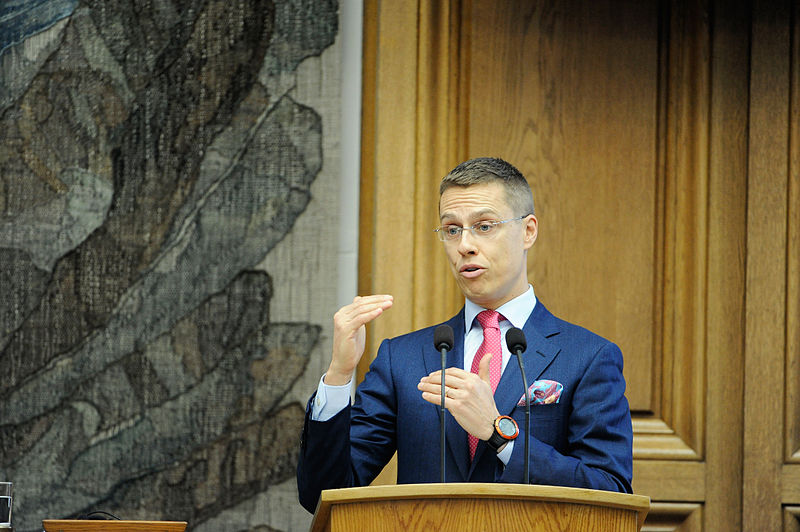
The Finnish elections concluded on Jan. 28, with Alexander Stubb of the right-wing National Coalition party nominated as the nation’s next president. Stubb beat out rival Pekka Havisto, a current member of the Finnish parliament and the leading Green League party candidate, by securing 51.6% of the popular vote. Stubb is a well-experienced politician who previously served in positions such as Finland’s Prime Minister (2014-15), the Minister of Foreign Affairs (2008-11), as well as a member of the European Parliament (2004-08). Furthermore, Stubb was a chair for the Finnish National Commission on Sustainable Development, which works on the promotion of national sustainability goals, and is also one of the 12 members of the World Happiness Council. Stubb is highly knowledgeable in matters of the European Union and geopolitics more broadly, having published 16 books and numerous articles on the topics. He even has his own YouTube channel where he uploads insightful discussions on Geopolitics (which you can watch here).
Stubb’s platform has been structured around taking a hardline stance towards Russian aggression while simultaneously remaining highly sympathetic towards Ukraine. Interestingly, Stubb had taken a seven year hiatus from politics to transition towards a career in academia, with no clear intention of returning. However, the Russo-Ukrainian War and subsequent growing Russian aggression forced him to reconsider. Upon announcing his candidacy in August 2023, Stubb declared “I can say, hand on heart, that consideration of the presidential candidacy was not relevant before the war started.”
Despite this seemingly staunch attitude towards Russia, Stubb has substantially changed his stance towards the country over the past decade. While Prime Minister in 2014, he supported the construction of a nuclear power plant in partnership with Rosatom, a Russian state-owned corporation, dismissing critics of the project as “Russophobic”. However, he overturned these comments after the Russian full-fledged invasion of Ukraine in February 2022. Since then, he has been a firm opponent of Putin and Moscow, while avidly supporting Ukraine’s fight against Putin’s escalating despotism.
Note that, unlike most other European countries, the Finnish president has the power to both formulate foreign and security policy, while also acting as commander in chief of the military. In other words, this position isn’t just ceremonial; the president holds considerable authority. This allows the individual who possesses these powers to fully enforce their foreign policy, and secure Finland in the manner they see as best for the country in the current global order. From his history and platform, Stubb’s ambitions as president are relatively clear: he hopes to establish Finland as a vital member of NATO in an attempt to deter increased Russian antagonization.
Non-alignment has been a hallmark of Finnish diplomacy since the end of WWII. In other words, the country had remained neutral in the ever-growing standoff between the Soviet Union and the United States in the latter half of the 20th century. It was not until the Finns decided to join NATO last year that they steered away from this policy that has persisted for almost 80 years. The Niinistö administration made a choice that seems particularly necessary to Finnish security. In international politics, a state must be flexible and willing to redirect its policies to fit the ever-changing world order. When a state and its policies remain stagnant, it faces the prospect of falling behind the rest of the world, or in more extreme cases, annihilation. In this instance, joining NATO was necessary for Finland to maintain its stability and sovereignty.
Now with Finland’s admittance into NATO, it seems the fear of a Russian invasion should dissipate. Article 5 of the North Atlantic Treaty states that an attack on one member of NATO is deemed an attack on NATO as a whole, and the other members will take necessary measures to assist the attacked ally. In the instance that Russia invades Finland, it is almost definite that Article 5 will be invoked, sparking a full-fledged war with NATO. Russia should further be deterred by recent NATO initiatives to establish multinational task forces in the Baltics -the most likely point of Russian penetration in Europe- in preparation for a potential invasion. Although Putin has made some seemingly incomprehensible strategic moves during his tenure as president, even he must understand how costly an attack on NATO soil would be.
Now, Stubb is placed at a crossroads in the history of his nation. He has inherited a state that has just joined the strongest military alliance in the world, opening up new gateways for mutual protection and economic opportunities. On the other hand, he is faced with the looming threat of Putin and Russia in their advance Westward. This threat is becoming ever more probable due to events currently unfolding in the United States.
Recently, the seeming strength of Article 5 of the North Atlantic Treaty and NATO’s authority as a whole have come under question. In 2006, NATO members agreed to commit a minimum of 2% of their respective GDPs to defense spending, in preparation for the event that Article 5 is invoked and mutual cooperation is needed. However, at a rally in South Carolina on Feb. 10, Republican Presidential candidate Donald Trump raised fears of how this mutual protection would look under his potential return to the Executive Office. Discussing if the U.S. would protect countries invaded by Russia that did not meet this minimum defense spending requirement, Trump responded with quite a shocking response. “No I would not protect you. In fact I would encourage [Russia] to do whatever the hell they want. You gotta pay. You gotta pay your bills”.
It is no secret that the United States essentially pulls the strings for NATO. The organization was practically created by and for the United States and its interests. If the US were to leave, then NATO would be reduced to a shell of its former self. The United States is the largest contributor to NATO defense spending, with contributions comprising two-thirds of the total NATO defense expenditures. Moreover, out of the roughly 3.3 million military personnel within NATO, 40% are American. With these major losses on top of the absence of the World’s most powerful country, NATO would face difficulties in learning how to evolve and continue to thrive.
Perhaps we are just once again over-analyzing a bullish, provocative Trump remark. However, even if this is the case, it still significantly undermines NATO’s authority and appeal as a strong, cooperative defense organization. That being said, it may be wishful thinking even to dismiss these remarks as solely empty words. According to “The Return of the Great Powers”, which will soon be published by a former senior U.S. official, if Trump wins the election “the US will be out of NATO”. This possibility is further supported by Trump’s repeated hinting at a potential US exit from NATO during his presidency. It is truly not so inconceivable to think he will go through with this, especially if the Republicans can get control of the Senate in the next election cycle.
Stubb must prepare for this very real threat, in which NATO would be reduced to a much less powerful institution. That being said, NATO still would be able to provide mutual defense for one another and work together on political and economic issues, although now on a more limited scale. For example, both German and Polish defense spending has drastically increased in response to the Russian invasion of Ukraine, causing other NATO members, including the Baltic states, to follow suit. However, this defense would not be quite as deterring to Putin, without the presence of the U.S. and its major contributions to NATO.
It seems that Europe is quickly preparing for a war that may never even happen. However, when one state shares a large border with an aggressive state that has unclear and sporadic intentions, it must be prepared. It is clear that Stubb is highly anti-Russian in his rhetoric and campaign promises, however, it will be important to see to what extent he acts on these. It will also be crucial to watch Finland during its first years in NATO, and how this may affect Russia’s sentiment towards the powerful intergovernmental organization and the West.
I would urge the continued use of hard power in terms of economic sanctions, such as those approved by the European Union. These sanctions have been effective in targeting politicians, military decision-makers, and businesspersons with close connections to the Kremlin. Also, Finland should not waiver on other aspects of its policy towards Russia, including maintaining a closed airspace to Russian aircraft. Furthermore, sanctions against Belarus and its Russian puppet government under President Alexander Lukashenko are necessary. Countries, such as Belarus, which openly support Russia, should be scrutinized almost to the same degree. Lastly, Finland is an important contributor of bilateral aid to Ukraine, having allocated over $2.1 billion in aid since February 2022. Continued financial support for Ukraine can help bolster the spirited Ukrainian army in their fight against Russia, thereby squashing any hopes of Russian expansionist policy before they can even truly gain traction.
Even though Finland has accrued the largest amount of debt in its history, I would be surprised if Finnish support for Ukraine didn’t significantly increase within the first year or two of Stubb’s presidency. Stubb has made his priorities clear in terms of international policy, and I would think he would strive to achieve his goals to counter Russian opposition. Stubb is a charismatic and highly competent individual, who will undoubtedly be a key figure in NATO policy over the extent of his term.
As a well-established theorist and author in the discipline of geopolitics, Stubb understands the implications of Russian antagonization, as well as the benefits and shortcomings of Finland’s NATO membership. In my opinion, the Finnish people elected perhaps the best man to lead them into a new era as a NATO member in the face of Russian aggression. Times like these call for a man such as Stubb to guide not only Finland but NATO in this highly polarized global order.
Categories: Foreign Affairs

 The Texas Orator