
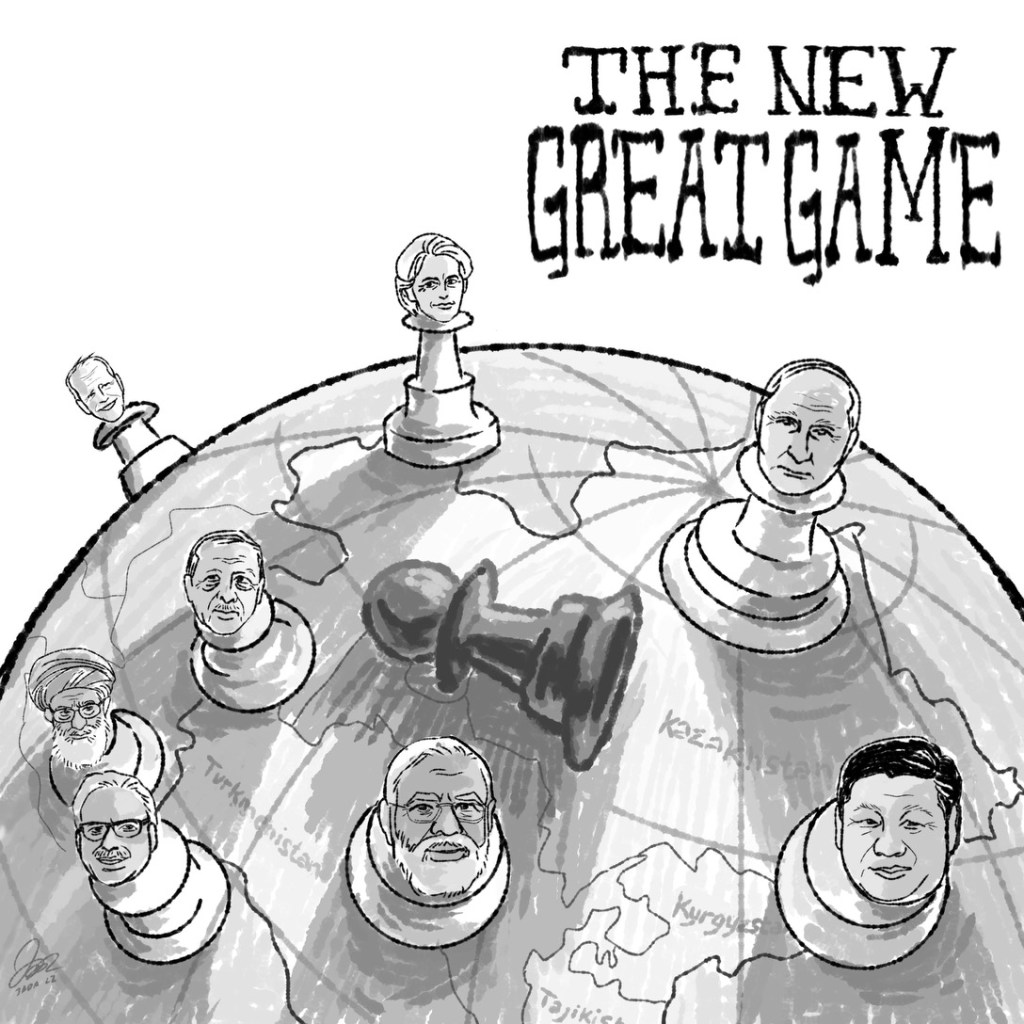
Since the dissolution of the Soviet Union in 1991, the geopolitical landscape of the Caucasus and Central Asia has witnessed a significant transformation, characterized as the “New Great Game.” This term alludes to the competition for influence, power, hegemony, and economic advantages among global powers in the region. It extends beyond economic interests to encompass ethnoreligious, cultural, and arms contests across a vast geographical expanse from Istanbul to Beijing, Tehran to New Delhi, and Tbilisi to Novosibirsk, involving a multitude of actors operating at the local, national, and international levels.
We endeavor to explore the interconnection between the New Great Game and the resurgence of geopolitics in this region. By delving into the intricate interplay between these two phenomena, we aim to elucidate that the New Great Game serves as a contemporary manifestation of the enduring geopolitical maneuvering in the region.
We can make a comparative analysis between the Original Great Game and the New Great Game through historical, thematic, and theoretical lenses with the overarching objective of assessing the latter’s utility as an analytical framework for understanding the complexities in the region.
The Original Great Game
The term “The Great Game” was coined in the 1830s, but it gained significant prominence in the 20th century through Rudyard Kipling’s novel, “Kim.” Although a work of fiction, the term succinctly captured the intense rivalry between the British & Russian empires for political ascendancy in Central Asia in the early 19th and 20th centuries.
The essence of the Great Game revolved around a relentless contest for political dominance, control, and security, primarily involving Britain & Russia over strategically vital territories and populations.
To grasp the nuances of this competition, it is imperative to dissect it into distinct phases.
The first phase commenced with the territorial expansion of the Russian Empire into the Caucasus and Central Asia, which engendered tensions with the British East India Company. British involvement escalated through the 19th century, evolving from a private enterprise into a crucial component of imperial defense, foreign policy, and colonial strategy. This phase witnessed a surge in covert operations and overt military actions, culminating with the signing of the Anglo-Russian Convention in 1907.
The second phase unfurled with Wilheimne Germany’s “Drang nach Osten”, maintaining similar operational practices from the first phase, but shifting its focus toward gaining control over India.
The final phase emerged in the wake of the 1917 Russian Revolution when the Bolsheviks aimed to liberate Asia from imperialist domination. This phase ultimately led to the Bolshevik consolidation of power in the former Tsarist territories. Despite the evolving objectives and fortunes of the contestants in this competition, the overarching goals of the Great Game remained consistent: safeguarding imperial security and consolidating power.
The New Great Game
The concept of the “New Great Game” characterizes a contest for influence, power, control, and economic profits in Central Asia and the Transcaucasus. It is widely acknowledged that the region was once a focal point in the 19th century Great Game, and has once again become pivotal to Eurasian security. Major global powers, including Russia, strategically isolated by the Western allies, are engaged in complex geopolitical maneuvers and economic rivalries in what is referred to as the “Great Space.”
The quest for Caspian petroleum takes center stage in the geopolitical debate, fueling nationalism, corporate interests, historical claims, and international rivalries.
The New Great Game revolves around six Islamic republics situated around the Caspian Sea, which possess substantial untapped oil and natural gas reserves, rivaling those in the Middle East. Control over pipelines, tanker routes, petroleum consortiums, and contracts constitutes the primary stakes in the contest. Major global players, including India, China, Russia, Europe, and the United States, vie for access to these resources. At the same time, peripheral states like Turkey, Iran, and Pakistan pursue their own sociopolitical and cultural interests.
A significant aspect of the New Great Game pertains to traditional politico-military hegemony, particularly Russia’s efforts to reassert political influence over the former Soviet states. Since 1991, there has been a pervasive perception that geostrategic issues in the region revolve around favoring Russian dominance. This contest involves both political and military strategies, particularly evident in the Caucasus, where the Russian defense forces’ presence and involvement in Transcaucasian conflicts underline the struggle for influence.
While the politico-military factors are significant, the focus has shifted to energy politics and competition for the region’s oil and gas reserves. Economic and political influences are intricately interwoven in this context, with discussions since 1994 increasingly highlighting the vast potential wealth flow from untapped resources. International bidders and companies have eagerly entered the fray, leading to debates about pipeline routes, construction responsibility, and profit sharing. Notable examples the Caspian Pipeline Consortium (CPC) and Azerbaijan Operating Company (AIOC) exemplify the struggle for influence in the energy industry, involving both corporate and state actors.
The strategic importance of oil, gas, energy resources, and securing energy supplies became paramount in the aftermath of the Gulf War. Non-regional governments including China, Pakistan, Iran, Turkey, and Israel, have further complicated the geopolitical landscape by pursuing oil and gas resources through various means such as pipeline connectivity and Siberian Oil exports.
Beyond the economic and energy concerns, the New Great Game encompasses cultural competition in Central Asia. For instance, Iran & Turkey, have historical and cultural ties to the region and have since then contested for influence. Meanwhile, India & Pakistan engage in regional rivalries as an extension of their broader strategic interests.
The emergence of non-traditional security threats following the 9/11 terror attacks and the subsequent military action in Afghanistan and Iraq, prompted a reevaluation of the New Great Game. Western military strongholds in the region raised alarms about the challenges to Russian hegemony and the expansion of the “War Against Terror” into Georgia, carrying significant geopolitical implications.
Additionally, the security aspects account for arms sales to the region and the involvement of non-regional states in regional security situations, such as Israel’s military cooperation with Uzbekistan and India.
As a multifaceted phenomenon, the New Great Game encompasses economic, political, cultural, and security dimensions, involving multiple actors, including multinational companies, governments, and transnational organizations, participating in this complex competition across different geographical areas. While the original Great Game of the 19th century has concluded, the New Great Game has taken its place which is shaping the dynamics of the Central Asia region.
The Analytical Significance Of The New Great Game Framework
The concept of the New Great Game has been widely employed, but its applicability and its validity require a thorough examination. To assess its suitability, a comparison between the New Great Game and its predecessor is warranted, considering factors such as geographical location, the array of actors involved, the evolving objectives, and the methods employed.
Geographical Location
While there are various geographical similarities between the two phenomena, such as Afghanistan, the New Great Game primarily focuses on the Caspian Basin, which is quite distant from the original Great Game center. These disparities introduce complexity in the overlap between the two games.
Actors
The original Great Game comprised the British and Russian empires primarily, whereas the New Great Game encompassed a diverse array of actors, significantly altering the dynamics.
Objectives
The original Great Game was aimed at territorial control and dominance, characterized by a zero-sum game where one actor’s gain came at the other’s expense. In contrast, the objectives of the new game are much more diverse, ranging from establishing neo-regal hegemony to securing economic interests and promoting cultural allegiances.
Outlook
The original Great Game was often covertly operated, while the new Great Game operated using a broad range of methods, from forming diplomatic alliances to military intimidation. The limited use of overt force reflects changes in the global governing system since the original Great Game.
Given the substantial differences and limited similarities between the two, it’s worth questioning whether the “New Great Game” is an appropriate label for the current situation in Central Asia.
The Validity of the Concept
The New Great Game is a subject of debate, as it may not accurately capture the complexities of contemporary international relations and socio-political realities in Central Asia.
The presumption that private companies inevitably serve their mother country’s nation is erroneous. Multinational corporations involved in the game often prioritize subjective profits over national interests, and their ownership and leadership can be varied. Moreover, the notion of the New Great Game overlooks the considerable cooperation among the member states and businesses in the region. While competition is inherent in market economics, cooperation among multinational corporations and states is prevalent, undermining the notion of aggressive competition. At the regional level, there is sizable evidence of cooperation, regional groupings, and shared security concerns, testing the notion of a new geopolitical game.
Thus the validity of the New Great Game could be better, as it accurately does not capture the complexities of contemporary international relations and the socio-political realities in Central Asia and the Transcaucasus.
The New Great Game and Geopolitical References
References to geopolitics and ideas related to geopolitics are often associated with the concept of the New Great Game. However, the application of geopolitics to this phenomenon demands careful examination.
One prominent geopolitical reference is Mackinder Heartland theory, which is widely used to support the New Great Game concept. Nevertheless, its applicability and relevance to the current situation in Central Asia is debatable, given the dynamic nature of socio-political and military realities in Mackinder’s time.
While geopolitics is often alluded to in debates surrounding the New Great Game, it often ends up being used ostensibly without comprehensively examining the discipline’s principles, objectives, and limitations. This lack of rigorous critique undermines the academic rigor of the concept and its applicability to Central Asia and Transcaucasus.
Analyzing The New Great Game
Since the early 1990’s the New Great Game has prominently influenced the turn of events in Central Asia and the Transcaucasus. However, its usage often lacks precision and draws misleading parallels between historical events, reflecting a nostalgic fascination with a bygone era. This trend has resulted in a distorted portrayal of contemporary events in the region and the inadequacy of academic inquiry.
Furthermore, both the concept of the New Great Game and the study of geopolitics demand rigorous intellectual and academic scrutiny, which has been lacking over the past decades. A more critical analysis is needed to enhance our understanding of the intricate dynamics at play in Central Asia and the Transcaucasus.
Categories: Foreign Affairs

 The Texas Orator