
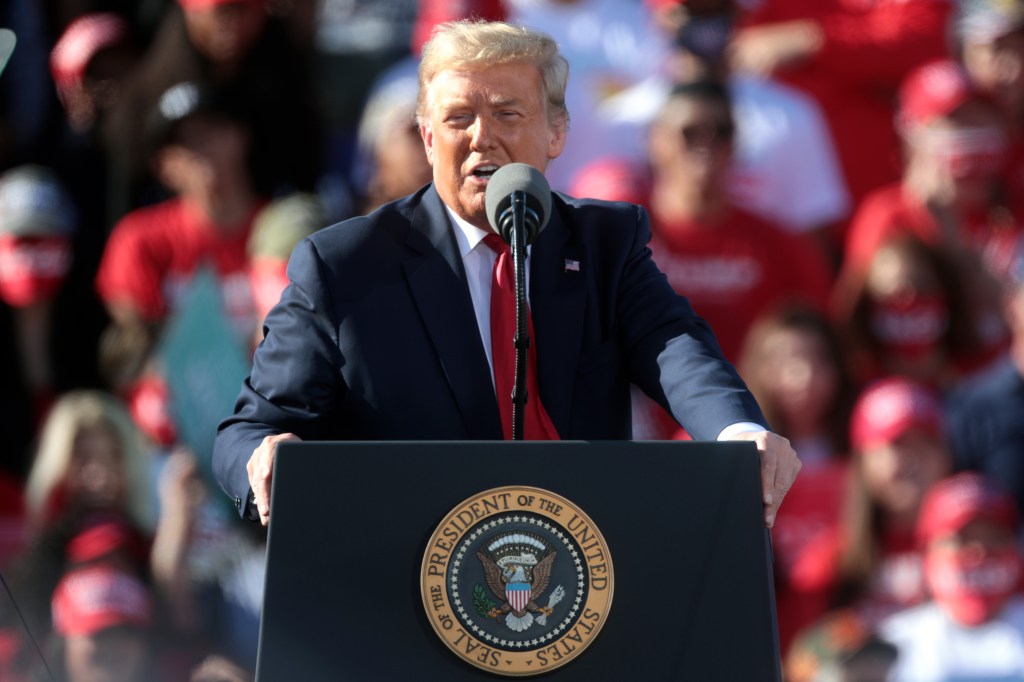
Former President and 2024 candidate Donald Trump has faced numerous lawsuits this fall that threaten to remove him from the 2024 primary ballot. The threat comes from invoking Section 3 of the 14th Amendment, which bars “those who have engaged in insurrection or rebellion against the country” from holding federal office.
The 14th Amendment, known as the Equal Protection Clause, was passed following the Civil War. To prevent Confederate politicians from returning to office, lawmakers added Section 3 to the bill. The clause has only been invoked a handful of times, and most of the adjudications of Section 3 involved Confederate soldiers. Although, even that was rare, as most Confederate soldiers did not try to return to office following the Civil War. However, a historical precedent is still in place that scholars and activists have pointed towards as disqualifying Trump from holding office due to his efforts to overturn the election that ultimately led to the riots on January 6, 2021 at the US Capitol.
The theory of using the 14th Amendment to disqualify Trump as a strategy to prevent him from holding office initially emerged within fringe elements of Trump’s opposition immediately after January 6. The idea picked up more supporters following Trump’s second impeachment trial in February 2021 for incitement of insurrection that ended with an acquittal after the Senate nearly missed the two-thirds needed to convict by 10 votes, but even then most advocates for using the theory to prevent Trump for holding office didn’t have much backing beyond liberal activists. In recent months, the argument has grown more popular in scholarly circles, as legal scholars have published articles about it as the 2024 primary draws closer. One important article came from two members of the Federalist Society, a conservative legal group that has considerable sway among conservative groups and is credited with pushing the efforts beyond liberal legal circles. Two law professors, William Baude and Michael Stokes Paulsen, wrote in an article for the University of Pennsylvania Law Review, arguing that, “the case for disqualification is strong” and that his speech to his supporters on January 6 contained strong messaging that the election was stolen. They argue that the clear language encouraged immediate action and as a response, his supporters stormed the capital to stop the legitimate transfer of power.
Trump is not the first person to face legal challenges in this way for his actions on January 6.
Free Speech For People, an advocacy group, previously represented voters in Georgia and North Carolina in a challenge to the 2022 reelection runs of Republican House members Marjorie Taylor Green and Madison Cawthron, arguing that their vocal support of the capitol rioters disqualified them from the 2022 ballot. Judges in both cases ruled that their actions were not enough to disqualify them, finding insufficient evidence that they participated in or encouraged the riot.
One legal challenge has been successful, however, as a county commissioner from New Mexico named Couy Griffin was removed from office by a state district court judge in September 2022 for his actions on January 6. Yet, there are a few important differences between this case and Trump’s. One is a question of political clout that comes with being a former president and 2024 Republican frontrunner. It will be considerably harder and more controversial to bar Trump from the 2024 ballot than it would be to kick a county commissioner who is on the bottom of the political food chain out of office. Another important difference is one of legal standing, as Griffin had already been found guilty of entering a restricted area during the riot. While Trump is facing charges for attempts to overturn the election in D.C., he has not yet been convicted for any wrongdoing. However, supporters of the effort have argued that section 3 doesn’t require a criminal convention to be handed down for someone to be barred from office and can be enforced through civil lawsuits.
In February 2023, the first Section 3 challenge was brought against Trump in Florida in an attempt to block his name from appearing on ballots in the primary election. Since then, mostly left-leaning voters and advocacy groups have brought challenges to 30 states. While the specific legal arguments used in each case differ, they all center around Trump’s actions on January 6, and what plaintiffs argue was insurrectionist language used that bars Trump from holding office. Most of the challenges are still pending approval in the courts and won’t be decided until later in 2023, but, three recent cases in Minnesota, Michigan, and Colorado were regarded as the most significant threats to Trump.
The case in Minnesota was ultimately dismissed in early November by the Minnesota Supreme Court, but the justices left open the possibility that another challenge could be heard to bar Trump from the 2024 general election, noting that the decision only applied to the primary ballot. This is because the court did not explicitly rule on whether Trump’s actions on January 6 disqualified him from holding office and instead explained their decision by noting that there is “no state statute in Minnesota that prohibits a party from placing a candidate on the primary ballot that is ineligible to hold office”. Likewise, in Michigan, a challenge was dismissed by Court of Claims Judge James Redford, who argued that Trump cannot be removed from the primary ballot because Trump followed state law in qualifying for the ballot and that it is up to Congress to decide whether Trump is disqualified under Section 3 because they, “embody the represented qualities of every citizen of the nation.” The group behind the Michigan case has asked the Michigan Supreme Court to hear an appeal of the lower courts ruling, seeking to bypass the court of appeals in what they argue is an “immediate and expedited consideration for appeal” to challenge the ruling before the primary ballots need to be finalized. The Michigan Supreme Court has not made a decision yet on whether or not they will hear the case. The Colorado Supreme Court will hear an appeal after District Court Judge Sarah Wallace dismissed the case against Trump, arguing that while Trump did engage in an insurrection, “the 14th Amendment’s insurrectionist ban doesn’t apply to presidents based on the text of the amendment.”
With an expected decision from the Michigan and Colorado Supreme Courts before the end of the year, and an expectation of appeals to follow those decisions as well as pending challenges in numerous other states, the widely expected outcome of the case is for it to end up before the U.S. Supreme Court for a final ruling if they decide to hear arguments on the case. However, working within a tight timeframe before the 2024 primary ballots need to be finalized, the Supreme Court would need to reach a decision quickly for it to have an impact on the primary elections. But, if the Supreme Court did hear an argument before the primary ballots were finalized, the most likely outcome would be for the conservative court to strike down the decision and allow Trump to remain on the ballot.
While the importance of these cases cannot be overstated, the impact of a potential decision by judges to remove Trump from a primary ballot brings the question of whether disqualification via Section 3 of the 14th Amendment is the right way to deal with the problem of Trump potentially winning the presidency again. Trump certainly needs to be held accountable for his rhetoric that led to the January 6 riots, and he did engage in an insurrection and act in an undemocratic manner. But, while bringing the cases to court can hold Trump accountable and discourage others from engaging in similar actions, it would take power away from voters to decide who they want their nominee to be. It certainly wouldn’t be very democratic to decide who voters can and cannot choose as their nominee. Taking the choice away from voters would damage an already struggling engagement level among the American public if they feel they have no say in the election. In addition, the decision risks alienating a segment of the population who already feels anger and distrust toward the government, risking making an already heated political environment worse. But most importantly, Trump is already facing criminal charges for his actions on January 6, and it’s best to let those play out instead of bringing a challenge with a hazy legal history. It is time to put our trust in voters to make the right decision with the ample amount of evidence of Trump’s wrongdoings. Moving forward risks a conservative Supreme Court striking down a Section 3 challenge and giving Trump and his supporters the chance to point to the decision and declare himself to be the survivor of a political witch hunt.
To track the status of Section 3 cases against Trump and view case fillings, visit LawFare.
Categories: Domestic Affairs

 The Texas Orator