
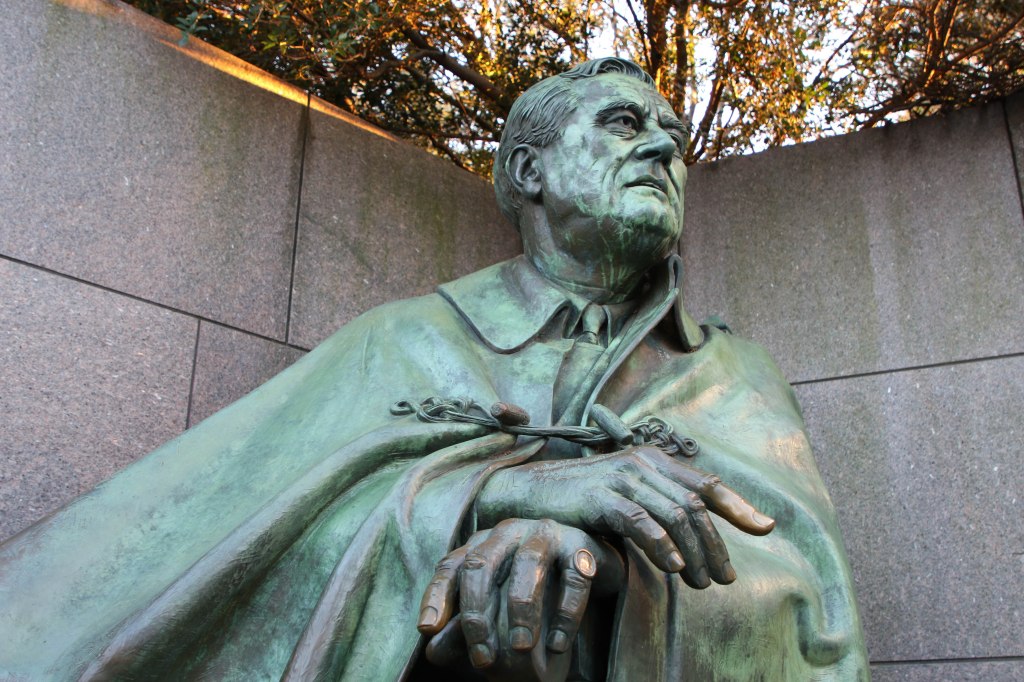
In 1940, Americans elected Franklin Roosevelt for an unprecedented third term as President of the United States. By this time, much of Europe had already fallen to Fascism. Great Britain, the mighty bulwark against the Nazi’s advance on Europe, was barely holding its own, struggling for support from allies.
The unstable circumstances of the day put America at a tentative crossroads as to its future, Many Americans continued to support isolationism, prioritizing needs at home over concerns abroad. As America searched for its sense of identity, President Roosevelt’s “Four Freedoms” speech made the case for America as defined by its deeply held convictions and which compelled Americans to overthrow the looming “new order of tyranny” with “the moral order,” founded upon “four essential human freedoms:” freedom of speech and expression, freedom of worship, freedom from want, and freedom from fear.
Roosevelt expressed his “freedom from fear” in “world terms” as a reduction in the armaments of any nation which would prevent any nation from committing “physical aggression” against any of its neighbors. With this “Four Freedoms” speech, Roosevelt provided Americans with the moral ammunition needed to navigate the challenges they faced.
The uncertainty and dread of those days seem all too present in our national conversation today. Roosevelt’s old “freedom from fear” may most aptly be described not in “world terms” but in “domestic terms” as preventing any man or group from committing aggression against our democracy or the rights and liberties of Americans. This freedom, updated for the current state of our politics, is vital to the health of America’s democratic institutions and the quality of our civic fabric as a free society. However, according to many of the thoughtful and interesting speakers at this year’s Texas Tribune Festival, it is increasingly under threat, with serious consequences on the line for America’s future.
During three panels at the Texas Tribune Festival, “Fighting the Fringe,” “God and Country,” and “Castro Family Values,” panelists discussed the challenges they perceive to American democracy. Such conversations among experts, politicians, and others who work in politics and policy are especially beneficial because of their professional insight and experience. Yet such conversations are too important to be left to the politicians and the professionals. Rather, protecting democracy requires every citizen to actively participate in the discussions that shape our collective future and to embrace the spirit of openness and tolerance that are a cornerstone of our democratic culture.
The most recurring issue of these conversations was the threat of far-right extremism, which takes many forms but poses the same threat: the weakening of our fundamental democratic institutions and norms. In “Fighting the Fringe,” panelists discussed how many of our major societal gatekeepers have failed to adequately combat the rise of extremism.
The Internet, for instance, has allowed barriers to conspiracy theories to be significantly reduced andprovides ready access to a community of believers. Mainstream media, most especially Fox News, has had a detrimental effect by mainstreaming conspiracy theories to the public. Take Fox News’ abetting of the Dominion Voting Systems conspiracy after the 2020 Presidential Election, which was consistently given a platform by top hosts such as Sean Hannity and Tucker Carlson. And the Republican Party has found it “politically expedient” to support conspiracy theories and politically court those who believe in them. As panelist Jessica Huseman, Editorial Director of Votebeat, claimed, “The base of the Party runs the Party and the establishment Republicans are just following along.”
Jeffery Toobin, journalist, is the author of several bestselling books including his most recent book, Homegrown (2023). This book looks at the rise of far right extremism in America and the case study of Timothy McVeighn, the terrorist who perpetrated the Oklahoma City Bombings in 1995. McVeighn, Toobin claims, was largely a product of 90s America, having listened excessively to Rush Limbaugh’s radio show and Fox News programming. The extremist right leans heavily on patriotic themes; according to Toobin, McVeighn had an “absolute obsession with guns and the Second Amendment,” an “obsession with the Founding Fathers,” and memorized much of the Declaration of Independence. Similarly, the events of January 6th, Toobin claims, featured much talk about the American Revolution from the insurrectionists.
In recent times, far right groups have applied pressure on elected officials to rewrite the rules on elections, from pushing for all-paper ballots, to allowing their groups to hand count ballots, which, Ms. Huseman claims, would likely lead to voter fraud. Such permanent changes that these groups are making will likely endure and affect “the way our government functions,” according to Ms. Huseman. The threats from the far right could not be any greater to one of the fundamentals of our democratic system: the right to vote.
“God and Country” featured conversations among panelists on the origins and nature of Christian nationalism. According to Amanda Tyler, the lead organizer of the Christians Against Christian Nationalism campaign, to be a Christian nationalist means to “insist on your own theological view” and to impose it on others, such as through the coercion of government. It is also a trojan horse for other dangerous ideas and movements, such as white ethnonationalism, racism, white supremacy, and theocracy. “Racism and white supremacy is so tied into this conversation,” said Tyler, who testified before Congress in 2022 on how Christian nationalism provokes white supremacist violence and was involved in the Jan 6th insurrection. For those working within the Christian nationalist movement, the movement has “given them a common cause, common vocabulary [and] symbolism.”
To Tyler, t christian nationalism also seeks the end of the American separation of church and state and of our traditional notions of religious liberty. According to panelist Dr. Anthea Butler, Professor at the University of Pennsylvania, the threat posed by the Christian nationalist movement is none other than the overthrow of our republican system. “Do you want a theocracy or do you not want a theocracy?” Butler asked the crowd, in no uncertain terms. “Do you want a theocracy or do you want a democracy?” Such are the stakes at hand. And, says Butler, “that is the question for 2024.” The American voter seems to have their work cut out for them this coming election cycle.
The Castro family has, without a doubt, an incredibly strong tradition of political activism and public service that tells the story of American progress and the challenges and triumphs faced by American Hispanics throughout the years. The panel featured Julian Castro, former Secretary of Housing and Urban Development and presidential candidate, Joaquin Castro, U.S. representative from Texas’ 20th District, and their mother, Rosie Castro, a longtime Chicano and civil rights activist. Rosie Castro began organizing in San Antonio, partly because she was moved by the vast discrepancies in wealth and opportunities between the richer parts of San Antonio, such as Alamo Heights, and where she was from. “Don’t agonize, organize!” she said to the crowd. Both her sons have already had very experienced careers in public service, and neither of them seem to be ready to give up the fight.
As a U.S. representative, Joaquin Castro’s career in Washington has given him some important insight into politics at the highest level, both on his side of the aisle and, importantly, into the other side. Among the ranks of the Republican party across the country, Representative Castro sees a “fascist” movement that is “dangerous and is undermining our democracy.” Julian Castro agreed with his brother, claiming that there exists “this anti-democratic impulses toward fascism” within our politics today. As evidence of the American fascist movement, Secretary Castro discussed the fake elector plot in which Donald J. Trump and his Republican allies allegedly tried to recruit a slate of fake electors in seven battleground states in the 2020 presidential election to sign false certificates claiming that Trump, rather than his opponentBiden, had won the votes in their respective states. These efforts by Trump and his allies are the subject of federal indictment by the Justice Department for what was an “unprecedented effort to block the peaceful transfer of presidential power and [to] threaten our democracy.” If Trump were to win the upcoming 2024 presidential election, it would, according to Secretary Castro, mean the beginning of Americans’ “march down a path our country has not seen before,” with threats to our rights and freedoms.
If the thought of America marching down the road to fascism, or at least toward a seriously more broken, illiberal democracy, doesn’t grab at your heart and squeeze, then neither your head nor your heart and doing enough work. If the panels at TribFest are any indication of reality, which I find they certainly are, then the current state of the undemocratic movement is comparable to the bleakest hours of the Second World War, when Americans seemingly stared down the barrel of what Roosevelt called “new order of tyranny.” If history is any model, the way forward from our present political moment is to follow the example of Roosevelt, to provide the moral ammunition for our commitment to democracy, freedom, and the rule of law. Commitments to these and other principles constitute the foundation and identity of the American people. It is, as Roosevelt did in his Four Freedoms speech, in reminding us of who we are that America finds its greatest strength. “As men do not live by bread alone,” Roosevelt claimed, “they do not fight by armaments alone.”
“Those who man our defenses, and those behind them who build our defenses, must have the stamina and courage which comes from an unshakeable belief in the manner of life which they are defending.”
For America to effectively defend our democracy from the threats we face today, it is essential that every American renew our faith in our democratic manner of life, and the moral and political obligations it entails.
Categories: Domestic Affairs

 The Texas Orator