
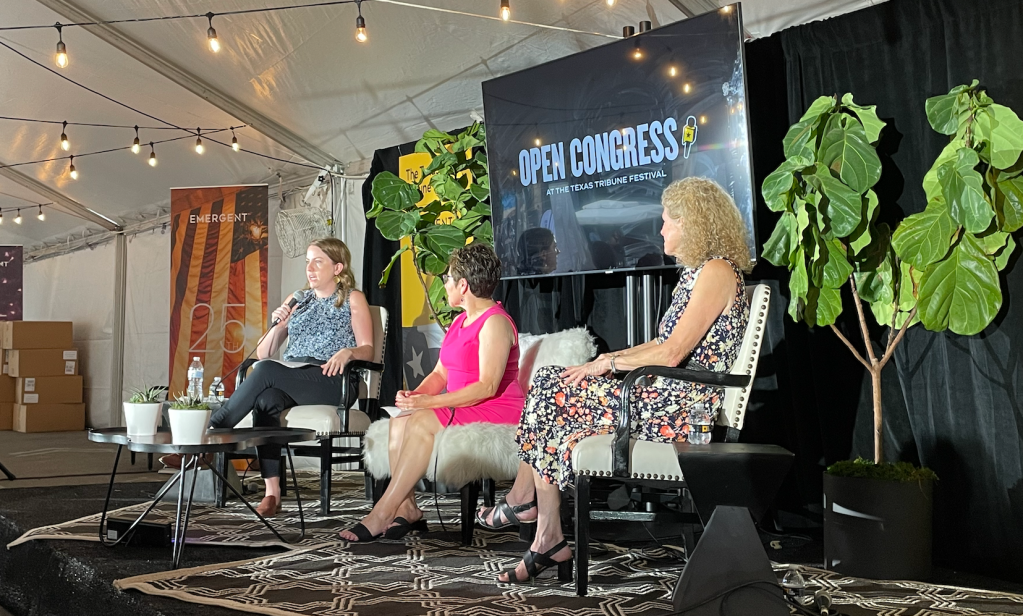
Hot on everyone’s mind in a post-Roe vs. Wade world, politicians and journalists alike did not shy away from talking about reproductive rights, maternal health, and rising healthcare costs during the 2023 Texas Tribune Festival.
Three panels, “Abortion and the States,” “Family Matters,” and “Getting a Handle of Healthcare Costs,” brought together activists and politicians to talk about Texas’ role in healthcare reform, especially regarding abortion, pregnancy, and contraception.
These were the key policy takeaways from these panels:
House Bill 3058, passed in 2023, allows “doctors to provide abortion care when a patient’s water breaks too early for the fetus to survive, or when a patient is suffering from an ectopic pregnancy.” Many panelists agreed that this law is vital in the wake of Texas’ abortion ban.
House Bill 12, also passed this year, expands Medicaid coverage to new moms from two months to 12. For advocates of maternal health reform, this change is essential to protecting new moms from rising healthcare costs.
Finally, the Center for Reproductive Rights is going to court, “seeking to clarify the scope of the state’s ‘medical emergency’ exception under its extreme abortion bans.” The Texas Supreme Court oral argument is set for November 28, 2023.
Abortion and the States
“This is not a woman issue, it’s a human issue.” – State Senator Carol Alvarado, Houston (D)
The “Abortion and the States” panel consisted of:
- State Senator Carol Alvarado
- Nancy Northup, CEO of the Center for Reproductive Rights
- Rebecca Traister, Writer for New York Magazine
- Moderator Eleanor Klibanoff, Women’s Health Reporter for the Texas Tribune
These women focused on litigation and new policies to protect Texans’ reproductive rights, even if abortion is officially illegal in our state.
One thing all of these women agreed on is that reproductive rights are a framing issue, something that Democrats need to recognize. Traister explained that policy officials need to put faces, names, and stories on the front line, especially those directly affected by Dobbs vs. Jackson.
Northup added that we stand alone in North America when it comes to reproductive rights. She was, of course, referring to Mexico’s newest decision to decriminalize abortion and Canada’s long-standing abortion protections.
When asked whether abortion regulations should be left to the states, all women said no. From Northup: “We don’t leave fundamental rights to the states.” This matched fears that Traister had about the future of reproductive rights, as she stated that bans on “contraceptives aren’t next. They’re now.”
Alvarado knows how dire the need for proper sex education and contraceptives is, stating that pro-life policymakers “basically don’t want anyone to have sex.”
In traditional politician fashion, Alvarado also urged the audience to go out and vote: “This is why elections matter, y’all… what happens in Texas spreads like an STI.”
Family Matters
“I’m feeling like there’s a lot of good momentum.” -Evelyn Delgado on strides towards maternal healthcare reform
Also moderated by Eleanor Klibanoff, “Family Matters” panelists included:
- Evelyn Delgado, CEO of Healthy Futures of Texas
- Donna Howard, Democrat and Texas State Representative from Austin
They discussed how maternal health has been affected by Dobbs vs. Jackson and what we can do to protect mothers.
Both stated that access to healthcare is important and discussed how Black mothers suffer the most from lack of healthcare and maternal mortality. They also emphasized that maternal mortality is not just caused by lack of healthcare access but by suicides and homicides as well. In 2020, the “pregnancy-associated homicide rate was 2.2 to 6.2 per 100,000 live births.”
In a post-Roe world, interpersonal violence towards pregnant people has only become more frequent. Howard took a moment to recognize that gun control would help alleviate domestic violence. According to the Journal of Women’s Health, 55% of maternal homicides are caused by guns. Women of color are seven times more likely to be killed while pregnant.
These women discussed how important Medicaid expansion is, especially as a bipartisan effort. As previously mentioned, HB 12 will expand coverage for pregnant people from two months to twelve. Before this bill, many Texans were at risk of losing their COVID-era coverage.
Current problems in maternal health also include a workforce shortage for nurses and OB-GYNs, especially since some healthcare workers move out of Texas and other pro-life states for training and then do not come back. Howard explained that some future doctors also have fears over being sued or arrested by the state, prompting them to move to states with more protections. Moreover, some rural areas continue to have little access to healthcare facilities, including birthing centers. Texans can end up having to drive 30 minutes to an hour just for healthcare.
In a post-Roe world, teen pregnancy is also on the rise. Delgado and Howard agreed that teenagers (and adults alike) need access to contraception and family-planning initiatives. Access to contraception can and should be codified, just as how Texas officially eliminated taxes on menstrual products, diapers, and other pregnancy-related items.
According to Howard, the Democratic Party is “pro-women and pro-healthcare.” Alongside other activists, she continues to fight for reproductive rights across Texas.
Getting a Handle on Healthcare Costs
“Medicaid expansion helps the most people in the smallest amount of time.” -State Representative Morgan LaMantia, South Padre (D)
Panelists included:
- James Frank, Republican Chairman of the Texas House Human Services Committee
- Nathan Johnson, Democratic State Senator from Dallas
- Morgan LaMantia, Democratic Texas Representative from South Padre Island
- Moderator Karen Harper, Health and Human Services Reporter for the Texas Tribune
All of the panel’s participants, regardless of political affiliation, want healthcare costs to be lower but disagree on how to go about doing so. Johnson and LaMantia have pushed for the expansion of Medicaid and an increase in government regulation. Frank, on the other hand, did not agree with more government regulation but is against monopolies in the industry.
Johnson also pushed for health literacy bills in the Texas Senate, citing that informed consumers expand economies and help everyone. Frank agreed and was vehemently opposed to misinformation on the part of corporations, stating that misinformation and Big Pharma money “spread like peanut butter.” The panelists also discussed overcharging and cost-shifting, and Johnson described his attempts to create a more updated provider directory, hoping to increase literacy.
Johnson also stated that increasing the quality of healthcare, especially maternal healthcare, boosts economies in the long run. He said that hospitals have “saved money by treating people better.”
At the end of the day, the panel agreed that Americans should be mad about the high costs of healthcare, and Harper chimed in that we all need to find a common enemy like Big Pharma. That enemy was not found at this event, but perhaps more bipartisan efforts will be made soon.
Overall, politicians, advocates, and journalists are working together across party lines to address some of the most crucial issues in healthcare. Thanks to the 2023 Tribune Festival, they all had an avenue to do so.
Categories: Domestic Affairs

 The Texas Orator