
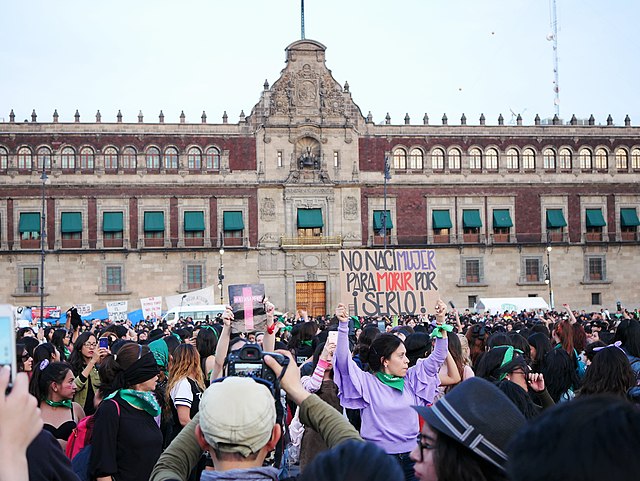
“I was not born a woman to die for being one”
This article introduces the Borderland and the history of feminism in Mexico before transitioning to the political and social issues encompassing the human rights issue of femicides. Femicides are targeted killings of women and girls on account of their gender. An in-depth interview of local author and UT El Paso professor, Alessandra Narváez Varela, adds to the “La Feminista Movement” discussion and its broader goals.
An Introduction to the Borderland
The Mexican-American Borderland is a place unlike any other, a tangible contrast between a First and Third-World country. On the American side, El Paso has been ranked one of the safest cities in the U.S. with a diverse public-private business economy. Its temperament is often described as warm and friendly by locals and visitors alike. Home to one of the largest military bases in the world, Fort Bliss trains the strongest contemporary military power.
In contrast, Ciudad Juárez exemplifies the struggles of a municipality under a corrupt government lacking infrastructure, a fair justice system, and a healthy economy. Across the “wall” and near the I-35 highway, what some might describe as a “slum” is one of the poorest neighborhoods in Juárez. Here, homes are bandaged together with cardboard, unhinged metal fences, and concrete brick walls. A lack of drainage systems means the monsoon season can devastate an entire community; already fragmented homes may be swept away by a single flash flood. To illustrate further, a lack of consistent street lighting makes the city a more dangerous place after hours. Like most places, this depiction does not characterize Juárez as a whole. Although some areas are more refined than others, even the wealthy sides of town take proper precautions with armed security, bulletproof vehicles, and high-rise walls surrounding their properties. These precautions may seem extreme, but to the average Juárez local, they have become a way of everyday life.
A Brief History of Feminism in Mexico
Although violence is no stranger to Juárez, there was once a time when a majority of people safely enjoyed the city’s liveliness. Grandparents often reminisce about their “traviesos,” or the fun mischief the city would so willingly offer. It was a place of elegance, fine dining, and classic Mexican bullfighting. Although violence is present in most large cities today, back then violence was only an underlying theme in Juarez rather than the main character.
In the late 1960s, a cloud of terror darkened the streets of Juarez, and since then, the violence has only worsened. Since the 1990s, homicides have risen to a shocking 3,000 per year average as reported in 2010. Subsequently, social movements in Mexico have seemed to take steps backward. Avid protesting rose in 1968 because of insufficient resources and anger towards the excess extravagance of the federal budget for the Mexican-hosted Olympics. To address and alleviate some of these issues, a UN World Congress was called on women to discuss equality and social relations for Mexican females. Unfortunately, the issues that plague Latinas today go beyond both the scope of what was discussed and the level of equality in the workforce today to something much more serious: organized crime accountability and female safety.
Since the 1990s, experts have developed many theories to describe the dramatic rise in female disappearances, coined “femicides” by the locals. There is a large consensus that these murders are cartel related because all of the targets have been young women who were often last seen on their commute to work across the border or in American factories. Unfortunately, many are found discarded in shallow graves, mutilated with signs of a very violent rape. Many mothers and loved ones are not only outraged by the high disappearance rates, but by the lack of investigative efforts from the Mexican government.
Furthermore, there seems to be a general understanding that much of the sexual violence women face is the byproduct of a corrupt police force that lacks accountability. Reproductive rights, such as access to contraceptives, are another important aspect of the La Feminista Movement that is closely tied to sexual violence. However, because public protests often take a violent turn, most members of the movement avoid public attention by instead showing support through nonviolent protests such as coalitions, public displays of art, and publications.
Poetics of Service
Born and raised on the Mexican side of the Juárez-El Paso Metroplex, Alessandra Narváez Varela is no stranger to the socio-economic complexities that plague the Borderland. As a writer herself and a creative writing professor at the University of Texas at El Paso, she humbly identifies not as an activist, but as a catalyst for change through “poetics of service.” She made an important distinction between the two, noting that although literature stands powerfully on its own, to change lives and history brave activists are needed in the community because not everyone has access to literature. Varela uses novels and verse to communicate issues surrounding social justice that impact her directly and indirectly. Published in 2021, “Thirty Talks Weird Love” is an example of how she uses her written talents to tell a coming-of-age story about a girl growing up in this environment. This novel is an effort to deal with and understand these troubling emotions as children from this area transition to adulthood.
When discussing the challenges of writing a poetic novel that touches on issues so close to home, Varea communicated the difficulty in balancing a relationship that honors the victims and their families without adding to further stigmatization of Juárez as a place simply characterized by its violence. Due to the fictional nature of the novel, Varela wanted to communicate empathy with her audience about what it would be like to lose a close friend in such a way and to such violence. She modeled much of the characters around those who she knows best: her friends. Verela was challenged with balancing these emotions without attempting to appropriate anyone’s story. Another challenge that presented itself while conducting this type of project was being removed from Juárez while living, writing, and working in the safety of the El Paso side of the border. Although her life is there now, she has the desire to reconnect with her hometown through literature and by immersing herself in that community once more. To exemplify the impact Verela hopes to achieve, she dedicates her book to the women and girls lost to the violence in Mexico, asking them to accept her book as a “humble prayer” for their return. The sentiment here is a true testament to the powerful importance literature has within a community.
Art and poetry have been significant players in the feminist movement both during and after the COVID-19 pandemic. For example, Mexican Artist Elina Chauvet’s “Los Zapatos Rojos” installation of 300 red shoes laid out in the public streets of Mexico to signify bloodshed, change, and hope sent a message across the world. The exhibit has been reinstalled in countries such as Chile, Canada, Italy, Spain, the United States, and more to show support and solidarity for the victims and their families. Other examples of powerful artistic voices in the community include events on Women’s Day in 2021. On this day, the Mexican government surrounded Mexico’s National Palace with a black metal fence to protect it from vandalism, but protestors still wrote thousands of victims’ names to commemorate their loss. The message was clear: those lost cannot be so easily forgotten. Art and poetry proved to have a very important and meaningful impact on spreading the message of the injustice of femicide across the world.
The Role: A Catalyst for Change
Her role is something Varela doesn’t take lightly. From a young age, Varela knew she wanted to dedicate herself to an act of service. She brought her passion for service with her like a writing utensil, wanting to bring people together in conversation. This is how teaching entered her life. Through her work, she further discovered the responsibility of social justice and healing others through hope. Writing Thirty Talks Weird Love allowed Varela to reconnect with her youth.
For this reason, her desired audience is teenagers between the ages of 13-16. While she did have an impact on this primary audience, the book lends itself to be visited by many ages. Girls and women alike took different messages from her poetry, often finding the comforting words of the character, Thirty, both useful and impactful in their own lives. This is the power of the story, giving hope across time and borders. Varela’s main goal is to expand this impact, as she optimistically announces the Spanish version of the book to be released for a broader audience in Latin American countries soon.
Goals: Educate and Inform
Unfortunately, the cultural connotation of “machismo,” or aggressive masculine pride, makes female education secondary to men’s in many Latin American countries. Coupled with gang violence, this factor has lent itself to a vulnerable environment where femicides are current and numerous because female job prospects are limited. The majority of victims are from the poorer classes, often last seen on their early morning commutes to work at factories or over the border. Furthermore, although there is not enough research to define a correlation, the violence seems to be concentrated in urban areas, specifically border cities, where the cartels are most powerful.
This being said, much of the broader goals of the Mexican feminist movement are to educate and inform. This includes educating young women on both sexual health and contraception options, even though this sometimes proves difficult in a highly traditional Catholic culture. As a woman living on the northern side of the border, Varela feels extremely grateful and privileged to be educated. She realizes this is a rare opportunity, especially for women in Juarez. There were many “lucky” coincidences that led her to this path in her life: she didn’t have to begin working at 15 to help support her family, they supported her academic aspirations, and she was able to attend university in the United States. Because of these privileges, she believes it is her responsibility to give back to the community with what she does best: service through writing. Although, she acknowledges that it is difficult to do this now, confined by the walls of UTEP, a university that in itself is an example of privilege: “Our levels of access to storytelling differ, especially when it comes to publication. If we have that access – by privilege, by luck – then it is our responsibility to help others to tell their story so that at some point in the future, they would all have that. I understand though that it is idealistic and this would be utopia.”
For the next challenge in her life, Varela hopes to immerse herself in the community and give voices to those that feel they have none. She wants to share this opportunity, especially with women and the families affected by the violence. Lastly, Varela is excited about the prospect of her book reaching more Latin American audiences with the Spanish translation. Because of efforts such as Varela’s, the voice of the victims and their families is becoming more powerful as tensions rise due to the lack of government cooperation. The hope is for legislative action to finally take effect, as well as due process, investigations, and trials for the crimes committed against these thousands of women.
Conclusive Thoughts
Femicides in Mexico are underreported, leaving the victims and their loved ones with unresolved hearts and minds. This extreme lack of information may be contributed to the constant danger journalists face when reporting on the Mexican government and/or cartel corruption. Evidenced in the introductory portion of this article, violence in Juarez is not a new phenomenon. However, a dramatic increase in cartel power and government corruption could be the culprits for the rise in femicides and sexual violence against women. These are mothers, sisters, brothers, fathers, and friends brought together by a need for justice in their country to combat some of the grief that has interrupted their lives.
I sincerely thank Alessandra Narváez Varela for her bravery in pursuing such a complex topic. There were times that she walked a thin line between trying to engage the emotional appeal of her audience without overstepping and adding to the stigmatism of the borderland. Nevertheless, her passion for service lives on with every new reader and the empathy they feel, which hopefully translates into action to support the movement.
Victims of Femicide:
- Deyanira
- Andrea Candelaria
- Ana Isabel López Motes de Oca
- Hilda Guadalupe
- Berenice Jaúrez Cabra
- Lucero Soto Corral
- Delores
- Maria Guadalupe Barrón Soria
- Valeria Fuentes Garcia
- Tania Tamara Saldańa Martinex
- Karen
- Daniela Sánchez Cureil (2015)
- Amanda
- Dayani Vanessa
- Guadalupe H.M
- Diana Valázquez Florencio (2017)
- Silvia elena Ojeda
- Julia Sosa Conde (2018)
- Nancy Hguadauple
- Maria de Jesús
- Andrea
- Juana Perez Glez.
- Nadia Muciño Mãrquez (2004)
- Blanca E. Orozco
- Carmela Hernández Valerio
- Paola Vergas
- Corina
- Josefa Ochoa A.
- Nayeli Ana Maria Dulce
- Sonia
- Jasmin Vera
- Paulina
- Maria Asuncion
- Hortensia
- Laura P.
- Carla Sacnité Peña Sanchez
- Merly C.
- Francisca Karla V.
- Maura Paloma Torres Frodríguez
- Evelin Jazmin
- Donata Inocenca
- Adilene Paz Lujano
- Evilin M.
- Lecero Garcia
- Rosa Garay Zayaleta
- Sanjuanita Guadalupe Guevara
- Valencia González
- Mariam
- Rosario
- Melixa Denisse Alvarez Gutíerrez
- Teyna
- Íris
- Martha Camarillo
- Salas Aracely
- Mayra Piñarrieta
- Salma
“We will always remember you. Your deaths mean more than a headline. Justice is yet to be done”
– Alessandra Narváez Varela
Categories: Culture

 The Texas Orator